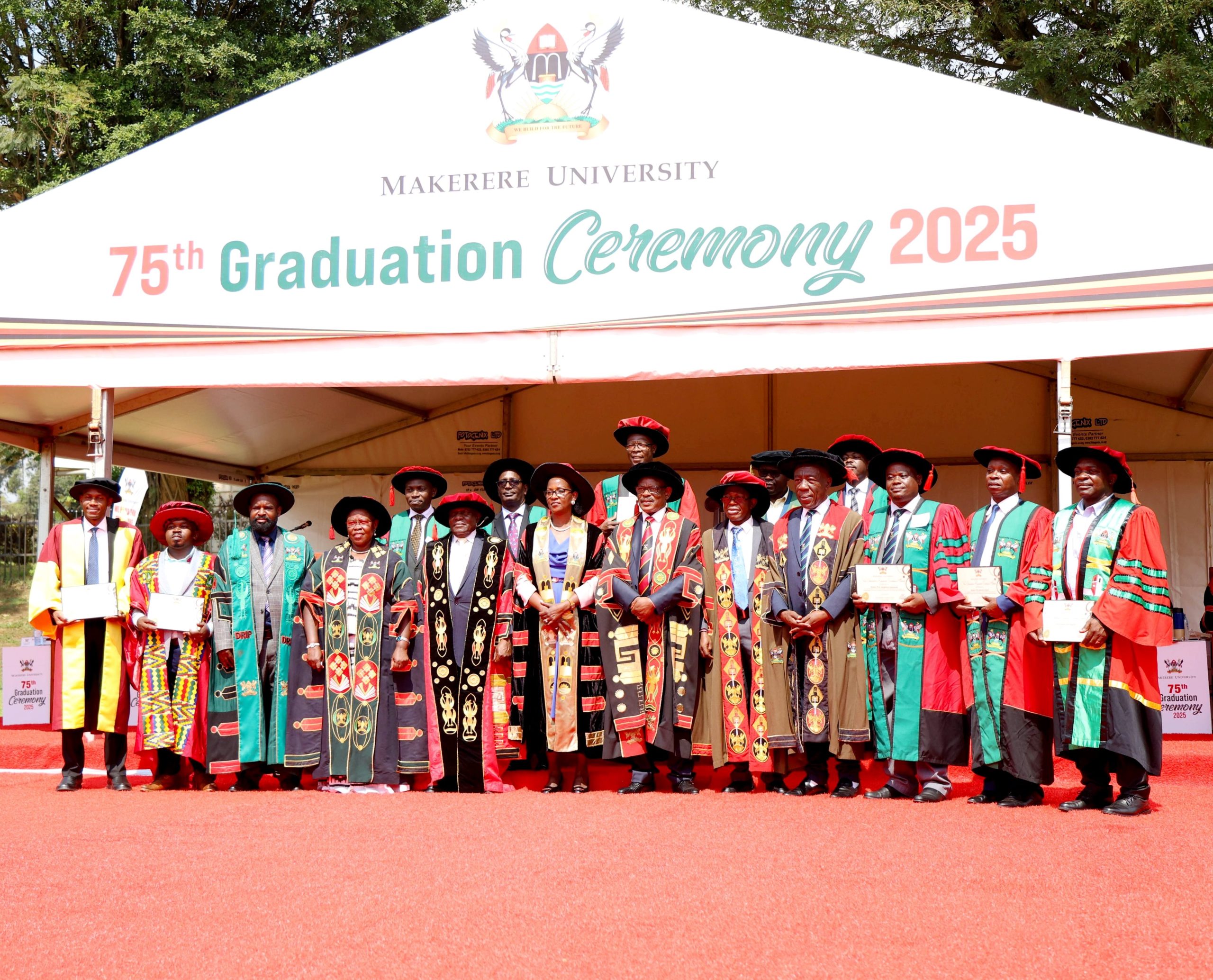
The Guest of Honour-Hon. Dr. Joyce Moriku Kaducu (4th L) and Chancellor-Hon. Dr. Crispus Kiyonga (5th L) with Chairperson Council-Mrs. Lorna Magara (6th L), VC-Prof. Barnabas Nawangwe (6th R), Ag. DVCFA-Prof. Henry Alinaitwe (4th R), AR-Prof. Buyinza Mukadasi (5th R), Chief DRIP-Dr. Robert Wamala (3rd L) and Research and Teaching Excellence Award Recipients.
The Chancellor Dr. Crispus Kiyonga conferred PhDs upon 49 candidates during the First Session of the 75th Graduation Ceremony of Makerere University which commenced on Monday 13th August 2025 in the Freedom Square. The College of Education and External Studies (CEES) presented 28 candidates (the highest for the 75th Graduation), while the College of Computing and Information Sciences (CoCIS), College of Veterinary Medicine, Animal Resources and Biosecurity (CoVAB) and School of Law presented 12 (twelve), 6 (six) and 3 (three) candidates respectively.
The First Session of the Graduation was presided over by the First Lady and Minister of Education and Sports, Hon. Janet Kataaha Museveni, represented by the Minister of State for Primary Education, Hon. Dr. Joyce Moriku Kaducu. The Minister in her remarks thanked the Vice Chancellor and University Leadership for the excellent organization and arrangement made for the success of this 75th Graduation ceremony, and thanked the NRM Government and the Leadership of H.E Gen Yoweri Kaguta Museveni for the peace and stability that has provided an environment conducive for learning and teaching to take place. She reiterated Government’s commitment to improving infrastructure at Makerere University and urged Graduands not to despise any jobs but start humble and trust the Lord to lift them higher.
Addressing the congregation, Dr. Kiyonga, thanked H.E. President Yoweri Museveni and Hon. Janet Museveni for availing him the opportunity to return and serve his Alma Mater as Chancellor. He equally reiterated the Directive by H.E. President Museveni to teach political economy across all courses and called for: Strengthening funding for research work at the University; Building stronger partnerships with the private sector to commercialise innovations at the University; Building structured relationships with the communities; Taking part in building a food security system for the country; and Building a model Agro-industrial park.
In his remarks, the Vice Chancellor congratulated Dr. Kiyonga upon presiding over his first graduation ceremony as Makerere University Chancellor, as well as the staff, graduands, parents, guardians and sponsors upon celebrating the important milestone. He recognized the best researchers and teachers, who were selected using criteria approved by the Senate. They were presented by the Academic Registrar, Prof. Buyinza Mukadasi and included:
Early Career Researchers
Dr. Ndejjo Rawlence, College of Health Sciences (CHS)
Dr. Omara Timothy, College of Natural Sciences (CoNAS)
Dr. Bwambale Erion, College of Agricultural and Environmental Sciences (CAES)
Mid Career Researchers
Dr. Musoke David, College of Health Sciences (CHS)
Dr. Mugabi Robert, College of Agricultural and Environmental Sciences (CAES)
Dr. Manga Musa, College of Engineering, Design, Art and Technology (CEDAT)
Senior Researchers
Prof. Kamya Robert, College of Health Sciences (CHS)
Prof. Kirabira John Baptist, College of Engineering, Design, Art and Technology (CEDAT)
Prof. Mugisha Lawrence, College of Veterinary Medicine, Animal Resources and Biosecurity (CoVAB)
Prof. Matovu Enock, College of Veterinary Medicine, Animal Resources and Biosecurity (CoVAB)
Best Evaluated Teachers
Dr. Wanyama Joshua, College of Agricultural and Environmental Sciences (CAES)
Dr. Lwasa John, College of Agricultural and Environmental Sciences (CAES)
Dr. Musinguzi Patrick, College of Agricultural and Environmental Sciences (CAES)
Dr. Kamulegeya Rogers, College of Health Sciences (CHS)
The commencement lecture at the First Session was delivered by the Vice Chancellor of the University of South Africa (UNISA), Prof. Puleng LenkaBula. It was based on the topic: ‘African Women, reclaim your Generational Mission and Redefine your Worth!’
“Prof. LenkaBula is the first female Principal and Vice-Chancellor of the University of South Africa (UNISA) in that institution’s 148-year history and she has been at the helm of that institution since January 2021” shared Prof. Nawangwe as he introduced the Commencement Speaker.
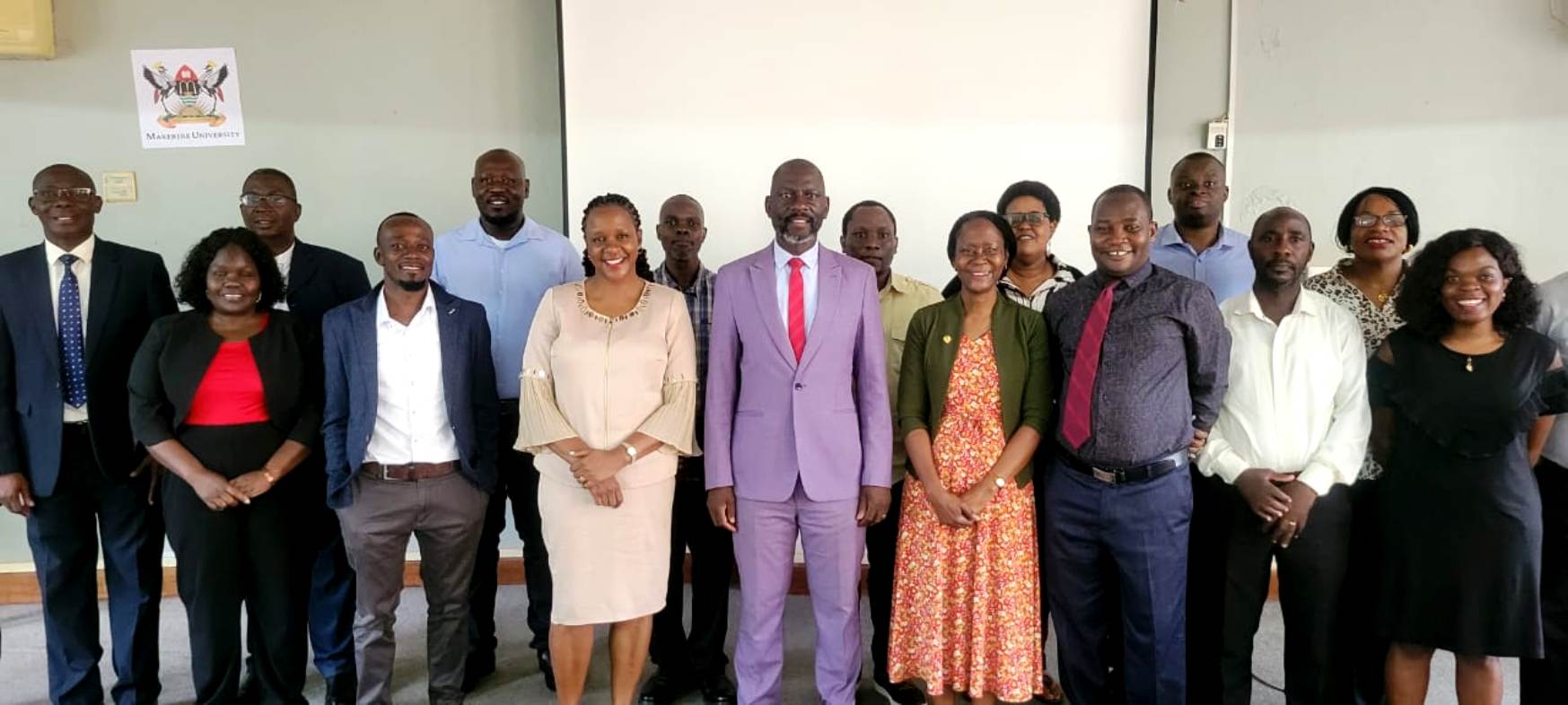
Kampala, 15 December 2025 — Makerere University on Monday held a reflective and inspiring Certificate Award Ceremony at the CTF 2 Auditorium , Yusuf Lule to award academic staff who completed the Graduate Supervision and Mentorship Course and PhD Students who successfully undertook the University’s compulsory cross-cutting doctoral courses. The event was presided over by the Deputy Vice Chancellor – Academic Affairs, Prof. Sarah Ssali.
The ceremony honored the efforts and achievements of 58 academic staff members, 39 men and 19 women from various colleges including CEDAT, CAES, CEES, COVAB and COBAMS, who completed a rigorous three-week Graduate Supervision and Mentorship programme.
Additionally, PhD students were recognized for completing cross-cutting courses in Philosophy of Methods, Scholarly Writing and Communication, and Advanced Research Methods.
Left to Right: Prof. Julius Kikooma, Prof. Sarah Ssali and Dr. Dorothy Sebbowa Kyagaba follow proceedings.
In her keynote remarks, Prof. Sarah Ssali, the Deputy Vice Chancellor–Academic Affairs, delivered a message of encouragement and renewed commitment to research excellence at Makerere University.
“It is both an honor and a privilege to be here today to celebrate a significant academic milestone, the completion of the PhD Cross-Cutting Courses by our students and the award of Supervision Certificates to our academic staff.”
“Your completion of this course is not just a personal achievement, but a critical contribution to strengthening the research and mentoring capacity of Makerere University.”
To the PhD students, Prof. Ssali offered warm congratulations and encouragement. “These courses have equipped you with essential tools to conduct high-quality, ethical research and to engage with complex academic questions. This achievement reflects your hard work, intellectual growth, and commitment to excellence.”
She reaffirmed Makerere University’s commitment to research advancement. “As a University, we remain deeply committed to fostering a culture of research excellence. We will continue to invest in both our students and our staff, ensuring that we uphold the highest standards in research and academic supervision.”
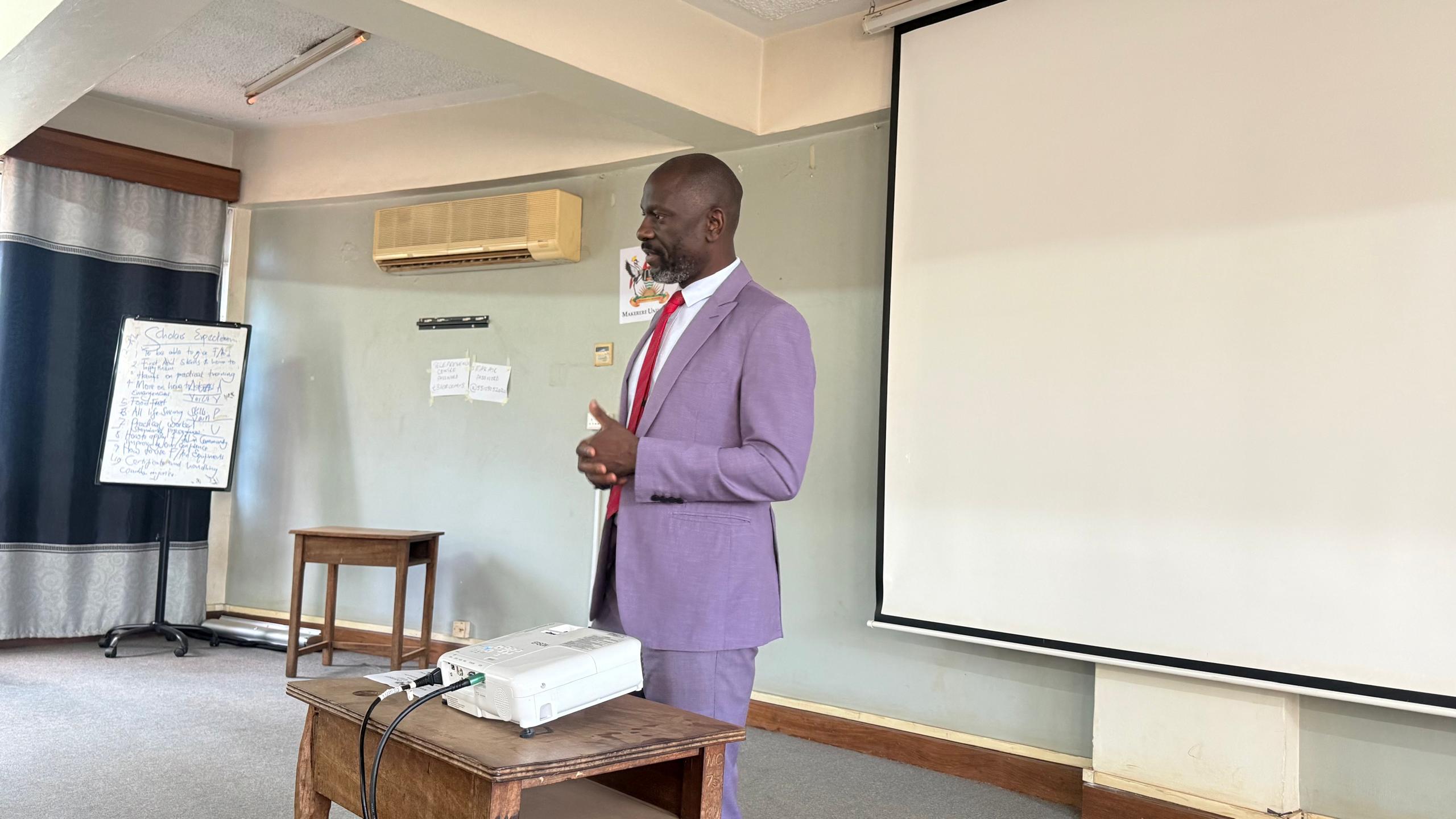
The Director of Graduate Training, Prof. Julius Kikooma, challenged the PhD students to approach research with urgency, intentionality, and a clear sense of purpose.
Prof. Julius Kikooma, the Director of Graduate Training.
“Completing the crosscutting courses in Philosophy of Methods, Advanced Research Methods, and Scholarly Writing and Communication has not been an easy task. However, the certificate alone is not the end goal. Don’t simply compile these certificates. Make them meaningful.”
Prof. Kikooma emphasized that the value of the courses lies in applying the knowledge gained. “These certificates give you the foundation knowledge. The question now is: Can we see the application of that knowledge in your different fields?”
He further urged doctoral students to begin producing serious academic work now, not at the end of their studies. “If you are becoming someone to be listened to, start now. It means the course is becoming useful. Write about issues that speak to societal challenges. Produce thinking pieces. Produce better outputs. “Look for low-lying fruits that can make your PhD journey more exciting and impactful.”
Prof. Kikooma also reminded students that while the PhD journey is shared by the academic community, its weight is uniquely felt by the candidates. “Your PhD journey is ours as a group. But you feel the heat. Speak to us so we understand your challenges. “You cannot be here for more than three years. Why are some of you still here? Is the journey heavy? How can we support you to complete it?” He asked.
He encouraged students to build thought leadership through the PhD Forum, adding that the forum is a strong voice for the students. A PhD is automatic leadership in the knowledge domain. Why doesn’t the PhD Forum come up with periodic writings that reflect what communities are experiencing? Start now so that by the time you finish the course, you hit the ground running.”
The Ag. Director of the Centre for Teaching and Learning Support (CTLS), Dr. Dorothy Ssebowa Kyagaba, gave a message to the academic staff who completed the Graduate Supervision and Mentorship Course, speaking with admiration for their dedication and high level of engagement.
Dr. Dorothy Sebbowa Kyagaba, the Ag. Director of the Center for Teaching and Learning Support (CTLS).
“I congratulate all the academic staff who have completed the three-week Graduate Supervision and Mentorship Course. Your commitment, hard work, and enthusiasm have been evident throughout the training.”
She described the course as a cornerstone of Makerere’s commitment to strengthening graduate supervision. “This course is a key component in Makerere University’s drive to strengthen the quality of graduate training, research supervision, innovation, and strategic partnerships.”
She highlighted the thematic richness of the training; covering Knowledge Production Perspectives, Supervisory styles, Supervisory meetings and conversation skills, Research Ethics, Intercultural supervision and diversity, Scholarly writing and feedback as well as Examination processes and Doctoral Viva. She expressed gratitude to the Directorate of Graduate Training led by Prof. Kikooma, and to Prof. Ssali for providing leadership that advances graduate training across Makerere University.
The approval by the Parliament of Uganda of a US$162 million concessional loan from the Korea Export-Import Bank (KEXIM) on 16th December 2025 marks a pivotal moment for Makerere University, as the institution enters the fourth year of its second century of existence. This funding approval comes at a critical moment as the university underscores its intention to become research-intensive, against the pressing need to align with global standards in science, technology, engineering, and mathematics (STEM) education.
With student numbers growing from 5,000 three decades ago to approximately 35,000 today, Makerere‘s facilities continue to be stretched. The loan’s timely approval during a plenary session chaired by Deputy Speaker Rt. Hon. Thomas Tayebwa, underscores the government’s commitment to revitalizing higher education amid national development goals outlined in the National Development Plan IV and the Ten-fold Growth Strategy.
Anticipated Developments
The loan will finance the construction of a state-of-the-art science and technology center, complete with advanced laboratories and innovation hubs for engineering disciplines. Upgrades to existing labs and smart classrooms at the College of Computing and Information Sciences are planned, alongside new buildings for Electrical, Civil and Mechanical Engineering Departments.
The College of Health Sciences will see expanded preclinical education facilities, and a dedicated structure for the School of Dentistry will incorporate cutting-edge equipment for dental technology, education, and clinical practice. These initiatives are not mere expansions; they aim to elevate Makerere to international benchmarks, fostering an environment where students can engage in hands-on research and practical training.
Furthermore, capacity-building programs will empower staff to harness new technologies, ensuring sustainable operations long after the 42-month implementation period, spanning financial years 2025-2026 to 2029-2030. The timing couldn’t be more opportune. Uganda’s ratio of science and technology graduates to humanities remains at 2:5, a ratio the loan is anticipated to improve to least 3:5 by 2030.
The loan facility addresses immediate challenges like inadequate spaces for growing programs, such as the Bachelor of Medicine and Bachelor of Surgery, which has seen a rise in intake, with increased interest from international applicants. Additionally, by investing in PhD training at Makerere, the loan reduces reliance on costly overseas programs, enabling resources to be redirected toward comprehensive educational enhancements.
Government’s Broader Strategy
Makerere as the premier regional institution has been prioritized to receive funding based on Government’s recognition of the trickle-down effect that enhancing the capacity at the university has on other higher education institutions and the education ecosystem. This approval builds on Makerere‘s legacy of resilience, positioning it as a beacon for African innovation. In an era where technological advancement defines global progress, this loan propels Makerere toward producing graduates equipped to tackle real-world challenges, from climate resilience to digital transformation.
Ultimately, the KEXIM loan is a timely catalyst for Makerere‘s renaissance. It not only revamps physical infrastructure but also reignites the university’s role in socio-economic transformation, with the Ministry of Education and Sports (MoES) as the executing agency. Therefore, as Uganda eyes Ten-Fold Growth from approximately $50 billion (2023) to $500 billion by 2040 via Agro-industrialisation, Tourism, Mineral-based industrialisation, Science and Technology/ICT (ATMS), empowering Makerere University is not just strategic—it’s essential.
Taking Stock of Previous Support
The African Development Bank’s (AfDB) US$29.2 million under the HEST program in 2016 funded infrastructure at Makerere, including two centralised teaching facilities with lecture rooms, auditoriums, e-learning labs, and specialized facilities like diagnostic, biotechnology, GIS, and computer labs. These transformed the skyline, enhanced large-class teaching, research access, and service provision to a thriving staff and students’ community.
Makerere University today hosted a delegation of members from the European Union (EU) for a high-level engagement aimed at reviewing the University’s involvement in EU cooperation programmes. The meeting focused on the linkages between the Erasmus+ Programme, Makerere University’s internationalization strategy, and the related institutional management and coordination structures.
The delegation was received by Deputy Vice Chancellor (Academic Affairs) Professor Sarah Ssali, provided an overview of how EU cooperation programmes are coordinated across different offices within the University. She highlighted Makerere’s integrated institutional approach to managing EU-funded initiatives, emphasizing collaboration among academic units, administrative offices, and support departments to ensure effective implementation and sustainability of projects.
Professor Sarah Ssali presenting to the delegation.
Prof. Sylivia Antonia Nakimera Nanyonga-Tamusuza presented an overview of how grants are handled at Makerere University, with particular emphasis on the role of the Grants Management and Support (GAMSU) Office. She explained that the office provides end-to-end support for externally funded projects, including proposal development, grant negotiation, compliance, financial accountability, reporting, and capacity building for project teams. The GAMSU Office plays a critical role in ensuring transparency, efficiency, and compliance with donor requirements, including those of the European Union.
Prof. Sylivia Antonia Nakimera Nanyonga-Tamusuza(R) interact with the delegation.
The University Secretary, Mr. Yusuf Kiranda, addressed the meeting and outlined how the University’s resources are managed to support academic programmes and international cooperation initiatives. He further explained the role of the Office of the University Secretary in supporting students, including policy oversight, governance, student welfare, administrative coordination, and ensuring that institutional systems effectively support teaching, research, and international partnerships.
Ms. Betty Nabisubi
Ms. Betty Nabisubi from the International Relations Office (IRO) provided a comprehensive overview of how Erasmus+ programmes are coordinated within her office. She explained that the IRO supports Erasmus students and staff from the time they arrive at Makerere University until their departure. This includes orientation, immigration support, accommodation guidance, academic coordination, cultural integration, and continuous student support. She also highlighted additional services offered by the office, such as partnership development, mobility coordination, and facilitation of international collaborations.
Following the institutional presentations, project representatives were allocated 30 minutes for structured discussions with EU project contact persons. The session began with short presentations focusing on project results, impact, and sustainability, followed by an interactive discussion and question-and-answer session. The representatives presented their projects clearly and confidently, demonstrating strong outcomes and long-term impact aligned with both Makerere University and EU cooperation objectives.
Overall, the engagement was highly productive and fruitful, providing a valuable platform for knowledge sharing, reflection on best practices, and strengthening collaboration between Makerere University and the European Union. The discussions reaffirmed Makerere University’s commitment to effective internationalization, accountable project management, and sustained partnerships under EU cooperation programmes.