Connect with us

General

Mak Urged to Strengthen GMD for Effective Policy Implementation

Published

on

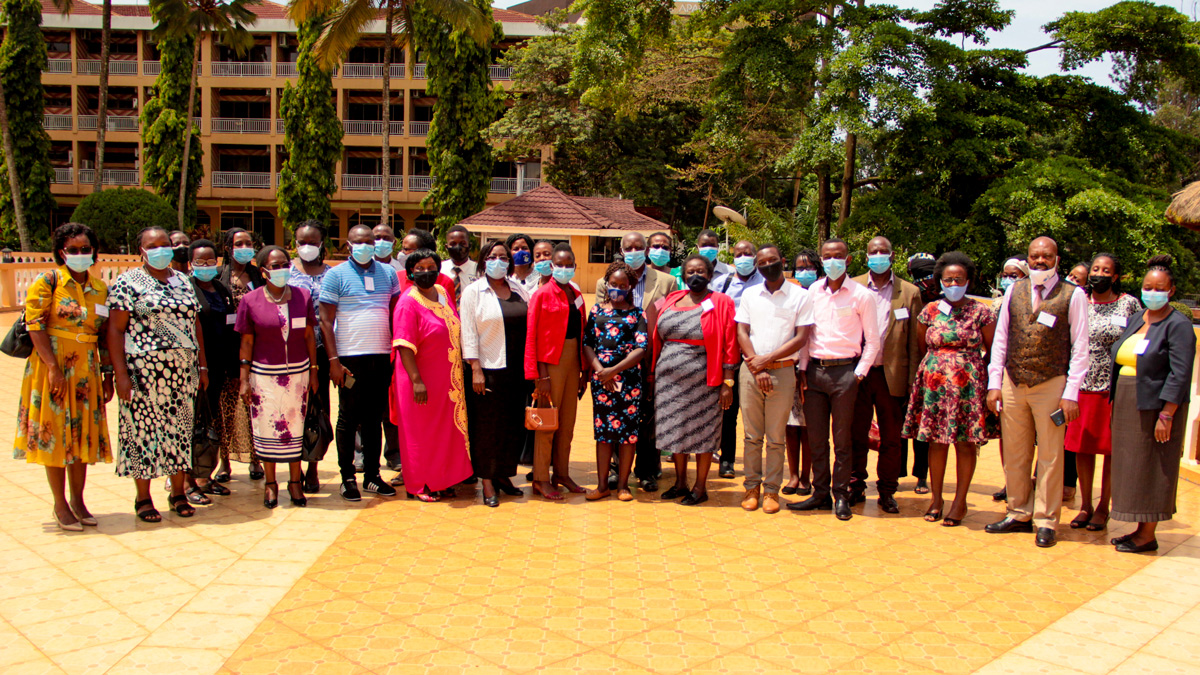
 Participants at a highly interactive two-day monitoring and evaluation workshop held on 29th and 30th April 2021 have urged Makerere University to prioritise the recruitment of more technical staff under the Gender Mainstreaming Directorate (GMD) as a guarantee of effective implementation of the Policy and Regulations Against Sexual Harassment (PRASH) and the Gender Equality Policy.

The evaluation session revealed that the staffing levels at GMD were very low in comparison to the magnitude of work, which entails the implementation of PRASH, the Gender Equality Policy as well as other critical roles and responsibilities. The participants learnt that although the GMD staff structure provided for a number of technical staff, many of these positions remained vacant. It was therefore imperative for the University leadership to evaluate the staffing levels versus the expectations from each Office, pay attention to the workload for each staff, and provide financial resources and equipment/tools required for each office to achieve its targets.
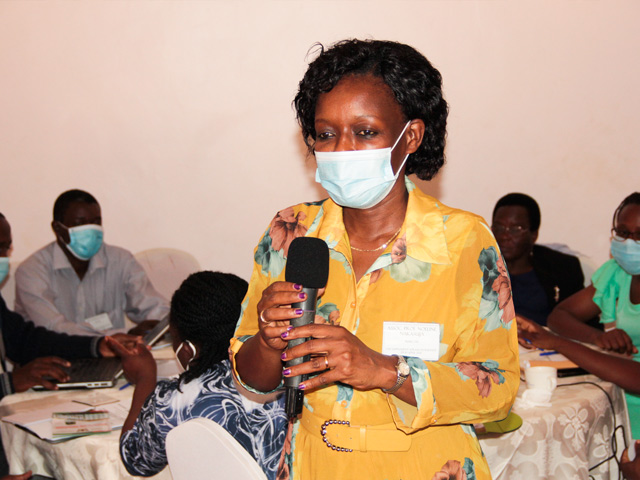
Associate Prof. Noeline Nakasujja, Head of the Department of Psychiatry-Mak College of Health Sciences

The participants also emphasized the need to institutionalise monitoring and evaluation systems at Makerere University.  “An office should be established and empowered with staff to perform the task of monitoring and evaluation of University systems, processes, policies, operations, programs and projects. This is vital if we are to remain on track. With monitoring and evaluation, one is able to detect early what is not working and reasons for such a scenario and identify whether the required finances, staff, equipment and other variables were provided. This would hold leaders and staff accountable.”

According to the participants, an independent and professional monitoring and evaluation function/office would ensure value for money and effective utilization of resources, guide management and staff to quickly establish what is not working and above all, improve the performance of institutional projects, policies and operations.

The recommendations were informed by free flow of ideas premised on presentations on PRASH by Dr. Euzobia Mugisha Baine, Director GMD, Associate Prof. Noeline Nakasujja, Head of the Department of Psychiatry-Mak College of Health Sciences (CHS), Dr. Gertrude Sebunya Muwanga an expert in Monitoring and Evaluation, and Prof. Moses Kamya-Mak CHS among other facilitators. 
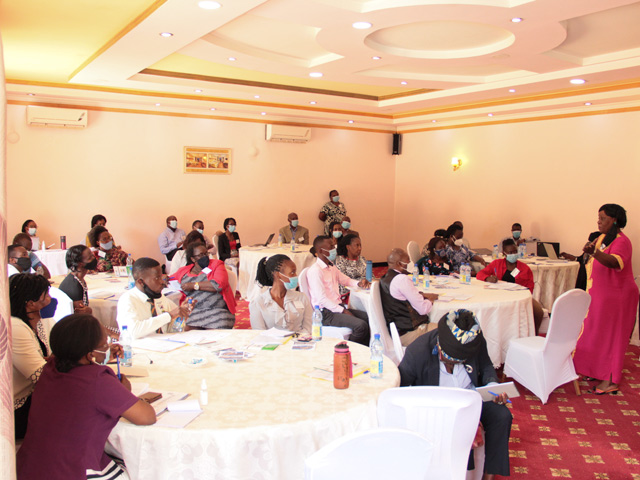
Dr. Gertrude Sebunya Muwanga (R) facilitating at one of the sessions during the two-day training.

Focusing on the program goal that seeks to strengthen the institutional capacity of Makerere University to implement and evaluate the policy strategies on sexual misconduct and harassment, the monitoring and evaluation workshop brought on board staff and students to critique PRASH.  The event was courtesy of a grant received by the Department of Psychiatry, School of Medicine, CHS in collaboration with the University of Washington at St. Louis from the National Institute of Health Fogarty International Centre.

In line with the best practices that necessitate a thorough understanding of the subject under critique, the organisers provided the essential information materials, experts, programmes and delivery styles to enable each participant gain a deeper understanding of PRASH.  Each participant also received a hard copy of PRASH for reference purposes.

To set the pace, Dr. Mugisha Baine provided an overview of PRASH, taking care to define what constitutes sexual harassment. According to the policy, sexual harassment means unwelcome sexual advances, requests for sexual favours or unwanted physical, verbal or non-verbal conduct of a sexual nature.  The policy is accessible on the Policies Website at this link: https://policies.mak.ac.ug/sites/default/files/policies/Policy-and-Regulations-Against-Sexual-Harassment-2018.pdf

Empowered with the necessary background information, participants pointed out the progress so far, implementation challenges and gaps. Some of the observations and measures include:

  1. Mak’s commitment to zero tolerance to sexual harassment lives on through the steps undertaken in the implementation of PRASH. Participants noted that the PRASH policy was reviewed, stakeholders were consulted during the review process, and the Vice Chancellor appointed the standing Roster of 100 that constitutes a pool of staff who would be called upon to investigate sexual harassment cases. The members of staff constituting the Vice Chancellor’s Roster of 100 were inducted, trained and equipped with knowledge and skills in preparation for the task ahead.                
  2. The GMD has conducted a number of sensitization engagements with staff and students through training workshops, dialogues, talks during the freshers’ orientation, and coordination of competitions/campaigns among students aimed at averting sexual harassment and sexual abuse.
  3. The policy is easily accessible on the Mak Policies Website. Hard copies of the same are in print in a light and friendly booklet format freely distributed to members of staff and students.
  4. GMD has deliberately engaged Mak Management and other key university units such as the School of Law, Directorate of Legal Affairs, School of Women and Gender Studies, Mak Public Relations Office, Mak Students’ leadership in PRASH awareness activities/programmes/campaigns.
  5. GMD has reached out to several partners and stakeholders such as the; UN Women, Embassy of Sweden, The Spotlight Initiative among others, to eliminate violence against women and girls.
  6. GMD in partnership with the Public Relations Office has engaged the media in the coverage of PRASH awareness and sensitization drives/programmes.
  7. Reported cases of sexual harassment have been investigated, and the culprits suspended and/or dismissed in line with PRASH and other laws governing the country.
  8. Messages have been shared encouraging students and staff to take be bold and report sexual harassment cases.
  9. Sensitization and training workshops have emphasized the PRASH position on the need for leaders to report and act on all complaints of sexual harassment.  ‘According to PRASH, any person in authority who receives a complaint of sexual harassment and fails to take any pro-active step to progress the matter in a timely and appropriate manner commits an offence and shall be subject to disciplinary action.”

During the workshop, the participants noted some challenges in the implementation of PRASH. These include; limited funding to the GMD, low staffing levels at the Directorate and lack of representation of GMD staff at the respective Colleges, which affect the implementation of PRASH and the Gender Equality Policy.  Due to limited funding, the Directorate is not able to sustain sensitization activities. Some of the participants revealed that a number of victims still fear to report sexual harassment cases.

Providing the way forward, participants underscored the need to recruit more staff that are technical and provide the required financial resources for GMD to effectively undertake its mandate. They highlighted the need to intensify sensitization to staff and students as well as implored GMD to come up with strategies for the Vice Chancellor’s Roster of 100 to help coordinate activities and programmes at the College level.
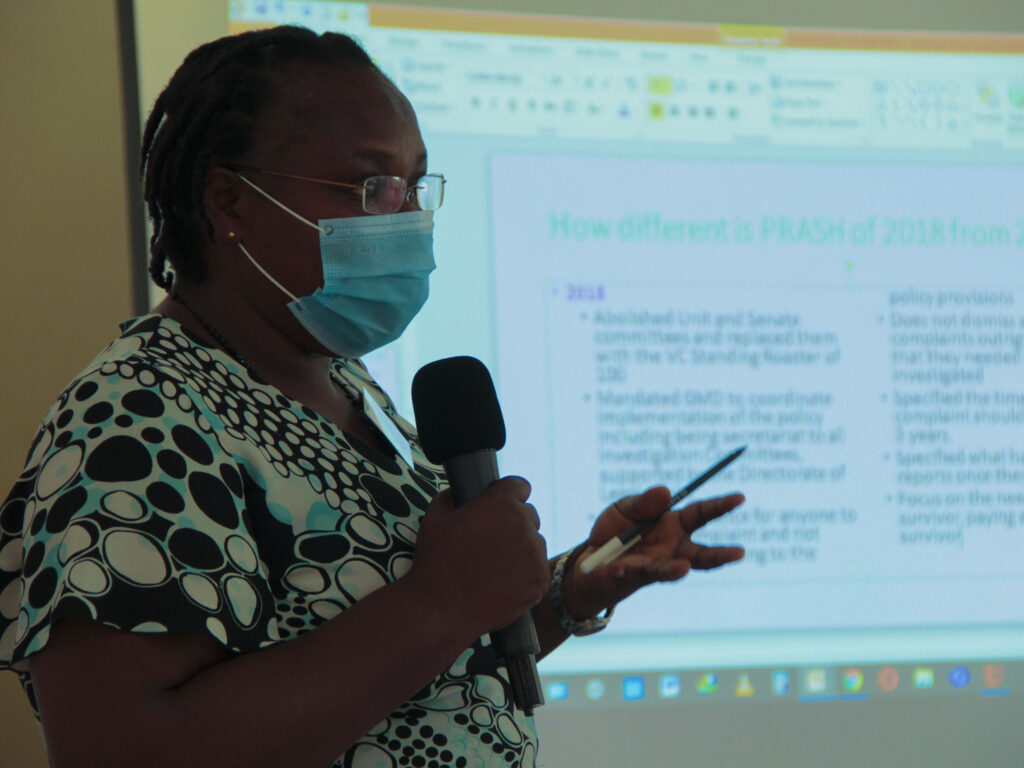
Dr. Euzobia Baine Mugisha – Director, Makerere University Gender Mainstreaming(GMD) giving an overview of the PRASH, key policy implementation procedures, challenges and gaps.

On 30th April 2021, the facilitators equipped participants with knowledge on monitoring and evaluation (M&E) including understanding of key terms such as M& E system, plan and framework. At the end of this session, the participants stressed the need to institutionalise monitoring and evaluation systems at Makerere University. 

Wrapping up the plenary session, Prof. Moses Kamya reiterated the need for all members of staff to undergo training in gender issues and sexual harassment.

Closing the workshop, Associate Prof. Nakasujja applauded the participants for dedicating time to participate in the training, evaluating the PRASH and providing valuable input that will strengthen the institutional capacity of Makerere University to implement and evaluate the same. In the same spirit, she commended the project staff for their commitment towards the successful delivery of the training workshop.

Article by: Mak Public Relations Office

Elias Tuhereze

Continue Reading

General

Mastercard Foundation Scholars Urged to Embrace Mentorship for Career Growth

Published

on

Mr. Steven Langa addresses the Mentor-Mentee matching session on 7th March 2026. Mastercard Foundation Scholars Program Mentor–Mentee matching session, 7th March 2026, Yusuf Lule Central Teaching Facility Auditorium, Makerere University, Kampala Uganda, East Africa.

Mastercard Foundation Scholars have been encouraged to embrace mentorship programmes as a way of maximising opportunities for personal and professional growth.

Mentorship is a professional relationship in which an experienced person (the mentor) supports another (the mentee) in developing specific skills and knowledge that enhance both professional and personal growth.

While speaking at a Mentor–Mentee matching session held on Saturday at the Central Teaching Facility, Mr Steven Langa, a counsellor and director at Family Life Network, told scholars that mentorship plays a pivotal role in preparing the next generation of leaders capable of transforming Uganda and Africa.

 “We live at a very challenging time in history, a time when Uganda and Africa have to rise up to the occasion to provide leadership, professional excellence and innovation,” Mr Langa, said.

Some of the Mentors address scholars. Mastercard Foundation Scholars Program Mentor–Mentee matching session, 7th March 2026, Yusuf Lule Central Teaching Facility Auditorium, Makerere University, Kampala Uganda, East Africa.
Some of the Mentors address scholars.

In his presentation, Mr Langa explained that a mentor is not a parent, therapist, or romantic partner, but rather a coach who helps the mentee build essential skills.

 “The mentoring relationship is built on mutual trust, respect and communication and involves both parties meeting regularly to exchange ideas, discuss progress and set goals for further development. A mentor does not need to know, or to provide all the answers; instead, the mentor encourages the mentee to use their available resources to identify solutions,” Mr Langa, noted.

Speaking at the same event, Ms Eva Nabasumba, the Principal Academics and Career Development Officer at the Mastercard Foundation Scholars Program, encouraged scholars to build strong relationships with their mentors, which could later provide credible referees for employment, scholarships and other opportunities.

Ms. Eva Nabasumba. Mastercard Foundation Scholars Program Mentor–Mentee matching session, 7th March 2026, Yusuf Lule Central Teaching Facility Auditorium, Makerere University, Kampala Uganda, East Africa.
Ms. Eva Nabasumba.

She highlighted several benefits of mentorship for mentees, including gaining advice, knowledge and insights from experienced professionals; developing professional communication skills; building valuable industry networks; engaging in employment-related conversations; exploring career pathways; and learning strategies for job searches, résumé writing and interviews.

During the session, mentors introduced themselves to their new mentees, allowing scholars to identify and connect with suitable mentors. Some of the mentors are doctors, teachers, counsellors, engineer’s business people and Accountants.

Apollo Mulondo, one of the mentors, urged scholars to take the mentorship opportunity seriously and respect the time and commitment of their mentors.

Some of the mentees smile for the camera. Mastercard Foundation Scholars Program Mentor–Mentee matching session, 7th March 2026, Yusuf Lule Central Teaching Facility Auditorium, Makerere University, Kampala Uganda, East Africa.
Some of the mentees smile for the camera.

“Some of us are who we are today because of our mentors. Our offices are always open to you, so feel free to visit anytime. It does not matter what your background is you can make it,” Mulondo said.

The mentor–mentee matching session enabled scholars to interact with professionals from different fields, giving them an opportunity to identify mentors whose experience aligns with their academic and career aspirations. The engagement also created a platform for scholars to begin building networks that will support their growth beyond the university.

Carol Kasujja
Carol Kasujja Adii

Continue Reading

General

Mak Cooperative Society holds AGM: Growth, Transparency and Member Welfare Take Centre Stage

Published

on

MUMCS AGM in session. L-R: Prof. Winston Tumps Ireeta (Secretary), Dr. Muhammad Kiggundu Musoke (Vice Chairperson), Prof. Juma Kasozi (Treasurer) and Prof. Fredrick Jones Muyodi (Chair-Supervisory Committee). Makerere University Multi-Purpose Cooperative Society (MUMCS) Annual General Meeting (AGM), 4th March 2026, Senior Common Room, Main Building, Makerere University, Kampala Uganda, East Africa.

“This is a perfectly managed Cooperative Society,” remarked CPA David Ssenoga, amidst applause from Members of the Makerere University Multi-Purpose Cooperative Society (MUMCS).

CPA Ssenoga made the remarks on 4th March 2026 as he presented the Auditor’s report from SDS and Company Certified Public Accountants at the MUMCS Annual General Meeting (AGM).

The Auditor’s report for the year ended 31st December 2025 highlighted adherence to the best corporate governance practices, confirmed proper allocation of funds, value for money, and steady progress.

CPA David Ssenoga presenting the Auditor's Report. Makerere University Multi-Purpose Cooperative Society (MUMCS) Annual General Meeting (AGM), 4th March 2026, Senior Common Room, Main Building, Makerere University, Kampala Uganda, East Africa.
CPA David Ssenoga presenting the Auditor’s Report.

“The Cooperative Society was found to be in excellent standing, with operations in compliance with International Financial Reporting Standards for SMEs, the Cooperative Societies Act, and relevant Ugandan regulations. The operations are efficient and transparent,” he reported.

Mandate of MUMCS

Chairing the AGM, the Vice Chairperson, Dr. Muhammad Kiggundu-Musoke, underscored that the MUMCS exists to promote the welfare of members. In pursuit of this mandate, MUMCS provides access to affordable credit at interest rates that are significantly lower than those offered by other financial institutions. Such support, he noted, empowers members to strengthen their financial stability, invest in personal and professional goals, and ultimately enhance their overall well-being.

Dr. Muhammad Kiggundu Musoke, Vice Chair. Makerere University Multi-Purpose Cooperative Society (MUMCS) Annual General Meeting (AGM), 4th March 2026, Senior Common Room, Main Building, Makerere University, Kampala Uganda, East Africa.
Dr. Muhammad Kiggundu Musoke, Vice Chair.

Steady progress

Highlighting MUMCS’ steady progress, Dr. Kiggundu-Musoke commended members for the tremendous growth recorded over time. He noted that the cooperative society had grown from handling a few hundreds of thousands of shillings in its early years to managing a portfolio now standing at approximately UGX 3.25 billion, a milestone he described as a reflection of collective effort, prudent management, and sustained member confidence.

He encouraged members to actively promote and popularise the cooperative within their respective departments. He proposed a structured approach of engaging Heads of Department to sensitize staff on the MUMCS’ services and benefits.

AGM highlights

The hybrid AGM, with physical participants assembled in the Main Building Senior Common Room, and virtual participants who followed the proceedings via zoom, provided a platform to review performance, highlight operational successes and governance milestones, as well as, finding solutions to challenges.

Secretary’s report

Presenting the report, MUMCS’ Secretary, Prof. Winston Tumps Ireeta, highlighted the growth in membership to 160, including 27 new recruits –  a testimony to the confidence in the quality of services provided.

Prof. Ireeta excited the members when he mentioned that the 2025 surplus of UGX 291 million was distributed to members, with administrative budgets executed as approved.

Prof. Winston Tumps Ireeta. Makerere University Multi-Purpose Cooperative Society (MUMCS) Annual General Meeting (AGM), 4th March 2026, Senior Common Room, Main Building, Makerere University, Kampala Uganda, East Africa.
Prof. Winston Tumps Ireeta.

On the issue of financial discipline and meeting obligations, Prof. Ireeta notified the members that the Management Committee implemented strategies that ensured compliance. “Outstanding loan arrears were settled through deductions from dividends of the concerned members,” he stated.

The Secretary reported that as approved during the previous AGM, the Vetting Committee consisting of Prof. Helen Nambalirwa Nkabala (Chairperson), Prof. Lawrence Mugisha (Member) and Dr. Alex Okello (Member) had been constituted and has embarked on the tasks as per the terms of reference.

With reference to the Secretary’s report, the Members praised the MUMCS Management Committee headed by Prof. Barnabas Nawangwe, for ensuring the successful implementation of key decisions agreed upon during the previous AGM.

Treasurer’s report

The Treasurer, Prof. Juma Kasozi, provided members with a detailed overview of operations, liquidity, investments, and returns.

Emphasizing MUMCS’ commitment to transparency, Prof. Kasozi noted that the Management Committee ensures that the balance sheets, profit and loss statements, and trial balances are shared monthly with members, which enables them to monitor performance throughout the year.

Prof. Juma Kasozi. Makerere University Multi-Purpose Cooperative Society (MUMCS) Annual General Meeting (AGM), 4th March 2026, Senior Common Room, Main Building, Makerere University, Kampala Uganda, East Africa.
Prof. Juma Kasozi.

Prof. Kasozi explained that the Cooperative Society maintains strong liquidity, with approximately UGX 1.6 billion invested with fund managers and insurance companies. These liquid investments he said, provide a solid foundation to support loans, withdrawals, and operational needs. He encouraged members to increase their savings and shareholdings, in order to strengthen MUMCS’s financial base and enhance lending capacity.

The Treasurer highlighted the Society’s loan products, including instant loans; which provide same-day disbursement and long-term term loans. He reported that in 2025, UGX 479 million was disbursed in instant loans, and UGX 913 million as long-term loans.

He informed the AGM that the major challenge faced during the year 2025, was premised on disruptions in payroll deductions. “Before this setback, payroll deductions generated over UGX 50 million per month.  Due to temporary disruptions, the amount generated reduced to UGX 20 million,” he explained.

The Treasurer briefed the members that discussions with the payroll management team had been successful, and full deductions were expected to resume, a step that would restore the expected income stream of the Cooperative Society.

He re-assured members that despite challenges with payroll deductions, MUMCS remains financially stable, with strong liquidity, robust investments, sound loan recovery mechanisms, and a commitment to member welfare.

He encouraged members to recruit colleagues, increase shareholding, and actively participate in strengthening the Cooperative Society’s growth and impact.

Members applaud the Management Committee

Impressed by the reports presented by the Secretary and Treasurer, the Members praised the MUMCS Management Committee headed by Prof. Barnabas Nawangwe, for the successful implementation of key decisions agreed upon during the previous AGM.

Some of the Members of the Management Committee headed by Prof. Barnabas Nawangwe. Makerere University Multi-Purpose Cooperative Society (MUMCS) Annual General Meeting (AGM), 4th March 2026, Senior Common Room, Main Building, Makerere University, Kampala Uganda, East Africa.
Some of the Members of the Management Committee headed by Prof. Barnabas Nawangwe.

Presentation from the Welfare Committee

On behalf of the Welfare Committee, Ms. Ritah Namisango, commended the Management Committee for effectively implementing the Society’s Welfare Policy. Ms. Namisango noted that the policy stipulates the contribution to weddings, loss of a member, and/or when a member loses a parent, spouse and a biological child. She encouraged the members to read the Welfare Policy in order to tap into the benefits that accrue to them.

“We invite all members to read the Welfare Policy and inform the Management Committee early enough whenever a situation arises. I am glad that, because of transparency and communication through the WhatsApp group, most of you have been notifying the Executive Committee promptly. Most of the Members who have received contributions from MUMCS during such situations, have acknowledged receipt, and gone an extra mile, to send messages of gratitude via MUMCS’ WhatsApp group,” she said.

Ritah Namisango. Makerere University Multi-Purpose Cooperative Society (MUMCS) Annual General Meeting (AGM), 4th March 2026, Senior Common Room, Main Building, Makerere University, Kampala Uganda, East Africa.
Ritah Namisango.

She welcomed the AGM’s approval of an additional UGX 2.5 million allocation to the Welfare Fund, to boost the Cooperative Society’s ability to extend support as well as standing in solidarity with the Members.

The Welfare Committee consists of Ms. Ritah Namisango, Dr. Oscar Mugula and Mr. Michael Kasusse.

Supervisory Committee report

The Chairperson, Prof. Fredrick Jones Muyodi, congratulated the Management Committee and the Members, upon the positive financial performance of MUMCS with a gross surplus of UGX 351,533,935/=, and a net surplus of UGX 49,510,181/= after deduction of all expenses.

Prof. Fredrick Jones Muyodi. Makerere University Multi-Purpose Cooperative Society (MUMCS) Annual General Meeting (AGM), 4th March 2026, Senior Common Room, Main Building, Makerere University, Kampala Uganda, East Africa.
Prof. Fredrick Jones Muyodi.

Concerned that some members have faced challenges with payroll deductions, the Supervisory committee welcomed the progress reported by the Secretary toward resolving the issue.

He stated that the Committee reviewed the financial proposals presented by the management committee and endorsed the recommended dividend payment of UGX 38,630,000 to shareholders, noting that dividends cannot exceed 10 percent under the law.

In addition, the Committee supported payments to service providers, the purchase of a second laptop to enhance data security, the use of cloud and external storage for safeguarding records, the proposed welfare and AGM budgets, and the allocation of 65% of the gross surplus as return on savings.

L-R: Caroline Kirumira Kwesiga, Claire Nakaseeta, and Fazira Nakabugo-new Members of MUMCS who physically attended the AGM, Senior Common Room, Main Building. Makerere University Multi-Purpose Cooperative Society (MUMCS) Annual General Meeting (AGM), 4th March 2026, Senior Common Room, Main Building, Makerere University, Kampala Uganda, East Africa.
L-R: Caroline Kirumira Kwesiga, Claire Nakaseeta, and Fazira Nakabugo-new Members of MUMCS who physically attended the AGM, Senior Common Room, Main Building.

The Supervisory Committee consists of Prof. Fredrick Jones Muyodi (Chairperson), Prof. Edgar Nabutanyi (Member) and Dr. Jamidah Nakato (Member).

Closing remarks

Closing the AGM, Dr. Kiggundu-Musoke thanked members for their active participation and challenged them to actively support the growth of the cooperative society. He emphasized that membership growth would not only strengthen the Makerere University Multi-Purpose Cooperative Society’s financial standing, but also enhance dividend returns for all members.

A cross-section of MUMCS members who physically attended the AGM pose for a group photo at its conclusion. Makerere University Multi-Purpose Cooperative Society (MUMCS) Annual General Meeting (AGM), 4th March 2026, Senior Common Room, Main Building, Makerere University, Kampala Uganda, East Africa.
A cross-section of MUMCS members who physically attended the AGM pose for a group photo at its conclusion.

Ritah Namisango
Ritah Namisango

Continue Reading

General

Makerere University and World Bank Sign Partnership to Strengthen Environmental and Social Sustainability Capacity

Published

on

A group photo of representatives from various partners at the MOU signing. Signing MoU with International Development Association (IDA), World Bank Group, establishing a strategic partnership aimed at strengthening environmental and social sustainability systems in Uganda and the wider East African region, 5th March 2026, Main Building, Makerere University, Kampala Uganda, East Africa.

On 5th March 2026, Makerere University signed a Memorandum of Understanding (MoU) with the International Development Association (IDA), the financing arm of the World Bank Group, establishing a strategic partnership aimed at strengthening environmental and social sustainability systems in Uganda and the wider East African region.

The collaboration brings together Makerere University through the College of Agricultural and Environmental Sciences (CAES) and the College of Humanities and Social Sciences (CHUSS) and the World Bank to jointly advance training, research, and policy advisory in environmental and social sustainability.

The three-year agreement provides a framework for cooperation focused on building national capacity to manage environmental and social risks associated with large-scale development investments.

Advancing Sustainable Development through Knowledge Partnerships

The partnership will be anchored in the Environment and Social Sustainability Centre (ESSC) at Makerere University, a national hub established to promote applied research, policy engagement, and professional training in environmental and social governance.

Through the Centre, the two institutions will collaborate to strengthen Uganda’s ability to plan and implement development projects in ways that safeguard communities and the environment.

Speaking during the signing ceremony, Ms. Francisca Ayodeji (Ayo) Akala, the World Bank Country Manager emphasised that the collaboration reflects a shared commitment to strengthening systems that support sustainable growth.

Ms. Francisca Ayodeji (Ayo) Akala giving her remarks during the MOU signing. Signing MoU with International Development Association (IDA), World Bank Group, establishing a strategic partnership aimed at strengthening environmental and social sustainability systems in Uganda and the wider East African region, 5th March 2026, Main Building, Makerere University, Kampala Uganda, East Africa.
Ms. Francisca Ayodeji (Ayo) Akala giving her remarks during the MOU signing.

“This partnership with Makerere University is an important step in strengthening Uganda’s systems for environmental and social sustainability. By working through the Environment and Social Sustainability Centre, we aim to build the capacity of professionals across government, the private sector, and development institutions to better manage environmental and social risks and deliver investments that promote sustainable growth while protecting people and the environment.” Ms. Francisca Ayodeji (Ayo) Akala, World Bank Country Manager, Uganda, noted.

The partnership will support training, research, and policy advisory activities through the ESSC, helping Uganda pursue a development trajectory that promotes economic growth while protecting people and the environment.

Building National Capacity for Environmental and Social Risk Management

Uganda’s development agenda under the Fourth National Development Plan prioritises large-scale investments in infrastructure, agro-industrialisation, energy, and science and technology. However, such investments require strong environmental and social risk management systems to ensure sustainable outcomes.

The new partnership, therefore, focuses on building a skilled workforce capable of applying international best practices in environmental and social governance.

Under the MoU, Makerere University will design and deliver demand-driven short-course training programs targeting public sector officials, development practitioners, financial institutions, civil society organisations, and private sector actors implementing major projects.

Seven certificate-level short courses have already been developed and approved across multiple colleges at the University. These courses cover areas such as environmental and social risk management, climate risk assessment, construction health and safety, and integrating environmental and social considerations into investment cycles.

Prof. Barnabas Nawangwe and Ms. Francisca Ayodeji (Ayo) Akala after signing the MOU. Signing MoU with International Development Association (IDA), World Bank Group, establishing a strategic partnership aimed at strengthening environmental and social sustainability systems in Uganda and the wider East African region, 5th March 2026, Main Building, Makerere University, Kampala Uganda, East Africa.
Prof. Barnabas Nawangwe and Ms. Francisca Ayodeji (Ayo) Akala after signing the MOU.

Makerere Universityis proud to partner with the World Bank in strengthening Uganda’s capacity to manage environmental and social risks in development investments. Through the Environment and Social Sustainability Centre, we have already developed and approved seven certificate-level short courses across multiple colleges, designed to equip professionals in government, the private sector, and development institutions with practical skills to plan and implement sustainable projects. This collaboration reflects Makerere’s commitment to providing knowledge-driven solutions that support Uganda’s development while safeguarding communities and the environment.” Prof. Barnabas Nawangwe noted.

Strengthening Collaboration between Academia and Development Partners

As part of the agreement, the World Bank will support the development and delivery of the training programs, including conducting Training of Trainers (ToT) on the Bank’s Environment and Social Standards and international best practices.

The Bank will also leverage its convening power to encourage participation from development partners, government institutions, and project implementers, while supporting impact monitoring of trained professionals to document improvements in project performance and job creation.

The collaboration will further promote professional networking, policy dialogue, knowledge exchange, and the development of knowledge hubs containing environmental and social tools, databases, and resources for practitioners.

Positioning Makerere as a Regional Knowledge Hub

Through this partnership, Makerere University seeks to position the Environment and Social Sustainability Centre as a leading knowledge hub for environmental and social governance in Africa.

By combining academic expertise with the World Bank’s global experience in development financing and technical assistance, the initiative is expected to strengthen the institutional capacity required to deliver sustainable and climate-resilient investments in Uganda.

The partnership also aligns with the World Bank’s broader commitment to supporting Uganda’s development agenda and strengthening country systems for environmental and social sustainability.

Together, the two institutions aim to equip professionals across government, the private sector, and development organizations with the skills required to ensure that Uganda’s development pathway remains inclusive, responsible, and environmentally sustainable.

Caroline Kainomugisha is the Communications Officer, Advancement Office, Makerere University

Caroline Kainomugisha

Continue Reading

Trending