
Computing & IS
CoCIS Annual Report 2019/2020

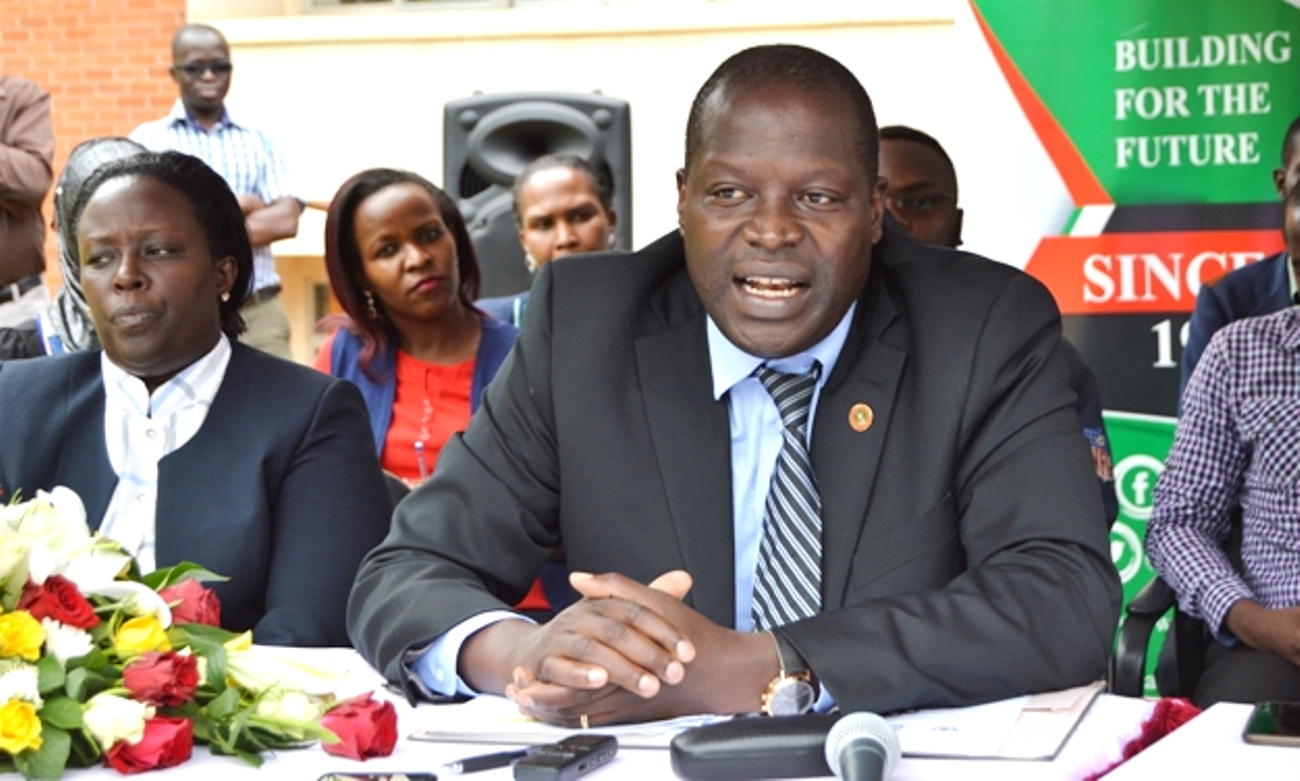





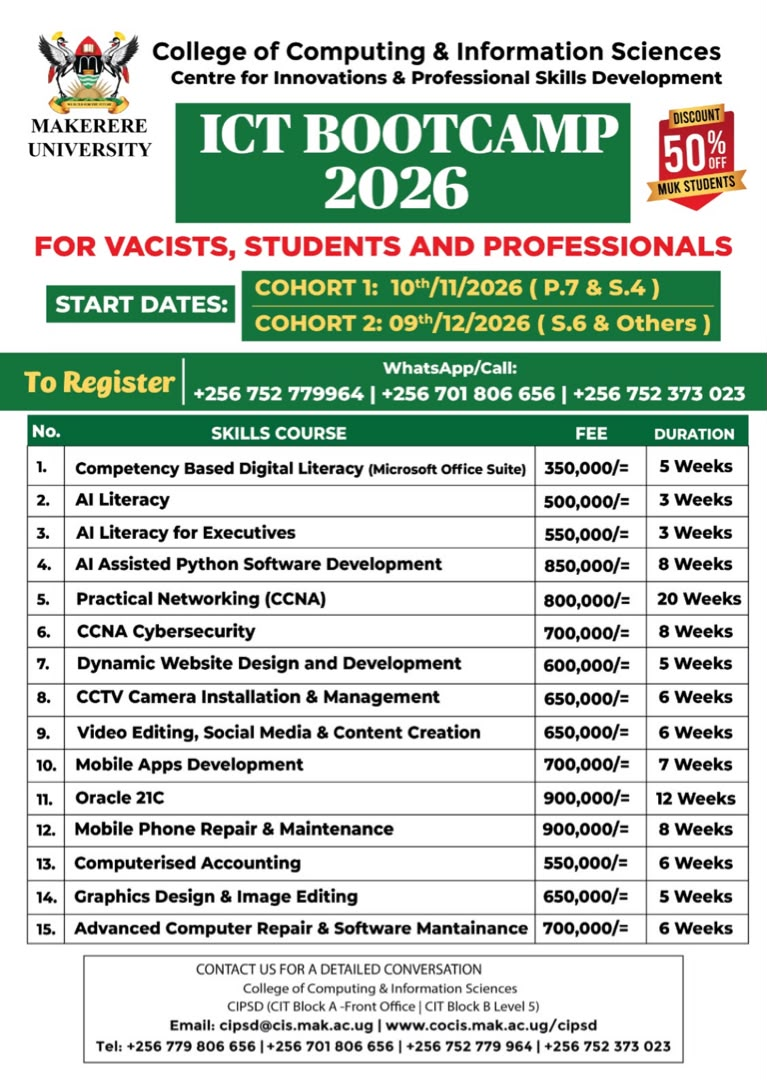
Prof. Engineer Bainomugisha invites applicants for specialized training in the following Tech skills courses starting October 2026. (Registration is free).
P7 and S4 Start on 10th /11/2026 ,S6 and professionals start on 09th/12 /2026.
Below is the Bootcamp link for Computer Training and IT events calendar.
https://forms.gle/c4EkTTKRwP2Vh4ALA
Contact Information
E-mail: psd.cis@mak.ac.ug
Tel: +256 779 806 656 | +256 701 806 656 | +256 752 779 964 | +256 752 373 023
URL: https://cocis.mak.ac.ug/cipsd/

KAMPALA, Sept. 18, 2026 — Makerere’s and Ugandan clean-air technology initiative AirQo has been named a finalist for the 2026 Earthshot Prize, earning global recognition for its efforts to improve air-quality monitoring across Africa using low-cost sensors, open data platforms and artificial intelligence.
AirQo was selected in the Clean Our Air category of the environmental award founded by Britain’s Prince William. The initiative is among 15 finalists chosen from nearly 7,000 nominations across 169 countries, according to The Earthshot Prize.
The recognition highlights AirQo’s work addressing a longstanding shortage of air-quality data in African cities, where pollution from transport, industry and waste is growing alongside rapid urbanisation.
Founded at Makerere University in 2015, AirQo has installed more than 500 air-quality monitors across 16 cities in nine African countries, including Uganda, Kenya, Nigeria, Ghana, Senegal, Cameroon, Zambia, Mozambique and South Africa. The organisation says its network provides real-time air-quality information to communities with a combined population of more than 30 million people.

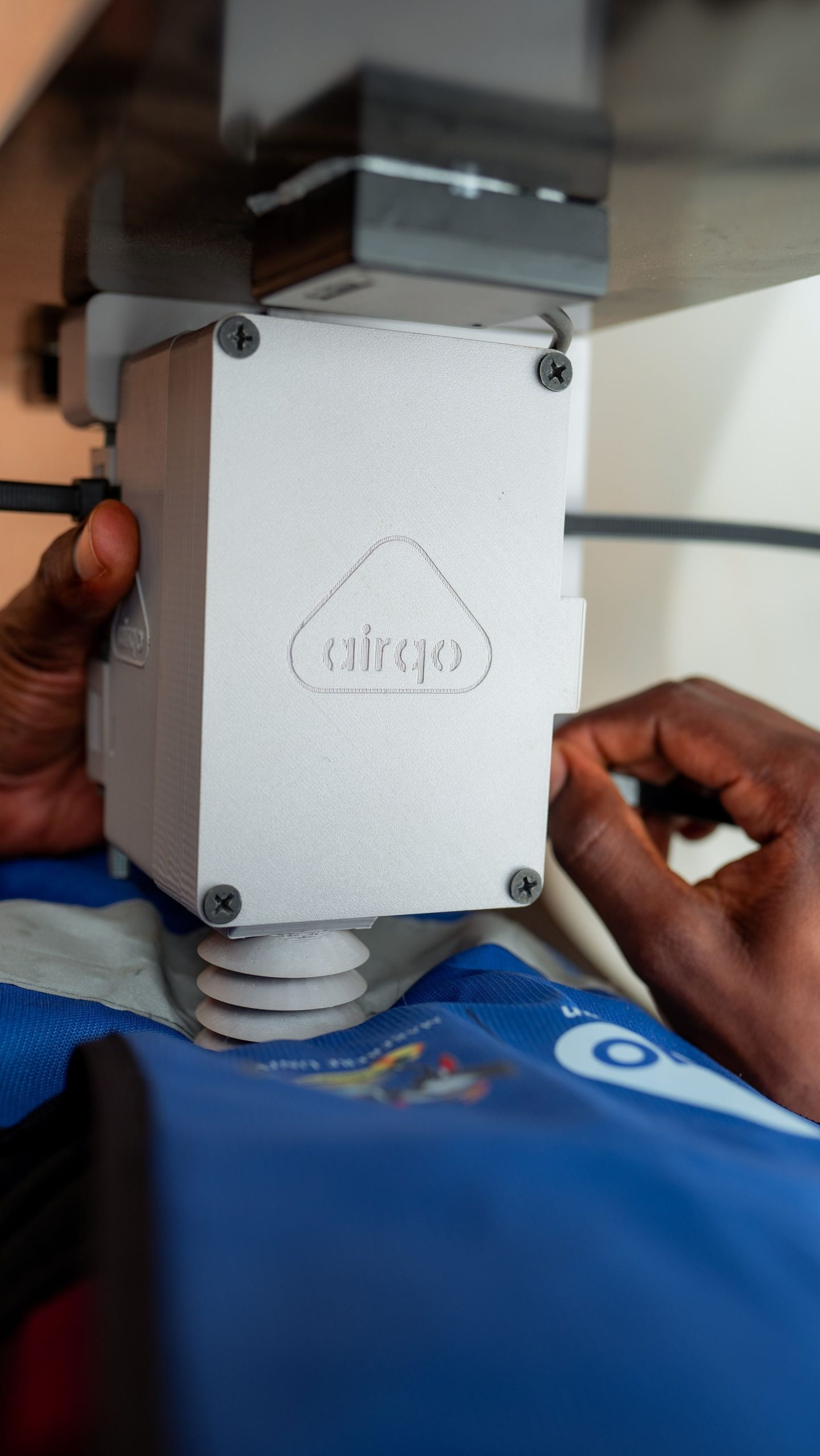
The Earthshot Prize said AirQo’s monitoring systems are designed for African conditions, including dust, unreliable electricity supplies and limited internet connectivity. The network combines fixed monitoring stations with mobile sensors mounted on motorcycle taxis, known locally as boda bodas, to collect street-level pollution data.
The data is disseminated through digital platforms, dashboards and application programming interfaces, while artificial intelligence and machine-learning tools are used to calibrate sensors, forecast pollution levels and identify pollution hotspots.
Air pollution remains a major public health challenge across the continent. The Earthshot Prize said air pollution was the second-leading risk factor for death in Africa in 2019 and contributed to an estimated 1.1 million deaths that year.
AirQo founder and Makerere University computer science professor Bainomugisha said the initiative was established to address the lack of reliable local air-quality information in African cities.

“Air pollution has remained invisible across too many African cities because the data needed to understand it has been scarce,” Bainomugisha said in a statement. “Being named an Earthshot Prize finalist will help us scale this infrastructure, equip more African technologists and city leaders, and make reliable air-quality data a public good.”
According to AirQo, its data and technical expertise helped inform Uganda’s first national air-quality regulations and have been used to support traffic-management measures in Kampala. The organisation said its monitoring systems are intended to help governments identify pollution hotspots and guide policy decisions, while acknowledging that monitoring alone does not reduce emissions.
As a finalist, AirQo will receive support from The Earthshot Prize aimed at expanding its operations, attracting investment and strengthening partnerships with governments, funders and technology organisations.
The initiative plans to expand to 10 additional African cities in the coming years, develop an open-source air-quality platform featuring a conversational AI interface, and increase technical training for students and clean-air specialists through programmes at Makerere University.
Prince William, founder and president of The Earthshot Prize, said the finalists demonstrate that environmental solutions can be scaled despite mounting global challenges.
“Every year, our finalists give me renewed optimism,” he said. “They show us that, even as the environmental challenges remain urgent, extraordinary people around the world are already proving that progress is possible.”
Five winners, one from each Earthshot category, will be announced during the Earthshot Prize awards ceremony in Mumbai, India, on Nov. 17.
AirQo has secured about $6 million in funding and support from partners including Google.org, the World Bank and the Clean Air Fund, according to the organisation.
The Earthshot Prize, launched in 2020, seeks to identify and scale solutions addressing five environmental challenges: protecting and restoring nature, cleaning the air, reviving oceans, building a waste-free world and tackling climate change.
Details in the Earthshot Press release below:
Daily Monitor:
Nile post:
Earthshot prize:
https://earthshotprize.org/winners-finalists/airqo
Airqo:
Computing & IS
Prof. Engineer Bainomugisha Takes Over as Principal of CoCIS, Pledges Focus on Excellence, Research and Innovation


Prof. Engineer Bainomugisha has officially assumed office as Principal of Makerere University’s College of Computing and Information Sciences (CoCIS), pledging to work with staff, students and university management to strengthen academic excellence, research, innovation and the welfare of the college community.
Bainomugisha formally took over the leadership of the college during a handover ceremony held on the afternoon of September 10, 2026, in the Block A Conference Room, Level 4. He succeeds Prof. Tonny Oyana, while the immediate handover was conducted by Dr. Peter Nabende, who had served as Acting Principal for about one month.
The ceremony was moderated by CoCIS Principal Human Resource Officer Julius Lebo and attended by a representative from the Office of the Makerere University Chief Internal Auditor, heads of departments, deans, administrative and support staff, as well as student representatives.
Bainomugisha said he was honoured and privileged to serve as Principal, thanking the University Council, University Management, Senate and the Search Committee for entrusting him with the leadership of the college.

He said his appointment followed a competitive selection process involving the Search Committee, Senate, the Appointments Board and ultimately the University Council.
“I would like to thank the University Council, the University Management, Senate, and the Search Committee for giving me the opportunity to serve as a College Principal,” Bainomugisha said.
He also expressed appreciation to Vice-Chancellor and other university officials for accommodating his participation in the selection process, including allowing him to make his Senate presentation online while he was travelling.
Four priorities for CoCIS
In outlining his vision, Bainomugisha said he wants CoCIS to build a strong reputation around four key areas.
First, he said the college should be recognised for producing graduates who demonstrate excellence, with teaching and learning aligned to Makerere University’s strategic plan.
Second, he said CoCIS should become globally recognised for undertaking impactful research.

Third, he identified innovation and technology transfer as another priority, stressing the need for innovations developed at the university to move beyond academic settings and create wider societal impact.
Finally, he pledged to promote a conducive working and learning environment for both staff and students, underpinned by teamwork.
“I would like to see a College that is known to produce graduates who are really excellent,” he said. “I would like to see a College that is globally recognised to undertake impactful research. And I would like to see a College that is also known for innovations and technology transfer.”
He added that the college should also be “a conducive work environment for staff and students, as well as teamwork.”
Bainomugisha called for collective responsibility in achieving the priorities, saying the Principal’s office would work with academic and administrative units, students, University Management, Council and other stakeholders.

He acknowledged that the college faces several challenges, but said these would have to be tackled progressively.
“There are many challenges that the outgoing principal has outlined, and I believe that we can work together to address some of those challenges,” he said. “Obviously, we’ll address one challenge at a time. We cannot promise that we’ll address all of them on day one.”
Nabende hands over college with staffing and programme challenges highlighted
In his handover report, Dr. Peter Nabende provided an overview of the college’s academic programmes, staffing situation, research and innovation activities, budget, committees, grants and other administrative matters.
Nabende said he had sought to build on the handover report prepared by the former Principal, Prof. Tony Oyana, while incorporating developments from his one-month period as Acting Principal.
He said his report was structured around the responsibilities assigned to him, including implementing university policies and regulations, overseeing academic programmes, promoting research and innovation, coordinating the college budget, managing units and committees, mobilising resources and research grants, and providing progress reports to university management.

Nabende said no legal cases had arisen during his brief tenure, noting that he had sought to operate within university policy and regulatory frameworks.
He also provided an overview of CoCIS academic programmes, noting that accreditation and curriculum review remain important issues for the college as the university moves toward competence-based education and training.
According to Nabende, a number of programmes remain active and accredited, while others are under review or being proposed. He noted that the college must prepare for the implementation of the competence-based education and training framework, which institutions are expected to comply with by 2027/2028.
“This is a critical item that will concern the college for the coming one year,” he said, urging the college to strategise to meet the requirements.
Staffing shortage raises concern
One of the major challenges highlighted in the handover was staffing.
Nabende said the college is operating a growing number of academic programmes while facing limited staffing capacity. He warned that increasing student enrolment, combined with staff shortages, could put pressure on the quality and effective delivery of academic programmes.

He also raised concern about the increasing attrition of staff, saying several employees had recently left the university, including some who had recently obtained PhDs.
“We have increasing attrition rate. We have a number of colleagues who are leaving,” he said, describing the trend as concerning because the college can find itself replacing staff at roughly the same rate as those leaving.
He said the university and college leadership need to find ways of addressing the staff exodus.
Nabende also reported that Jinja Campus remains severely understaffed and said the college continues to support some of its programmes through staffing arrangements involving CoCIS departments.
He further pointed to administrative staffing gaps, saying the workload generated by the college’s growing numbers of programmes and activities affects productivity, output, quality and responsiveness.
Research and innovation on the rise
Nabende said CoCIS has experienced increasing research activity and output in recent years and urged the college to build on that growth.
He cited a number of research and innovation initiatives, including the Ocular project, AIRCOR and work involving natural-language technologies, speech recognition, artificial intelligence applications in mental health, agriculture, livestock health and education.
He said the college’s innovations had also attracted recognition from government officials, citing a recent visit by the Minister responsible for Science, Technology and Innovation.
The college currently has 24 external research projects, according to the handover presentation, alongside seed grant initiatives supporting staff and students.

The seed grant programme has supported 56 staff projects and 48 student projects, with the projects continuing.
Nabende encouraged the college to continue nurturing such initiatives so that smaller research projects can develop into larger programmes with greater impact.
Budget and financial position
The handover report also outlined the college’s budget position for the first quarter.
Nabende said approximately Shs461.5 million had been released for the quarter and that roughly one-third had been utilised at the time of the handover.
He noted that most budget-related processes are now managed electronically, allowing administrators to monitor requests, expenditure and other financial information through the university system.
The incoming Principal was therefore handed responsibility for continuing implementation of the approved budget while working with relevant administrative offices.
Graduation and academic administration
Nabende said the College Academic Board had considered and recommended results for the 2025/2026 academic year, placing CoCIS in a good position ahead of the forthcoming graduation.
He, however, called for attention to student complaints and graduate examination processes to ensure that more students are cleared for graduation.
He also outlined the work of various college committees, including the Establishments and Appointments Committee, Finance Committee, College Academic Board, Quality Assurance Committee, Appeals and Academic Policies Committee and Contracts Committee.
Despite leaving the Principal’s office, Nabende said he would remain available to support the new Principal in his capacity as Deputy Principal and academic staff member.
He thanked the university leadership, fellow principals, deans, heads of departments, academic and administrative staff and students for supporting him during his brief tenure.
Nabende also praised Prof. Oyana for steering the college before his tenure and expressed gratitude for the opportunity to serve as Acting Principal.
“I’m really, really happy that I was given the opportunity to act as a principal,” he said, describing the experience as an important opportunity for him.
He told Bainomugisha that he would continue to support the college and university’s strategic direction.
Internal Audit calls for a smooth transition
Representing the Office of the Chief Internal Auditor, Aggrey Luwuliza commended Nabende for accepting to act as Principal and subsequently handing over the office.

Luwuliza said handover processes are important because they formally mark the transition from one office-holder to another and allow incoming leaders to understand the status of an institution.
He urged the outgoing and incoming principals to agree on the contents of the handover report and areas requiring follow-up so that the transition does not become a source of disagreement.
“We are here to support you,” Luwuliza said, stressing the importance of agreement between the two office-holders before the formal handover.
He also congratulated Bainomugisha for accepting the responsibility of leading the college and wished him success.
Students welcome new Principal
CoCIS student chairperson Jim Ainamani, a fourth-year Bachelor of Software Engineering student, congratulated Bainomugisha on his appointment and pledged students’ cooperation.
Ainamani said students’ experiences at the college are significantly influenced by its leadership and expressed optimism that the new Principal would continue the tradition of caring leadership.
“For the time I’ve been here, for the three and a half years, I have been able to witness caring principals, from Professor Tony to our outgoing principal,” he said.

He said students hoped to work with Bainomugisha, learn from his leadership and benefit from an improved experience at the college.
Staff pledge cooperation
Dr. Swaibu Kyanda Kaawaase, Head of the Networks Department, delivered a vote of thanks on behalf of the college, welcoming Bainomugisha and pledging staff cooperation.
Kaawaase said staff expected positive developments under the new leadership and would work with the Principal to make CoCIS more innovative and globally recognised.
He also highlighted staff welfare and student experience as areas where cooperation would be important.
“We pledge cooperation in all aspects to ensure that our college can be the one that can be talked about in the rest of the globe as being very innovative,” he said.
He further pledged cooperation to ensure students receive the best possible education and staff welfare is strengthened.

A new chapter for CoCIS
The transition comes at a time when CoCIS is expanding its academic programmes, research and innovation portfolio while simultaneously confronting staffing constraints, programme accreditation and review requirements, rising student numbers and staff attrition.
Bainomugisha begins his tenure with a detailed handover outlining both the achievements and pressure points facing the college.
Rather than promising an immediate solution to every challenge, he called for a collaborative approach focused on addressing issues progressively.
He also reaffirmed that the Principal and Deputy Principal would work closely together, maintaining continuity in the leadership of the college.
“As we are just starting off, what I’m praying for is for God to give us wisdom and good life, and teamwork,” Bainomugisha said. “I look forward to working with you all.”
The handover formally closes Nabende’s brief stint as Acting Principal while marking the beginning of Bainomugisha’s tenure, with the new Principal expected to steer CoCIS through the next phase of academic, research, innovation and institutional development.
Who is Engineer Bainomugisha?
Note: Name Origin: “Engineer” is his actual first name, given by his parents who noticed his childhood curiosity about how things work.
Engineer Bainomugisha is Professor of Computer Science and the former Chair of the Department of Computer Science at Makerere University. His research focuses on Computer Science-driven solutions to the prevailing world challenges. He is also passionate about contributing to quality Computer Science education that is of sufficient breath and depth, practical and fast enough. Professor Bainomugisha currently leads several innovative initiatives that aim to create and apply computational methods and tools that can improve the quality of life especially in the developing world setting.
His current research projects include building networks of miniature devices to: measure and derive trends of air quality in over 50 urban centers in Uganda to tackle the growing air pollution challenge in developing countries; monitor soil conditions to help farms make smart decisions; measure the quality of road infrastructure in Uganda to help municipalities and road users. Professor Bainomugisha and his team are also building a multi-cloud solution that supports portability of apps and services between private and public clouds while taking into account unique African realities like bandwidth constraints, Internet and power outages. Previously
Professor Bainomugisha investigated and developed programming languages and software tools to help programmers easily write highly adaptive mobile software without worrying about low-level concerns. His research in this area helped create iScheme and Flute programming languages. He is also the Principal Investigator for several research projects including “Probabilistic low-cost air pollution monitoring”; “Centre for Data Technology”; “Build Research Capacity for Innovative ICT4D”; and “African Virtual Cloud Initiative”;
Professor Bainomugisha received a Ph.D. and MSc. in Computer Science from Vrije Universiteit Brussel, Belgium in 2008 & 2012, respectively; and a B.Sc. in Computer Science from Makerere University in 2006. Prior to returning to Makerere University he worked as a pre-doctoral and postdoctoral researcher at the Software Languages Lab, Vrije Universiteit Brussel, Belgium.
Jane Anyango is the Principal Communication Officer CoCIS
Photo Credits: Peninah Nalubega 4th year Journalism and Communication student
-
 Humanities & Social Sciences1 week ago
French Embassy Presents Four Makerere Scholars with Academic Palms
-
 General1 week ago
Job Opportunities: NETOMA Study
-

 General1 week ago
Makerere University and Xiangtan University Advance Strategic Partnership in Chemical Engineering
-
 Health1 week ago
PhD Fellowship Opportunity: NETOMA Study
-
 General1 week ago
Applications Open: Short Course in Decision Modelling for Economic Evaluation