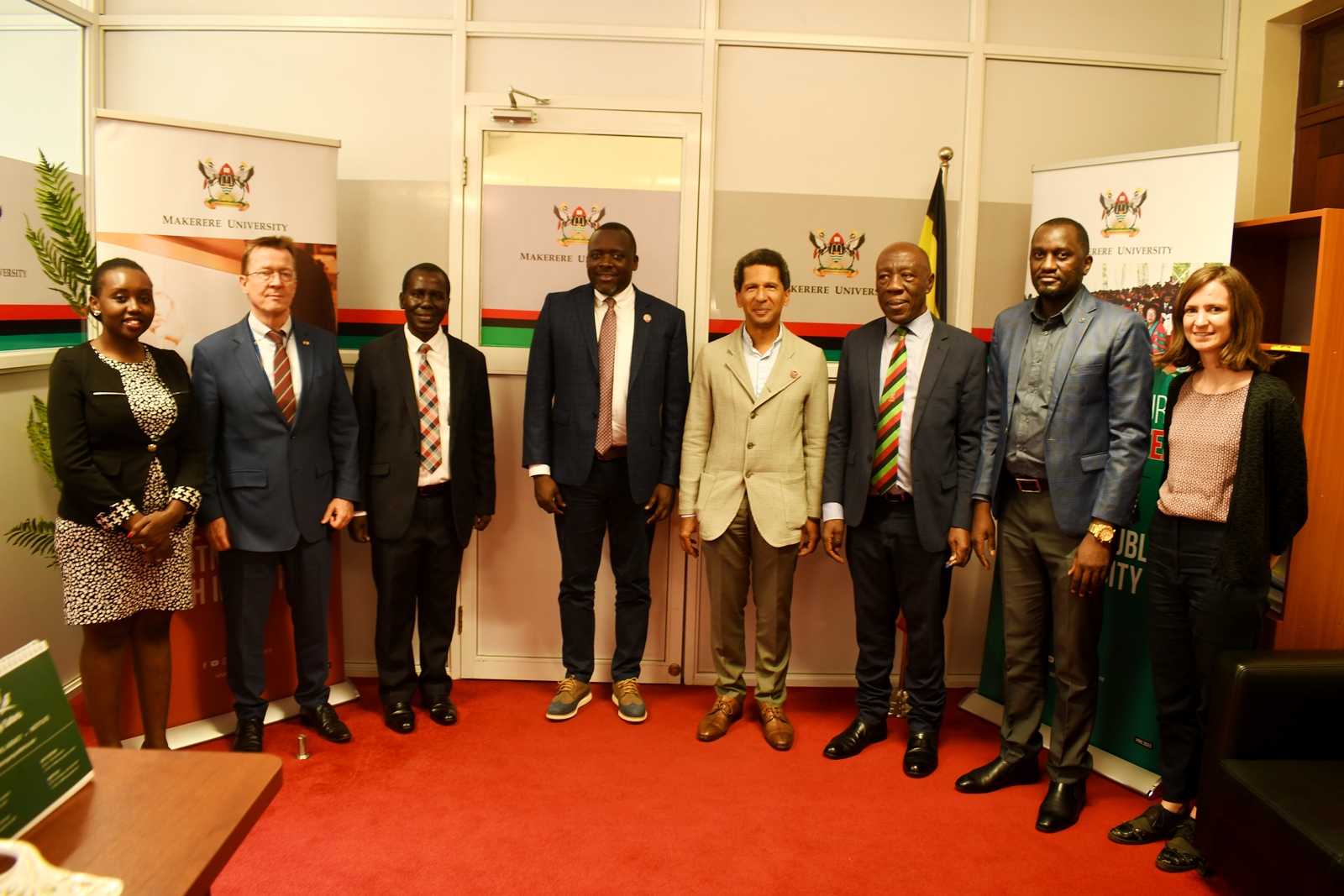
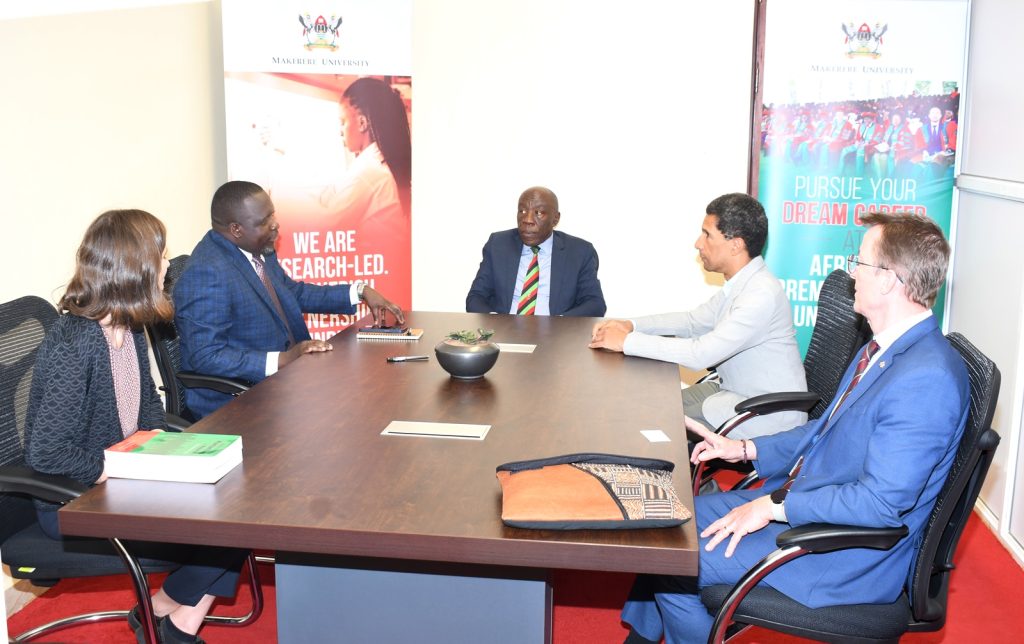
The Ambassador of France to Uganda-H.E. Xavier Sticker (4th R), DVCFA-Prof. Henry Alinaitwe (3rd R), University Secretary-Mr. Yusuf Kiranda with officials from Makerere University and the French Embassy during the meeting on 19th January 2024.
The Ambassador of France to Uganda, H.E. Xavier Sticker on Friday 19th January 2024 visited Makerere University to familiarize himself with the French Corner, the French Section of the Department of European and Oriental Languages and institution’s Internationalisation function. He was officially received by the Deputy Vice Chancellor (Finance and Administration), Prof. Henry Alinaitwe, the University Secretary, Mr. Yusuf Kiranda as well as various leaders.
Welcoming the H.E. Sticker, Prof. Henry Alinaitwe emphasised that Internationalisation is prominent on the University’s strategic agenda, and the International Office is in the process of being strengthened so as to better support this function, and ensure an environment conducive to the welfare of international students.
“Therefore, any support rendered to this office in terms of language and feedback will be helpful so as to better serve our international stakeholders. Although we are currently hosts to students from over 40 nationalities, we could have more, because Africa alone has over 50 countries” said Prof. Alinaitwe.
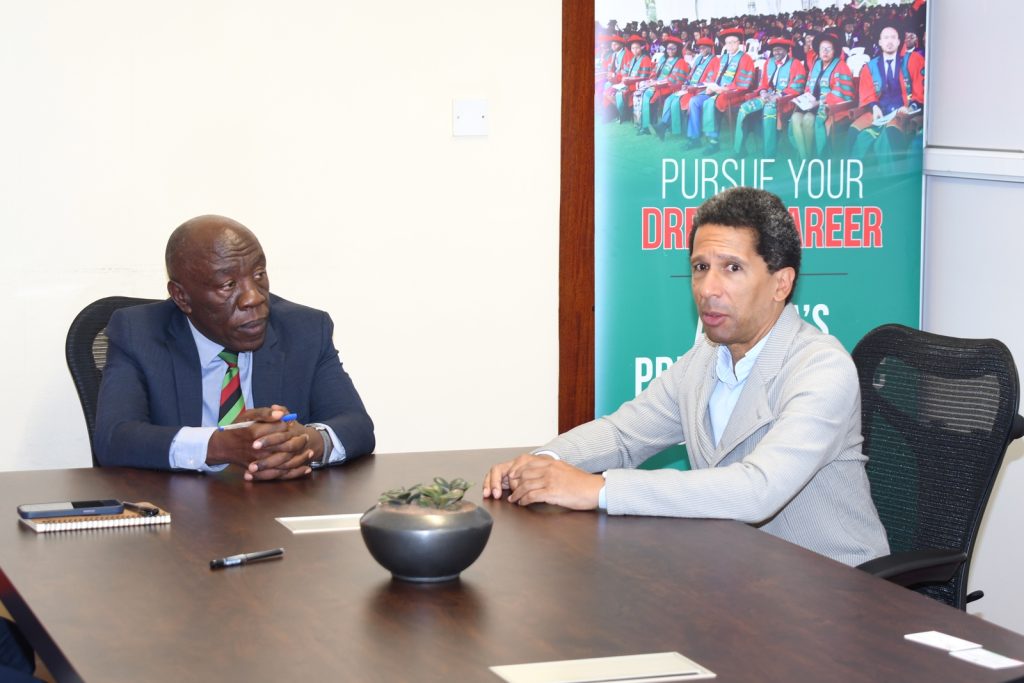
H.E. Xavier Sticker (Right) and Prof. Henry Alinaitwe (Left) during the meeting.
The University Secretary in his remarks reiterated that the International Office is at the heart of coordinating visits by international delegations and supporting the teaching and learning function by providing efficient services to international students and visiting academics.
“The target is to facilitate them through the entire chain from admission to registration to processing entry visas, study permits and making sure that when the international students are here, they are home” remarked Mr. Kiranda.
Mr. Yusuf Kiranda (2nd Left) speaks during the meeting.
Additionally, Mr. Moses Rutahumbya, one of two Administrative Assistants at the International Office, the other being Ms. Betty Nabisubi, noted that the unit also facilitates mobility programmes for Makerere University Students visiting partner institutions.
H.E. Xavier Sticker in his remarks noted that his visit was aimed at acquainting himself with the premises and operations of the Campus France Office at Makerere and how it facilitates access by students to French Universities.
“I can say that we are happy with the number of Ugandan students who have gone to study in France and returned. The number of 60 students currently studying in France could be better” remarked the French Ambassador.
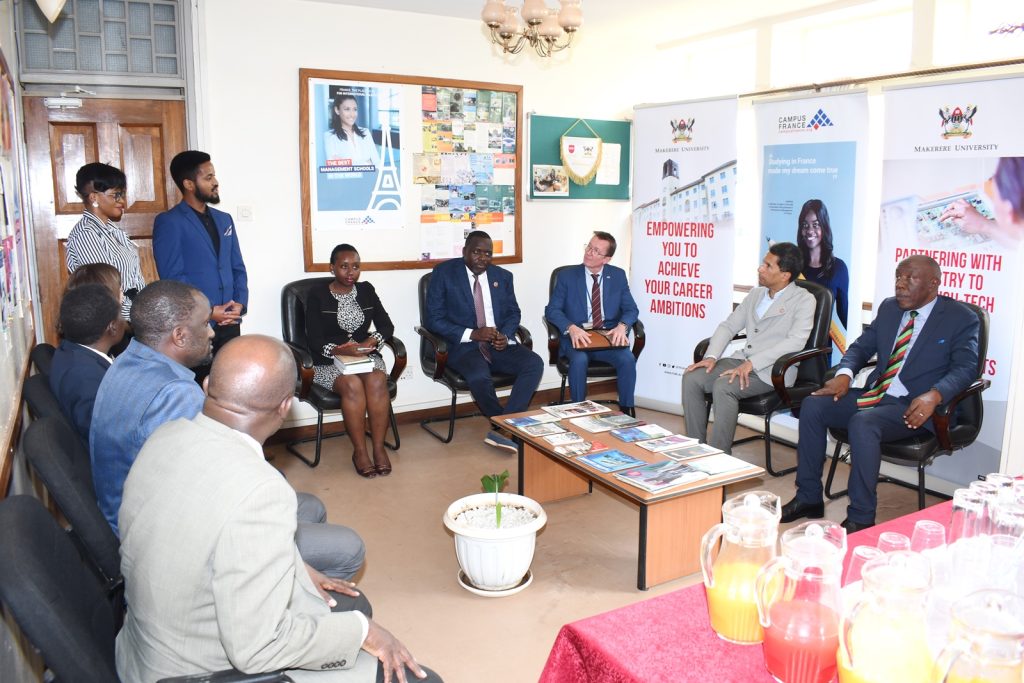
Standing: Ms. Betty Nabisubi and Mr. Moses Rutahumbya talk about the roles of the International Office during the Ambassador’s tour of the premises.
H.E. Sticker emphasized the need to enhance the infrastructure and visibility of the International Office. He underscored the importance of effective promotion, particularly among students interested in studying in France, to bolster the office’s standing.
Additionally, the Ambassador noted that it was important to ensure that students who return from French Universities form an association through which experiences can be shared.
The visit not only strengthened ties between Makerere University and the French Embassy but also provided a platform for discussing pivotal strategies to enhance the International Office’s efficacy. The collaborative efforts discussed during the visit are poised to elevate the office’s visibility and infrastructure, contributing to a more enriching experience for students both from France and around the globe.

Makerere University has challenged newly admitted postgraduate diploma and master’s students to take ownership of their academic journey, produce knowledge that addresses Africa’s challenges and use their training to create opportunities for society.
The call was made on Tuesday, August 11, 2026, during the orientation of postgraduate diploma and master’s students held at the Main Hall, Main Building, Makerere University. The orientation was conducted under the theme “Harnessing the Power of Graduate Training to Transform Africa’s Research Trajectory.”
Addressing the students, Prof. Sarah Ssali, Deputy Vice Chancellor for Academic Affairs, said admission to postgraduate education marked an important transition from undergraduate study and should come with greater independence, critical thinking and responsibility.
“Postgraduate study is not just the accumulation of knowledge. You are now active researchers, critical thinkers and creators of your own knowledge,” Prof. Ssali said.
She said postgraduate training should enable students to deepen their expertise, strengthen their analytical abilities and develop solutions to real-world problems.
Prof. Sarah Ssali.
“Through your projects, dissertations, innovations and professional practice, you have the opportunity to contribute knowledge that can influence policies, improve services and transform lives. Your research matters, and your contribution matters,” she said.
Prof. Ssali urged students to see their studies beyond the pursuit of a degree, encouraging them to ask themselves why they had chosen postgraduate education and what contribution they intended to make to their communities and professions.
“See your coursework as an opportunity to develop knowledge and skills that will help you propose new solutions to real-world challenges,” she said.
She also encouraged students to embrace collaboration with communities and non-academic partners, saying many of them were already coming to the University with professional and community experiences that could enrich their research.
“Don’t think that your scholarship is only for those who look academic. Embrace community, embrace networks,” she said.
Prof. Ssali further cautioned the students against wasting time, noting that many postgraduate students have employment, family and other responsibilities alongside their studies.
“Make the most of your time and don’t waste it,” she said, urging students to use available study time productively even when there are changes in their lecture schedules.
She also emphasised the need for students to take responsibility for their progress instead of waiting for lecturers or supervisors to push them.
“Postgraduate education requires independence, independent inquiry, independent research, independent interrogation and also active participation,” Prof. Ssali said.
Prof. Julius Kikooma, Director of Graduate Training, told the students that their admission was a significant achievement given the large number of applicants seeking postgraduate opportunities at Makerere.
“We received over 12,000 applications to our postgraduate programmes, but we are only able to take just a small percentage of that. That means you are just the few people who are able to do this,” Prof. Kikooma said.
He urged the new students to appreciate the opportunity and understand that graduate education carries responsibilities beyond attending lectures and completing examinations.
According to Prof. Kikooma, Uganda and Africa require highly trained human capital capable of driving national and continental development priorities.
“The country needs more highly trained people if it is going to achieve its aspirations and priorities for national development,” he said.
Prof. Julius Kikooma.
He challenged the students to consider what Uganda and Africa would look like in the coming decades and to question whether the continent would continue relying on ideas, innovations and creations generated elsewhere.
“Will it still be a country that always depends on ideas, innovations and creations that come from outside?” he asked, before urging the students to become part of the generation that develops home-grown solutions.
Prof. Kikooma said much of what Uganda would need in the future would depend on what the country invests in today, particularly in human capital and research.
He also explained that the Directorate of Graduate Training works with colleges, schools, departments and central University units to strengthen the quality of graduate education.
“We want to make sure that what you are taking away from here is of a certain quality,” he said, adding that the University has established policies, standards and systems intended to create an environment in which postgraduate students can succeed.
However, Prof. Kikooma stressed that the University cannot take responsibility for the entire academic journey on behalf of students.
“We will not replace your programme. We will not replace your lecturers. We will not replace your supervisors. Each of those has a different role to play along your journey,” he said.
He encouraged students to be proactive by understanding their programmes, colleges and the various support services available to them.
“Successful graduates tend to be proactive rather than reactive. So don’t wait until you have a problem, then you start running from it,” Prof. Kikooma said.
He further urged the students to work within the stipulated programme period, noting that most master’s programmes take about two years while postgraduate diploma programmes generally take one year.
Prof. Robert Wamala, Director of Research, Innovations and Partnerships, urged the newly admitted students to use their graduate training to produce knowledge capable of addressing challenges facing their communities, Uganda and Africa.
He challenged them to move beyond consuming knowledge generated elsewhere and instead become producers of knowledge and solutions.
L-R: Dr. Mike Barongo, Dr. Kizito Ongaya, Prof. Julius Kikooma and Prof. Robert Wamala.
Prof. Wamala emphasised the importance of connecting research to society, innovation and professional practice, encouraging students to identify problems within their workplaces and communities that could become areas for meaningful research.
He said Africa needed researchers capable of generating evidence, innovations and practical solutions to support development rather than simply importing solutions from other parts of the world.
The Director encouraged the students to build collaborative networks during their studies and to regard the University as an ecosystem in which researchers, professionals, communities and other partners can work together.
Dr. Kizito Ongaya, Deputy University Librarian, introduced the students to Makerere’s extensive library and information resources, urging them to make the library a central part of their postgraduate studies.
He said the University Library operates a hybrid system combining physical collections with electronic resources.
“We have over 200,000 types of books in our library, with 45 e-journal databases,” Dr. Ongaya said.
He encouraged students to make use of the University’s electronic databases, noting that substantial resources are invested in providing access to scholarly journals.
L-R: Dr. Mike Barongo, Dr. Kizito Ongaya, Prof. Julius Kikooma and Prof. Sarah Ssali.
“If you don’t use e-journals, you are unacceptable,” he told the students, emphasising that postgraduate research requires extensive engagement with scholarly literature.
Dr. Ongaya also highlighted the University’s archival collections, specialised libraries and information centres located across its colleges.
He said students would be guided on how to access both physical and electronic resources and encouraged them to explore specialised collections that could support their individual research areas.
Dr. Mike Barongo, Team Leader ICT, Department of the Academic Registrar, told the new students that Makerere had increasingly digitised its academic and administrative processes and urged them to complete their online registration as an immediate priority.
He said students could access their provisional admission letters through the online application system and use the student number provided to activate their student portals.
Dr. Mike Barongo.
“The student portal is very, very critical,” Dr. Barongo said.
He explained that students must enrol and register in order to access key University services, including institutional email and Wi-Fi.
“Once you enroll, you create an institutional email address. That institutional email address is the gateway for you to access so many things, like Wi-Fi,” he said.
Dr. Barongo also informed students that ICT support centres were available to assist those experiencing challenges with enrolment, registration or access to digital services.
Mr. George Mugabi Turyamureeba.
He urged students to ensure they enrol and register every semester so that the University systems can accurately capture their academic and financial information.
Others senior members in attendance include the Deputy University Bursar Mr. George Mugabi Turyamureeba and Mr. Henry Nsubuga, the Manager Makerere University Counselling and Guidance Centre.
Makerere University has challenged its newly admitted PhD students to go beyond pursuing academic qualifications and become independent scholars capable of generating knowledge, solving societal problems and contributing to Africa’s transformation.
The call was made by the Deputy Vice Chancellor for Academic Affairs,Prof. Sarah Ssali, during the orientation of the 2026/2027 PhD cohort at Makerere University’s Main Hall in the Main Building on 10th August 2026.
Prof. Ssali told the new scholars that a PhD marks a fundamental shift from previous levels of education, requiring students to take greater responsibility for their academic progress rather than depending entirely on lecturers and supervisors.
“You will have to push yourself and also push your supervisor to move with you,” Prof. Ssali said, urging the students to take ownership of their doctoral journey.
Prof. Sarah Ssali.
She acknowledged that many PhD students have to balance their studies with employment, family responsibilities and community leadership, making doctoral training demanding. However, she urged them to remain focused on completing their programmes within the prescribed three, four or five years.
Prof. Ssali said Makerere expects its doctoral training to produce scholars who can create knowledge, challenge existing ideas and develop solutions to societal problems.
She encouraged the students to embrace ambiguity and become comfortable questioning what they already know, noting that doctoral education requires scholars to identify important questions, investigate them and generate answers that advance knowledge.
The Deputy Vice Chancellor also urged the students to develop interdisciplinary collaborations and scholarly networks rather than confining their research to their individual disciplines.
She said the success of doctoral education should not be measured merely by the number of dissertations completed or papers published, but by the extent to which research contributes to society.
Officials pose for a group photo with the 2026/2027 PhD cohort.
With Africa facing complex challenges, including climate change, disease, population growth and development pressures, Prof. Ssali said PhD scholars have a responsibility to generate evidence that can influence policy, strengthen institutions and advance innovation.
She challenged each scholar to continually ask what problem their research addresses, what solution it advances and whether that solution can create sustainable value.
The Director of Graduate Training,Prof. Julius Kikooma, said the new cohort was joining Makerere at a time when the University is implementing reforms aimed at strengthening graduate education and improving completion rates.
Prof. Kikooma revealed that Makerere received close to 12,000 applications across its master’s, postgraduate and PhD programmes but admitted about 6,000 students.
He said graduate education has been placed at the centre of the University’s efforts to strengthen research capacity and prepare scholars to contribute to knowledge production and innovation.
Under the reforms, PhD students will undertake compulsory cross-cutting courses designed to provide foundational knowledge and skills for doctoral research. They will also be required to undertake teaching in either their second or third year under the guidance of their supervisors.
Prof. Julius Kikooma.
In addition to completing their theses, students will be required to produce at least two publications before graduation, a requirement intended to prepare them to become the next generation of researchers, innovators, inventors and creators.
Makerere has also introduced a digital system to monitor the progress of every PhD student each semester. The system is intended to enable students, supervisors and university officials to identify challenges early and intervene in real time.
Prof. Kikooma urged the scholars to write regularly, think critically, maintain open and constructive relationships with their supervisors and protect their academic integrity and professional reputation.
He also encouraged them to build scholarly networks and remain resilient, noting that rejected papers, disappointing data and unexpected challenges are normal aspects of doctoral training.
The Director of Research, Innovations and Partnerships, Prof. Robert Wamala, challenged the scholars to ensure that the knowledge they produce is trustworthy, responsible and ethically sound.
Prof. Wamala emphasized the importance of respecting the dignity, rights, safety and autonomy of research participants, particularly where studies involve individuals, communities and personal information.
Prof. Robert Wamala.
He highlighted informed consent, privacy, confidentiality, justice and accountability as critical principles of ethical research and urged students to maintain transparency throughout the research process, from developing research questions and collecting data to analyzing and reporting findings.
Prof. Wamala also cautioned the students on the responsible use of artificial intelligence in research.
He said although AI can assist researchers with activities such as language improvement, it does not remove the researcher’s responsibility for the final product.
Researchers, he said, must verify AI-generated information and remain accountable for inaccurate statements, misleading interpretations and incorrect references.
He further urged students involved in international and other research collaborations to establish clear agreements on roles, authorship, data ownership, access and intellectual property before commencing their research.
The Deputy University Librarian, Dr. Kizito Ongaya, meanwhile, urged the new scholars to make full use of Makerere’s library and information resources throughout their doctoral journey.
Dr. Kizito Ongaya.
Dr. Ongaya said the University operates a hybrid library system combining physical and electronic resources, with more than 200,000 books, 45 e-journal databases and over 16,000 archival materials available to researchers.
He encouraged the students to participate in library training to learn how to access and effectively use electronic resources and to explore specialized libraries and information centers across the University’s colleges.
These include resources covering natural sciences, agriculture, veterinary medicine, health sciences, education and humanities, as well as museums, botanical gardens, specialized collections and other research facilities.
Mr. Henry Nsubuga.
The newly admitted doctoral students were also addressed by Mr. Henry Nsubuga, the Manager Makerere University Counselling and Guidance Centre, Mr. George Mugabi Turyamureeba, the Deputy University Bursar and members of Makerere University Convocation.
The Office of Academic Registrar, Makerere University has released admission lists of candidates admitted under the Talented Sports Men & Women, Disability and District Quota Schemes with Government sponsorship 2026/27 Academic Year including appeals and remarked cases.
Other admission lists released include A-Level Applicants with Ugandan and those with Foreign Qualifications, Diploma in Performing Arts, Mature-Age Entry and Bachelor of Education (EXTERNAL Batch 2) for the Academic Year 2026/2027 under self sponsorship.