Prior to the conference, a number of activities were conducted including trainings in Mapping using unmanned Aerial Vehicle (UAV) and Wetland Vulnerability Analysis, both of which were held at the College of Engineering, Design, Art and Technology (CEDAT) from the 14th to 16th of August 2023.
Another pre conference activity was a Public Lecture on the subject of the progress of the implementation of the Land Policy- 10 years after it was launched held on the 16ht of August 2023. The panelists included Ms. Naome Kabanda, Ag. Director Land Management, Ministry of lands, Housing and Urban Development, Ms. Frances Birungi Odong from the Civil Society, Dr. Moses Musinguzi from CEDAT, and Mr. Simon Peter Mwesigye from Un Habitat.
The 2-day conference was conducted under the Theme; ‘Geomatics Excellence for a modernSociety-Sustainable Fit for Purpose Solutions for the 21st Century,’ and it drew the participation of researchers, scholars, and distinguished guests from a cross section of areas of Geomatics.
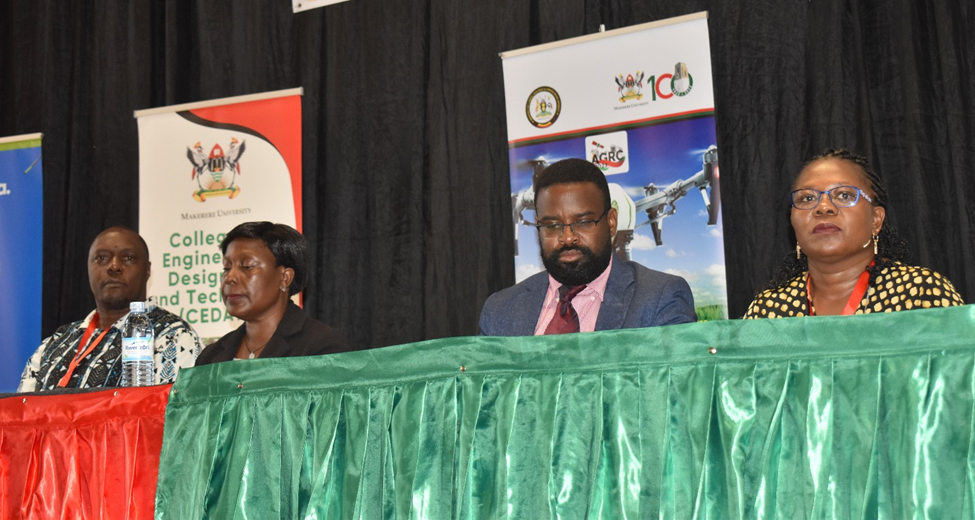
(L-R) Dr. Lydia Mazzi Kayondo- Ndandiko, HoD, Geomatics and Land Management, Prof. Robert Wamala (DRGT), Dr. Venny Nakazibwe, Deputy Principal CEDAT, Assoc. Prof. Anthony Gidudu, Dean, School of the Built Environment, CEDAT.
In his remarks at the opening ceremony, the Vice Chancellor Makerere University, Prof. Barnabas Nawangwe noted that the gathering hosted at the CTF II was testament to the relentless pursuit of knowledge and innovation in the field of geomatics, where cutting-edge advancements continue to reshape our perception and interact with our world.
Prof. Robert Wamala (DRGT) represented the Vice Chancellor, Prof. Robert Wamala at the opening ceremony
In a statement read for him by Prof. Robert Wamala for the Directorate of Research and Graduate Training (DRGT), The Vie Chancellor noted that Geomatics, with its diverse array of disciplines encompassing remote sensing, GIS, cartography, surveying, land management and more, has played a pivotal role in addressing some of our planet’s most pressing challenges. From environmental monitoring and urban planning to disaster management and resource allocation, the impact of geomatics on our global society cannot be overstated, he observed.
He said the 7th of the biennial conferences covering diverse areas of technology, science, and exploration, serves as a platform for the exchange of ideas, the dissemination of groundbreaking research, and the fostering of collaborations that have the potential to shape our future.
‘It is a forum where experts from around the world converge to share insights, discuss emerging trends, and explore novel methodologies. It is a space where we celebrate the successes of the past while laying the foundation for a future that is technologically advanced, environmentally sustainable, and socially equitable’, he said.
He extended gratitude to the sponsors, whose support was instrumental in making this event possible. Your belief in the power of knowledge and collaboration is a driving force behind the progress we continue to make in the geomatics field.
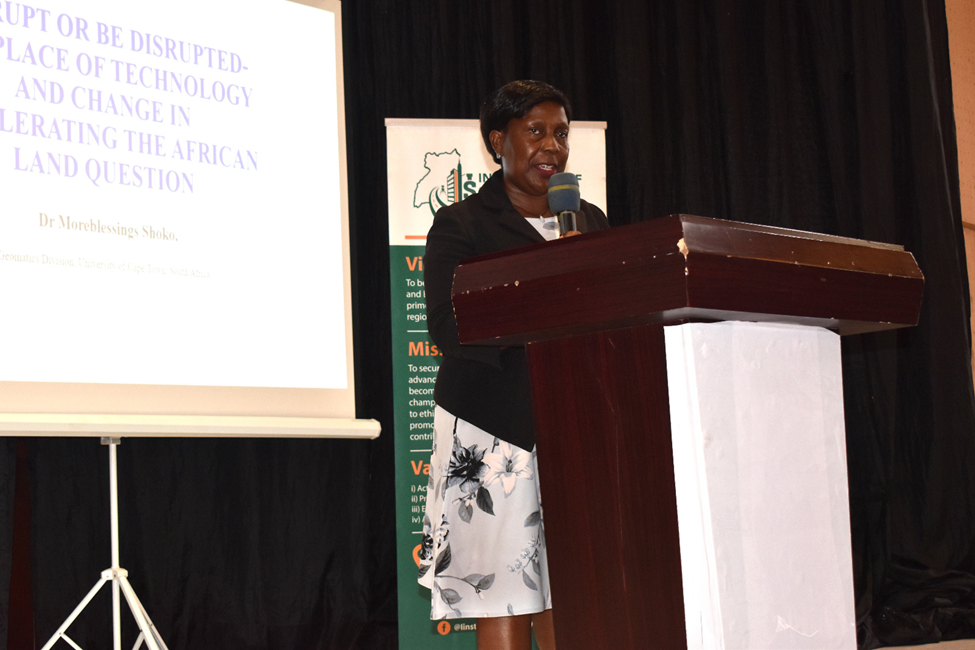
Dr. Venny Nakazibwe, Deputy Principal represented the Principal CEDAT, Prof. Henry Alinaitwe
Dr. Venny Nakazibwe, the Deputy Principal CEDAT on behalf of Prof. Henry Alinaitwe extended her appreciation to the Department of Geomatics and Land Management for sustaining the conference initiated in 2011. She said through the conference, the staff, the alumni and continuing students have a forum to showcase their knowledge through training and research dissemination for their career growth.
The conference attracted a number of dignified Scholars as key note speakers and they included; Dr. More blessings Shoko from the University of Cape Town, Dr. Moses Musinguzi from CEDAT, Ms. Vineet Chaturvedi a Research Scientist from the Technical University of Munich, and Ms. Viola Otieno, an Earth Observation Scientist.
Staff and the guest speakers at the conference
In the preparations for the conference, a call was sent out to researchers to submit abstracts on topics related to Geomatics research which were reviewed and evaluated by the organizing committee based on their relevance to the conference theme, originality, and scientific quality and that included; GIS Science & GIS Applications; Remote Sensing Applications; Photogrammetry & LiDAR Applications; Cartography; Spatial Information Management; GPS/GNSS Applications; Cadastre & Land Management; Geomatics Professional Standards & Practices; Engineering & Mining Surveying; History of Surveying & Measurement Geomatics Education; Hydrographic Surveying; Positioning & Measurement; Location-based Services and Integrated Spatial Planning.
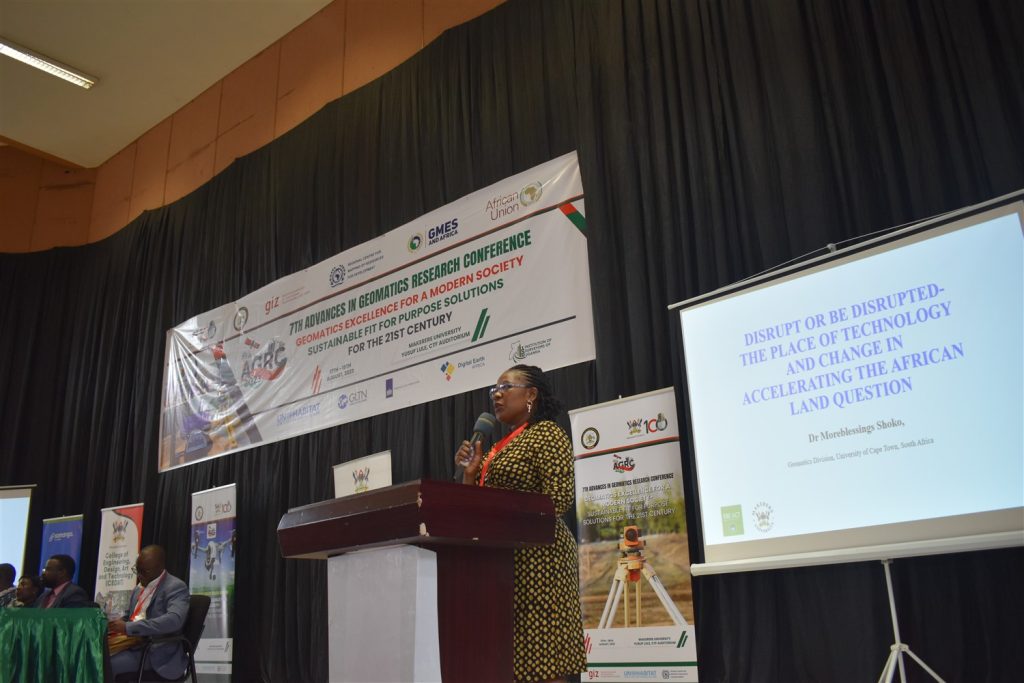
HoD Geomatics and Land Management, Dr. Lydia Mazzi Kayondo-Ndandiko, addressing the participants
According to the Head of Department, Geomatics and Land Management, Dr. Lydia Mazzi Kayondo – Ndandiko, the conference, the 7th of its kind was aimed at highlighting, promoting and encouraging scholarship in various Geomatics disciplines that are locally and internationally recognized as listed above. ‘The conference has created a for a where academia, researchers and practitioners in the field of geomatics within and outside Uganda have discussed and peer reviewed their work thus advancing geomatics scholarship in the nation’, she said.
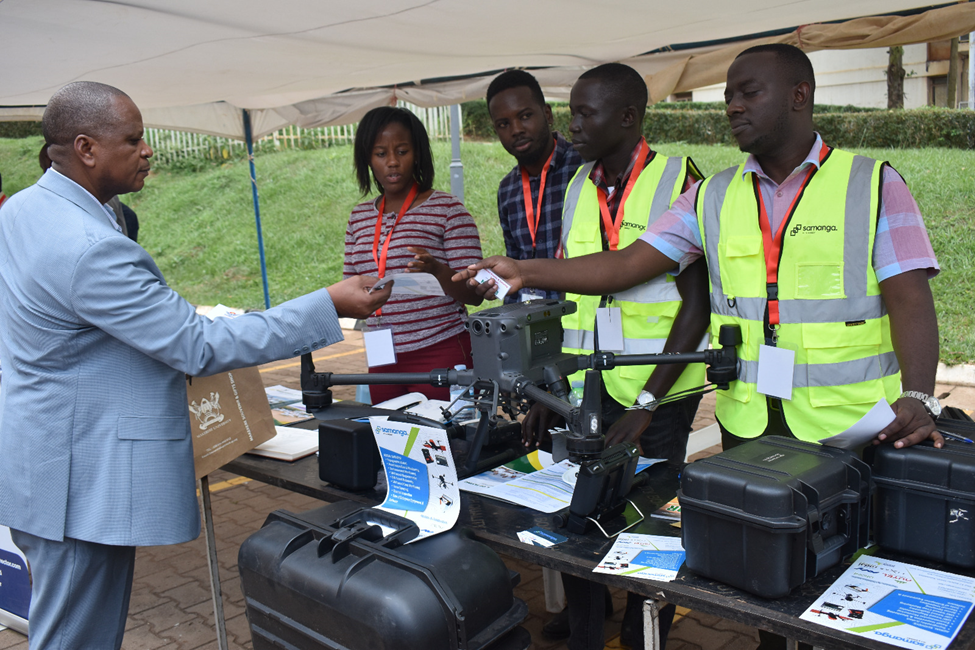
Dr. Moses Musinguzi talks to the UAV trainers and exhibitors
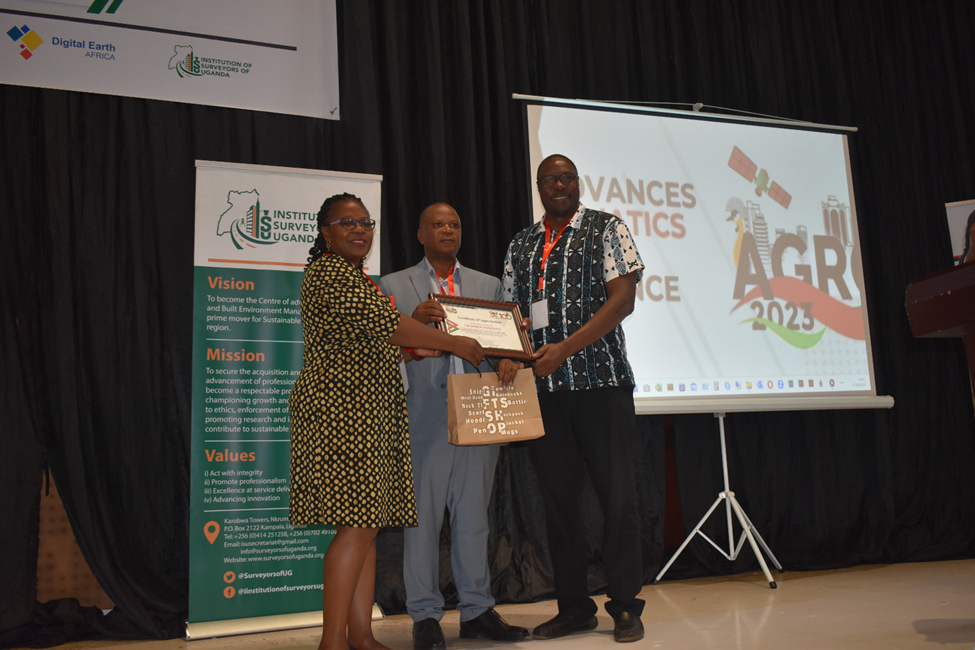
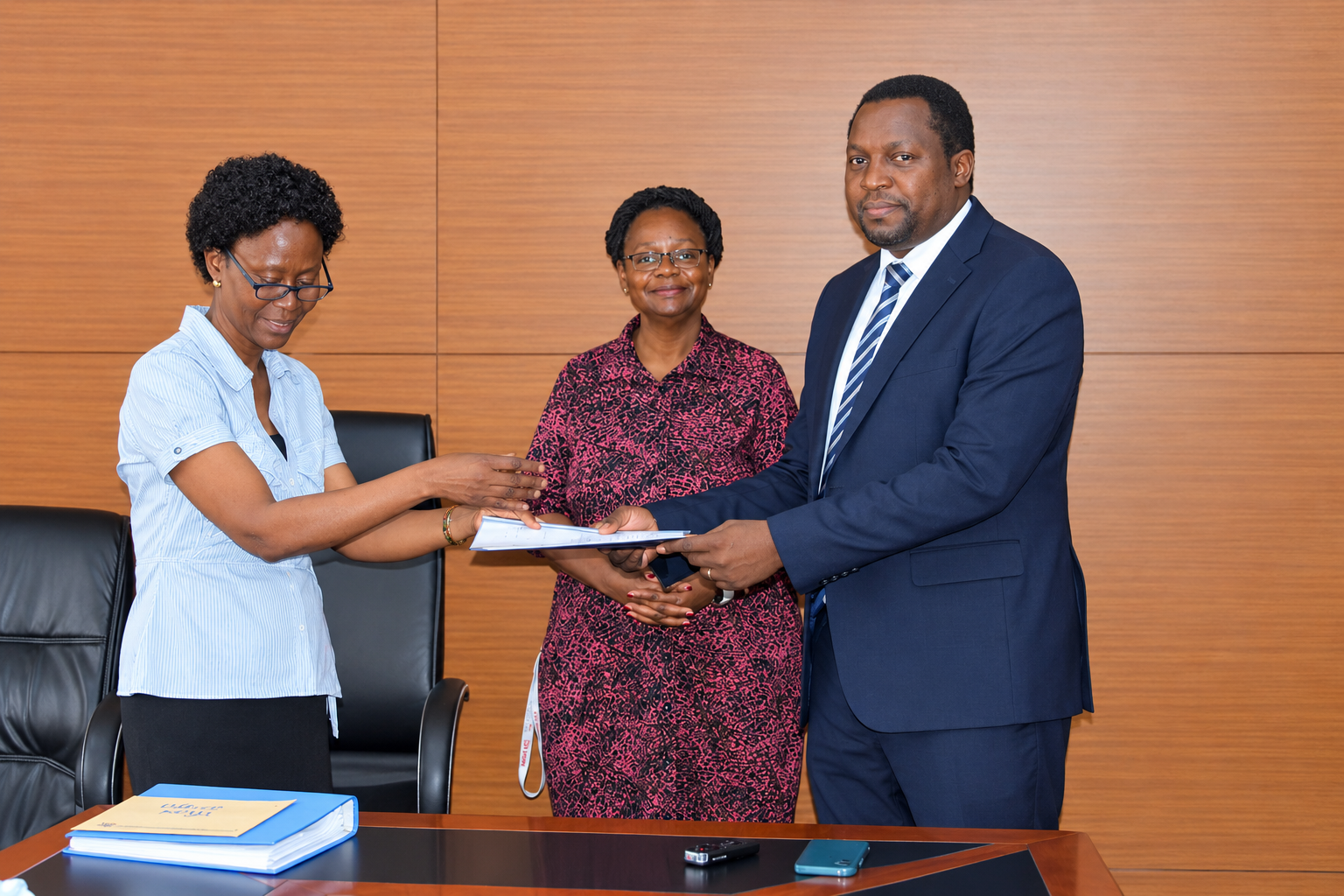
Dean, School of the Built Environment ® and HoD, Geomatics and Land Management hand over a certificate of appreciation to Dr. Moses Musinguzi, one of the Key note Speakers.
Prior to the conference, a number of activities were conducted including trainings in Mapping using unmanned Aerial Vehicle (UAV) and Wetland Vulnerability Analysis, both of which were held at the College of Engineering, Design, Art and Technology (CEDAT) from the 14th to 16th of August 2023.
Another pre conference activity was a Public Lecture on the subject of the progress of the implementation of the Land Policy- 10 years after it was launched held on the 16ht of August 2023. The panelists included Ms. Naome Kabanda, Ag. Director Land Management, Ministry of lands, Housing and Urban Development, Ms. Frances Birungi Odong from the Civil Society, Dr. Moses Musinguzi from CEDAT, and Mr. Simon Peter Mwesigye from Un Habitat.
Makerere University on 10th September 2026 hosted partners and government stakeholders at Kampala Fairway Hotel for the official high-level kick-off meeting of the Facilitating Local Organic Waste Exchange for Regenerative Systems (FLOWERS) Project. The two-year research initiative (2026–2028) is funded by the Climate and Clean Air Coalition (CCAC) and implemented by the Swiss Federal Institute of Technology (ETH Zürich), the Swiss Federal Institute of Aquatic Science and Technology (Eawag), Makerere University, End Plastic Pollution and Kampala Capital City Authority (KCCA).
The morning opening ceremony was presided over by the Deputy Vice Chancellor (Academic Affairs), Prof. Sarah N. Ssali, who was represented by the Director of Research, Innovations and Partnerships (DRIP), Prof. Robert Wamala. Prof. Ssali later attended the afternoon proceedings and officially closed the kick-off meeting.
Research That Treats Waste as a Resource
In the opening remarks delivered on her behalf by Prof. Wamala, Prof. Ssali noted that the rapid growth of the food-service sector in many sub-Saharan African cities has concentrated large volumes of food waste in urban areas. When this waste is poorly managed, she said, it drives pollution and nutrient loss while leaving unused an opportunity to rebuild soil fertility and support more circular food systems.
“Rather than viewing restaurant organic waste simply as a disposal problem, the project seeks to examine how it can become a resource within a regenerative system, returning nutrients to agricultural production through appropriate mechanisms for recycling and reuse,” the Deputy Vice Chancellor stated.
Prof. Sarah Ssali graced the event.
She described FLOWERS as timely for Kampala, where population growth, changing consumption and expansion of restaurants and food vendors are placing new pressure on municipal waste systems. She urged the team to produce evidence that can inform policy, practice and investment, and to keep a clear line of sight from research excellence to societal impact, including relevance to Sustainable Development Goal 12 on Responsible Consumption and Production.
Prof. Ssali further encouraged partners to clarify roles, engage actors along the food-waste value chain, and ask from the outset what institutional arrangements, incentives and business models would be required if a tested intervention is to move beyond the pilot.
A Partnership Anchored at CEDAT
Makerere’s Local Principal Investigator is Assoc. Prof. Charles B. Niwagaba from the Department of Civil and Environmental Engineering, College of Engineering, Design, Art and Technology (CEDAT). In a session on evidence-to-policy lessons from earlier work, he argued that municipal solid waste management is too large a challenge for any single institution and that the city itself should be treated as a living laboratory—generating knowledge through research, students and laboratories; piloting innovations; and supporting KCCA to institutionalise what works.
The project overview was presented by Dr. Daniela Peguero, with next steps outlined by Gioia Francesca of the international team. Camille Tahon delivered welcome remarks on behalf of CCAC. The programme also featured presentations from the National Environment Management Authority (NEMA) on the Strategy of Organic Waste developed under the SOWU project; Mr. Julius Mughuma Masereka of the Ministry of Local Government on national waste-management policy; and Dr. Sarah K. Zalwango of KCCA on the current status and future plans for solid waste management in Kampala.
What FLOWERS Will Do in Kampala
Assoc. Prof. Charles B. Niwagaba.
FLOWERS addresses a documented gap: despite informal systems that already move some restaurant leftovers and peelings to farms, there is limited empirical evidence on how food waste actually flows in African cities, and whether a targeted supply-chain intervention can increase recycling and reuse.
The Uganda phase of work will: map and analyse urban food-waste flows in the Greater Kampala Metropolitan Area; and experimentally assess an intervention designed to redirect a greater share of source-separated restaurant waste to farmers, tracking both mass and financial flows along the chain.
Methods to be deployed include panel surveys of restaurant managers, farmers and waste traders; two intensive waste-measurement campaigns supported by trained restaurant staff; six months of GPS tracking on waste traders’ bicycles; and a staggered, randomised matching of restaurants with traders. Makerere will contribute to three of the project’s four work packages, including waste, financial and carbon-balance mapping; market assessment of products from anaerobic digestion, composting and black soldier fly (BSF) treatment; and national dissemination.
Assoc. Prof. Niwagaba told partners that Makerere’s immediate tasks include ethical approval, support to map licensed restaurants, recruitment and training of enumerators, and close coordination with ETH doctoral researchers. Field data collection is planned to run from September to December 2026.
Informal Traders, Technology and Policy Uptake
An afternoon session by Piotr Barczak examined waste transformation through black soldier fly farming as a circular-economy option. A panel on integration of informal waste traders in restaurant waste exchange brought together the National Environment Management Authority (NEMA), Ministry of Local Government, KCCA as well as private operators MTSL Energies and End Plastic Pollution.
The panel reflected a central design choice of FLOWERS: not to replace an existing informal chain, but to understand it, strengthen it where it works, and generate evidence that national and city authorities can use. Project documents note that KCCA, municipalities in the Greater Kampala Metropolitan Area, NEMA, the Ministry of Local Government and the Ministry of Water and Environment already recognise booking of restaurant food waste as a low-emission reuse strategy.
Prof. Robert Wamala officially opened the meeting.
The research is intended to give that recognition an empirical base—waste-flow and financial-flow maps, a methane balance, and results from a field experiment rather than anecdote.
Prof. Wamala, whose Directorate coordinates research partnerships across the University, framed the kick-off as consistent with Makerere’s mission to generate knowledge for societal transformation. Makerere, he indicated, would contribute research capacity, students, innovation platforms and knowledge translation and transfer power so that findings do not remain in publications alone.
From Kick-off to Implementation
Assoc. Prof. Niwagaba at the conclusion of deliberations summarised the next steps: finalise institutional support letters required for ethics review, update restaurant and farmer sampling frames with KCCA, train field teams, and keep policy actors engaged throughout data collection rather than only at dissemination.
In closing, Prof. Ssali commended CCAC for funding the project and thanked ETH Zürich, Eawag, End Plastic Pollution, KCCA, NEMA, the Ministry of Local Government and participating private and civil-society actors for a collaboration that treats Kampala’s restaurant waste not merely as a municipal burden, but as a nutrient stream that can support farms, livelihoods and cleaner air.
Makerere University’s College of Engineering, Design, Art and Technology (CEDAT) hosted a Validation Workshop on August 28, 2026, to review and validate the revised MSc. Renewable Energy curriculum. The event brought together engineers, researchers, policymakers, students, and industry representatives at the CEDAT Conference Hall. The workshop’s objectives included validating whether the revised curriculum responds to sector needs, incorporates practical training, mainstreams gender equality, and aligns with national development priorities.
Prof. J.B. Kirabira, the Co- PI of the Austrian Government supported project, ‘ Promotion of Hybrid Renewable Energy Systems towards Electricity Access in Uganda’ moderated the session, and emphasized the need for curricula that reflect rapid changes in the energy sector, citing climate change, energy security, and technological innovation. He noted that the revised program equips graduates with competencies in hybrid renewable energy systems, energy storage, system modelling, and energy policy, while integrating gender and social inclusion. Follow this link to access the details
As part of the Lake Victoria Improved Water Level Management through Advanced Modelling (LIVWA) Project, newly developed tools were unveiled during a dissemination workshop hosted by the College of Engineering, Design, Art and Technology (CEDAT) on August 26th, 2026. The project seeks to develop advanced hydrological and climate models to enhance water level management in Lake Victoria, East Africa’s largest freshwater resource.
The tools were designed to integrate remote sensing and reanalysis climate datasets with advanced hydrological modeling, enabling researchers and policymakers to better predict fluctuations in water levels in the lake. By combining historical data with AI and Machine Learning forecasting, the models aim to provide actionable insights for sustainable water resource management. Click here for details