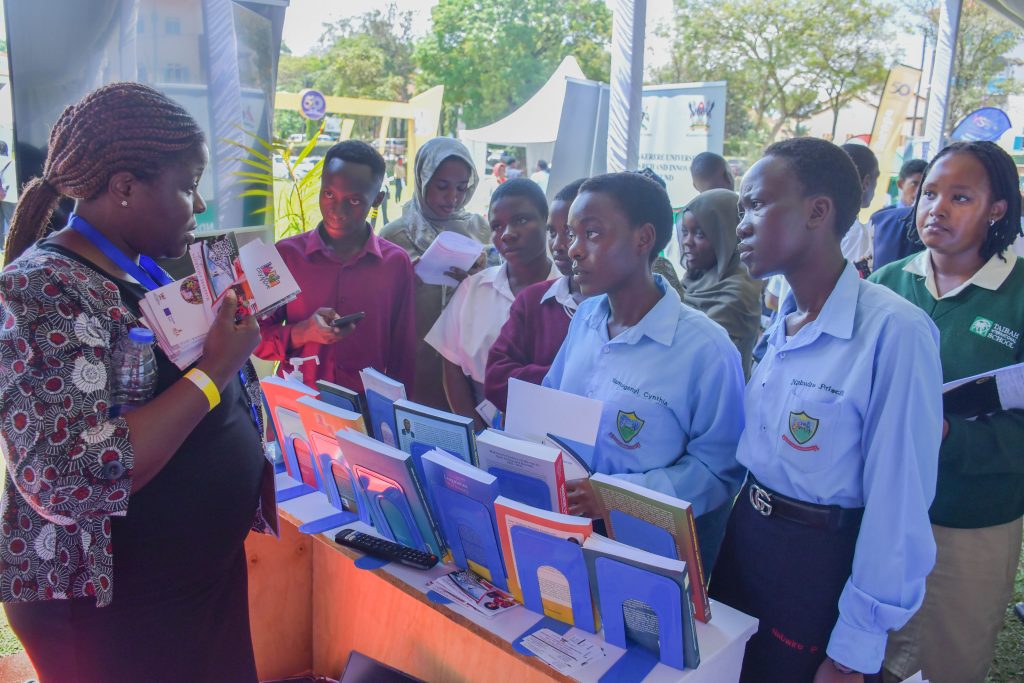
The Infectious Diseases Institute (IDI) Science Fair that was held online from 24th to 25th February 2021 provided a platform for disseminating results and updates on the progress of IDI research projects in order to facilitate research to policy discussions.
Based on the theme “Through Research to Implementation; The Role of IDI”, the Fair brought together research scientists, policy makers, implementing partners, leaders in academia, collaborators and early career scientists.
The Poster Exhibition held as part of the event featured the following topics;
Maternal Blood and Breast milk Pharmacokinectics of Tenofovir using Dried Blood and Breast Milk Spots in HIV Infected Postpartum Women in Uganda by Letisha Najjemba
Feasibility of a Theory-Informed Intervention to Improve Treatment Initiation Among Patients Diagnosed with TB using Xpert MTB/RIF Testing in Uganda by Stella Zawedde
Dolutegravir Population PK in Plasma, Cord and Breastmilk: Results from DolPHIN-1 by Laura Dickinson
Evaluation of Radio Effectiveness as a Demand Creation Strategy for Voluntary Medical Male Circumcision (VMMC) in Urban Areas by Boneventure Brian Kawere
Circulating Levels of Angiogenic Factors and their Association with Preeclampsia among Pregnant Women at Mulago National Referral Hospital in Uganda by Sheila Nabweyambo
Why Are They Diagnosed So Late? Understanding the Circumstances Preceding Diagnosis Amongst Patients with Kaposi Sarcoma Identified by Rapid Case Ascertainment in East Africa by Miriam Laker-Oketta
Impact of IPC Mentorship in Bunyoro Region Supported by GHS-IDI by Maureen Kesande
Improving Access to Alcohol Based Hand Rub Using a District-Led by Fred Tusabe
Public Engagement to Improve Knowledge of Warfarin Therapy by Geraldine Kisa
“I Swore to myself that men should never see my private parts unless I am giving birth”: Women’s Experiences with Self-sampling During Community-based Cervical Cancer Screening in Rural Uganda by Miriam Nakalembe
Thoracic Point Of Care UltraSound (POCUS) Training by Telemedicine during COVID-19 Restrictions by Peter Waitt
Involvement of Village Health Teams to Develop Tools and Resources to Communicate about Antiretroviral use in Pregnancy and Breastfeeding at Community Level in Uganda: A Public Involvement Project by Elizabeth Tindyebwa
Affected or Infected: A Mobile Exhibition Showcasing the History of HIV in Uganda by Ruth Nalunga
The Makerere University Retirement Benefits Scheme (MURBS) on Thursday, 8 January 2026 organised a Member Sensitisation Session on “Understanding Identity Shifts; Developing Routines; Sustaining Motivation and Purpose”. The session focused on holistic retirement planning, emphasising that readiness for life after work goes beyond finances to include psychological, emotional, and social well-being across all career stages—from early career to post-retirement.
The session featured a keynote presentation by Professor Seggane Musisi, who highlighted how work-related titles and roles often shape personal identity, and how retirement can trigger a sense of loss if individuals are unprepared to redefine themselves. Members were encouraged to consciously design a post-work identity grounded in values, purpose, and community contribution.
Participants learned practical strategies for:
Preparing early for retirement at different career stages;
Developing healthy, meaningful routines that support mental stability and productivity;
Sustaining motivation and purpose beyond formal employment;
Managing stress, maintaining physical and mental health, and nurturing social connections; and
Balancing family responsibilities with personal well-being.
The discussion also addressed cultural realities of retirement in Uganda, including family expectations, social obligations, and financial pressures. Special attention was given to age-related challenges such as dementia, depression, and chronic illness, underscoring the importance of preventive health care, emotional resilience, and timely professional support.
Overall, the session reinforced the message that retirement is a lifelong transition, not a one-time event. Members were encouraged to plan early, adapt continuously, and intentionally design a fulfilling, purposeful life beyond work—psychologically, socially, and financially.
To view the session, please click the embedded video below. Further below is the presentation.
Every day in Kampala, millions of people inch through gridlock, dodge swarming boda-bodas threading through narrow gaps in traffic, inhale dangerously polluted air, and walk along streets rarely designed for pedestrians. These conditions, and more, are often dismissed as ordinary transport frustrations. Yet researchers at Makerere University School of Public Health (MakSPH) are examining how such everyday realities translate into public health outcomes, shaped not simply by congestion, but by governance, policy, and power. Their work forms part of a multi-country project investigating the political economy of urban mobility in three African cities.
A boda-boda rider navigates floodwaters alongside a car on a waterlogged road in Kampala’s Industrial Area in 2024, highlighting how rapid urban development, inadequate drainage, and car-oriented road design combine to heighten daily mobility risks for vulnerable road users.
Co-led by Dr. Aloysius Ssennyonjo, the Principal Investigator and health systems and governance researcher at MakSPH, together with Uganda’s Country Principal Investigator, Dr. Esther Bayiga-Zziwa, a road safety and injury epidemiologist, and Co-Principal Investigator Dr. Jimmy Osuret, an injury prevention researcher, the project titled The Political Economy of Urban Mobility Policies and Their Health Implications in African Cities (PUMA) applies a political economy lens to understand how political interests, institutional arrangements, and power dynamics shape mobility systems and their consequences for public health in Kampala, Kigali, and Lilongwe.
To note, political economy analysis examines how public decisions are shaped by the interplay of politics, interests, institutions, and resources, in short, who has influence, who controls what, and how money and power circulate within a system. In Kampala, a capital of nearly two million residents whose daytime population swells with commuters, this lens helps explain why some transport options attract funding and enforcement while others are tolerated, neglected, or contested. These choices are not just technical, but reflect competing interests and priorities, with consequences for safety, equity, and the everyday well-being of those moving through the city.
Illustration of the Index of Sustainable Urban Mobility (I_SUM) in a planned city, highlighting how transport, accessibility, environmental, social, infrastructure, and political factors jointly shape mobility outcomes. Source: Internet.
Now, through the NIHR-funded project, the Ugandan team is currently working with colleagues from the University of Rwanda, led by Professor David Tumusiime, and Kamuzu University of Health Sciences in Malawi, led by Dr. Dominic Nkhoma. The research partnership aims to generate evidence that can strengthen mobility governance and improve public health outcomes across the three African cities above, with advisory support for the research consortium from the University of Antwerp in Belgium and Canterbury Christ Church University in the UK.
Explaining the project’s rationale for the Politics of Urban Mobility, or PUMA, during the 2025 Universal Health Coverage Day webinar held on December 12 under the theme “Mobility, Costs, and Politics: How Urban Systems Shape Access and Progress Towards Universal Health Coverage in African Cities,” Principal Investigator Dr. Ssennyonjo said Africa is urbanising at an unprecedented pace. Projections show that by 2050, nearly 60% of the continent’s population will live in cities, a shift that is intensifying transport pressures and increasingly turning everyday mobility into a public health risk.
Participants at the PUMA Stakeholder Analysis Workshop held on November 21, 2025, where policymakers, practitioners, and researchers examined how political and governance dynamics shape urban mobility and public health outcomes in Kampala.
“Rapid urbanisation has created multiple challenges: transport systems are under strain, risks and vulnerabilities are rising, and opportunities for healthy behaviours such as walking are often limited. Access to livelihoods is also affected, with broad implications for health,” Ssennyonjo noted, adding: “Crucially, these issues are shaped by political and governance dynamics, yet few initiatives explicitly address them. This gap motivated our focus on the politics and governance of urban mobility.”
Dr. Aloysius Ssennyonjo, Principal Investigator of the PUMA project, speaks during the Stakeholder Analysis Workshop on November 21, 2025, highlighting the role of politics and governance in shaping urban mobility and public health outcomes in Kampala.
He mentioned that health outcomes are shaped by social, economic, and environmental factors, with transport costs, risks, and stress often posing greater barriers than medical fees alone to achieving affordable health for all. He noted that the PUMA project brings together multidisciplinary teams to study how governance and political dynamics shape urban mobility, public health, and development, a perspective reflected in Prof. Julius Kiiza’s observation that effective urban development relies on coordinated action by diverse stakeholders across sectors to improve health outcomes, though emphasising the primacy of politics.
“Uganda and Singapore had comparable levels of underdevelopment in the 1960s. Under Lee Kuan Yew, Singapore embarked on a deliberate nation-building project. Today, it is among the smartest cities globally, outperforming many Western cities in clean government, mobility, and liveability. Why are we lagging behind? The answer, I argue, lies largely in the nature of our politics,” Prof. Julius Kiiza cogently argued.
He intimated that the result has been cities that are “unreliable, unsafe, unsmart, and chaotic,” noting that claims of inclusive urban development often ring hollow. “I have argued, and repeat here, that boda bodas as a symbol of inclusivity represent a false model of inclusion. We must interrogate this and invest in better urban transport systems and wider, well-planned highways,” he affirmed.
Prof. Julius Kiiza, Professor of Political Science, speaking during a PUMA team–organised Universal Health Coverage Day webinar, highlighted how politics and governance shape urban mobility and public health outcomes. December 12, 2025.
Prof. Kiiza urged policymakers and practitioners to move beyond piecemeal technical fixes and instead treat urban mobility as a governance challenge requiring coordinated, cross-sector action. He stressed the importance of aligning transport planning with public health, housing, employment, and skills development, arguing that safer, more liveable cities depend on institutions that work together and are accountable to the public. Such reforms, he noted, demand sustained political commitment and inclusive dialogue across government, academia, civil society, and the private sector, precisely the terrain the PUMA project is engaging, by convening stakeholders and shaping a shared research agenda around Uganda and the continent’s urban mobility challenge.
Students cross a busy road in Kampala, Uganda, navigating traffic dominated by cars and motorcycles—an everyday reality that highlights the public health and safety risks shaping urban mobility in the city. 2024.
Indeed, on November 21, 2025, the Ugandan team convened a national stakeholder workshop in Kampala, bringing together a wide range of stakeholders. Opening the workshop, Assoc. Prof. Suzanne Kiwanuka, Head of the Department of Health Policy, Planning and Management (HPPM) at MakSPH, commended the team for highlighting what she described as a long-underexplored dimension of Uganda’s urban health landscape: mobility and its governance.
Reflecting on her own experience, she noted how boda-bodas have become increasingly indispensable for millions seeking quick, flexible transport, but also carry complex health, safety, and economic implications that demand multisectoral attention, calling for a balanced, evidence-driven dialogue that recognises their value while also addressing the infrastructural and policy gaps that shape mobility systems in Uganda’s rapidly growing cities.
“I sometimes use boda-bodas,” Assoc. Prof. Suzanne Kiwanuka said. “They are necessary when you need to move quickly during heavy traffic. Yet we all know how unsafe they can be. This PUMA initiative is timely to generate evidence not only on the politics of urban mobility and its health implications, but also its economic consequences.”
Prof. Suzanne Kiwanuka, Head of the Department of Health Policy, Planning and Management, addresses participants during a PUMA stakeholder workshop, emphasising the need for evidence-informed, multisectoral approaches to urban mobility and public health governance in Kampala.
Notably, road traffic crashes remain one of Uganda’s most urgent public health threats today. The recent Uganda Police Force Annual Crime Report 2024 recorded 5,144 road deaths, a seven per cent rise from 2023, with motorcyclists accounting for nearly half of all fatalities. In Kampala, pedestrians, cyclists, and motorcycle riders constitute 94 per cent of all fatal crashes, according to the Kampala Capital City Authority. Thousands more suffer life-altering injuries each year.
Still, evidence from MakSPH, through its Centre for Trauma, Injury and Disability Prevention (C-TRIAD) and the Johns Hopkins International Injury Research Unit (JH-IIRU) under the Bloomberg Philanthropies Initiative for Global Road Safety (BIGRS), shows that the design and use of city roads are worsening the risk environment. Between 2021 and 2023, the team conducted more than one million roadside observations across Kampala, finding that while only five per cent of vehicles are officially recorded as speeding, those that do travel at an average of 57 km/h, well above safe limits for dense urban corridors, making city roads increasingly unsafe.
The motorcycle rider at the centre of the image is travelling against the flow of traffic in Kampala, highlighting everyday road-use practices that increase safety risks in the city. 2024.
The World Health Organization (WHO) guidelines, cited in the report, recommend speed limits of 30 km/h on community roads and in urban areas where pedestrians, cyclists, and other vulnerable road users share space with motorised traffic, and 50 km/h on major urban roads. Yet the findings show that six in ten vehicles on community roads exceed these limits, heightening risks for those least protected and underscoring the need for lower-speed zones, traffic-calming measures such as speed humps and raised crossings, and consistent enforcement of traffic regulations.
For the PUMA team in Uganda, the writing on the wall shows that these rising injuries coincide with worsening congestion and rapid urbanisation, yet city mobility policies within Kampala remain heavily oriented toward road expansion and vehicular flow, with limited attention to safety, health protection, or non-motorised transport. This policy imbalance, then, explains why daily commuting remains hazardous and why progress on safer streets has been slow.
A designated non-motorised transport corridor on Namirembe Road, Kampala, intended for pedestrians, is partially occupied by parked motorcycles and roadside trading. The scene highlights how everyday encroachment weakens urban mobility interventions aimed at improving safety and walkability. November 2025.
The study uses a three-tiered approach that combines policy analysis, regional evidence, and local experiences to examine how mobility decisions are made in Kampala, Kigali, and Lilongwe, who holds authority, and how these processes affect public health and equity. This is strengthened by structured co-creation workshops with practitioners, policymakers, and community actors, which reveal how governance functions in practice, often diverging from what is written on paper.
In parallel, the research team is conducting a continent-wide review of academic and grey literature to map regional trends, gaps, and the broader forces shaping African mobility systems. Together, these streams enable the researchers to compare cities, identify shared challenges, and build a grounded analytical framework for improving mobility governance across Africa.
In Kampala, preliminary findings by the MakSPH PUMA research team show a city governed by many mobility policies but marked by weak mobility governance. The team shared that Kampala operates under a dense mix of frameworks, from the National Integrated Transport Master Plan and National Urban Policy to road safety, climate, and KCCA development plans. While these documents acknowledge congestion, urbanisation, and road injury risks, they also reveal overlapping mandates, blurred institutional roles, and limited coordination authority.
Minibuses crowd a busy transport hub in Kampala, reflecting the scale and intensity of the city’s paratransit-based transport system and the planning challenges shaping everyday mobility. 2024.
Key government Ministries, Departments, and Agencies (MDAs) actors include the Ministry of Works and Transport, KCCA, the Ministry of Lands, the Office of the Prime Minister, and the Ministry of Finance, with the Ministry of Health conspicuously absent despite clear health implications. Policy attention, according to the early findings, remains heavily skewed toward road transport, leaving non-motorised mobility and major health pathways, noise exposure, psychosocial stress, community severance, heat, and mobility independence largely unaddressed.
Governance realities are further shaped by political processes, including electoral cycles, informal negotiations with transport unions, selective regulation of boda-bodas, and heavy reliance on development partners that often influence what is prioritised and implemented. Together, these dynamics help explain stalled master plans, inconsistent enforcement, and resistance to progressive interventions. While the PUMA research remains at a preliminary stage currently, the emerging findings underscore the need for an integrated, multisectoral mobility agenda that places health at the centre of Kampala’s transport policy and practice.
Motorcycle riders travel alongside a heavy truck emitting exhaust fumes on a road in Kampala, illustrating how daily urban transport exposes road users to air pollution and related public health risks. 2024.
Livelihood activities such as farming, livestock keeping, construction, and night-time work significantly increase malaria risk in Uganda, according to new research by Dr Kevin Deane, a development economist at The Open University, UK, and Dr Edwinah Atusingwize and Dr David Musoke, a Research Associate and Associate Professor of Environmental Health at Makerere University School of Public Health, respectively.
The study, Livelihoods as a key social determinant of malaria: Qualitative evidence from Uganda, published on December 2, 2025, in the journal Global Public Health, examines how everyday economic activities shape exposure to malaria, often undermining conventional prevention measures such as insecticide-treated nets and indoor residual spraying. The findings are based on qualitative fieldwork conducted in June 2024 in Busiro County, Wakiso District, a peri-urban area with persistently high malaria transmission in Uganda.
Using a qualitative design, the researchers conducted 14 key informant interviews, 10 focus group discussions, and 11 in-depth interviews with households recently affected by malaria, engaging 100 participants from communities, health services, local government, and civil society across Kajjansi, Kasanje, and Katabi Town Councils, as well as Bussi Sub-County, in Busiro South. Their analysis, guided by the Dahlgren–Whitehead social determinants of health model, enabled the researchers to situate malaria risk within the broader social, economic, and environmental conditions shaping how people live and work.
Dahlgren and Whitehead model of the social determinants of health. Source: internet.
In their findings, participants linked malaria exposure to agricultural practices, among which is maize cultivation near homes, which was associated with increased mosquito density during the rainy season. “One of the most common crops cultivated in Uganda, which many rely on as staple foods, creates environments in which mosquitoes are attracted to and thrive, often in settings where maize is grown near homes in rural areas and urban areas. This increases mosquito density around homes and contributes to increased outdoor biting and the number of mosquitoes entering houses,” the study argues.
Its authors say this poses a difficult policy challenge because maize is central to household food security, leaving few practical options for reducing exposure. They argue that proposals to keep maize away from homes are often unrealistic for families with limited land or those farming in urban areas, while targeted control during flowering periods may have limited impact given mosquitoes’ ability to travel beyond cultivation sites.
Screenshot of the open-access research article “Livelihoods as a key social determinant of malaria: Qualitative evidence from Uganda,” published in Global Public Health on December 2, 2025.
Beyond crop farming, the study reports that livestock rearing, especially zero-grazing cattle kept close to houses, attracts mosquitoes into household compounds. Other livelihood activities, including construction and brick-making, created stagnant water-filled pits that served as breeding sites, while night-time livelihoods, such as street vending, guarding, fishing, bar work, and brick burning, among others, prolonged outdoor exposure during peak mosquito biting hours. Gender further shaped risk, with women’s livelihoods and caregiving responsibilities frequently exposing young children alongside them.
“The evidence we present illustrates the unintended health consequences of development strategies intended to promote key livelihood activities, food security, and poverty reduction. There are no straightforward solutions given the complexity of these relationships and the importance of these livelihoods for many households,” the authors assert.
They conclude that malaria elimination efforts will fall short unless livelihoods and development activities are explicitly integrated into malaria prevention strategies, calling for stronger alignment between public health, agriculture, urban development, and economic policy.