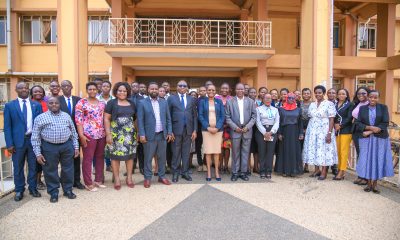
The Acting University Secretary, Mr. Yusuf Kiranda together with Members of Management on 8th January 2020 received the automated vehicle control system previously managed by the Kenya Airport Parking Services (KAPS) Limited for a period of over five years. In April 2014, Makerere University contracted KAPS to run commercial parking services at the Main Campus by introducing a 24-hour automated vehicle management system. Under the terms, the contractor was obligated to install booths at all main entrances of Makerere University manned by KAPS officials, and erect ticketing machines to bill external vehicles users who access the University.
Speaking on behalf of KAPS at the Handover ceremony, Mr. Lawrence Madialo noted that whereas his company’s contract with Makerere ended on 31st December 2019, they still remained committed to supporting University in the daily running of the system. “Handover is not an event but a process and KAPS is willing to nominate Fatuma (Ms. Fatuma Mohamed Ahmed) to support you and train staff during the transition period.”
In his remarks, Mr. Kiranda thanked KAPS for the services rendered to Makerere University over the contract period and the offer for additional support during the transition period. “I thank you for the insights shared, particularly that you are thinking of our use of this system post today’s official handover ceremony.”
Following the symbolic exchange of documents, the officials proceeded to the booth at the Main Gate where brief handover ceremony took place. The teams later visited the Directorate for ICT Support (DICTS) Network Operations Centre (NOC) at the College of Computing and Information Sciences (CoCIS) where they inspected the automated vehicle control system equipment.
Present at the handover ceremony were; Director Estates and Works-Eng. Christina Kakeeto, University Bursar-Mr. Evarist Bainomugisha, Director Legal Affairs-Mr. Henry Mwebe, Director Internal Audit-Mr. Walter Yorac Nono, Director DICTS-Mr. Samuel Mugabi, Manager Procurement and Disposal-Mr. Paul Agaba, Senior Legal Officer-Canon Goddy Muhumuza, Assistant Estates Manager-Mr. Darius Muwanguzi, Mr. Walter Odoch-Mak Finance Department and Mr. Amon Muteganda-DICTS.
KAPS was additionally represented by Mr. Kuria M. Njenga, Mr. Twinomusinguzi Julius, Ms. Nansubuga Jacqueline Anne and Mr. Fredrick Wuaw.
Makerere University on 17th June 2026 launched the upgraded Financial Management System (Mak-FMS) and Implementation Roadmap aimed at ensuring paperless end-to-end transactions right from requisition to sign-off. Mak-FMS was initially launched on 10th July 2024 to automate requisition initiation and approval. The upgraded system will ensure that the hitherto paper-based payment voucher generation, examination, digital clearance, and sign off are completed digitally.
Presiding over the launch on behalf of the Deputy Vice Chancellor (Finance and Administration) Prof. Henry Alinaitwe, the Principal, College of Natural Sciences (CoNAS) Prof. Winston Tumps Ireeta commended the Directorate of Finance and the Directorate for ICT Support (DICTS) on the strides made in digitalisation of financial processes at Makerere. He nevertheless called for the need to make approvals time bound at each stage of the process to ensure that requisitions are sanctioned or deferred for additional input promptly.
The University Bursar, Mr. Evarist Bainomugisha informed attendees at the launch that the objective of the Mak-FMS upgrade was to ensure paperless transactions by 1st July 2026. He added that Champions had been appointed from colleges and administrative units, and will together with ICT Support Staff be trained by DICTS to support users during the transition.
Mr. Bainomugisha nevertheless noted that incorporation of Mak-FMS into Uganda’s Integrated Financial Management System (IFMS) remains undone. He therefore called upon Finance Officers and Accountants to prudently ensure that the money committed on the Makerere system is charged to the appropriate Government code.
DICTS Chief, Mr. Samuel Mugabi reiterated that the upgraded system is not entirely new but is only aimed at further enhancing accountability and transparency of financial management for efficiency of Makerere’s business operations. He added that the upgraded Mak-FMS will be integrated with the recently rolled out Procurement System in a phased approach, especially as users increasingly get acquainted with the paperless working environment. He equally reiterated DICTS readiness to support the Directorate of Finance to ensure a holistic training of users.
Highlighting the ten-day Implementation Roadmap, DICTS Deputy Chief, Mr. Juma Katongole noted that launch of the upgraded Mak-FMS marked Day 1, while Day 2 will be dedicated to training Finance Officers, Accountants and ICT Support Staff and Day 3 to training Champions and more ICT Support Staff. Days 4 and 5 will be dedicated to Hands-on Training Sessions for College Bursars, Accountants and Champions, while Day 6 will feature University-wide pilot implementation of the upgraded Mak-FMS.
Day 7 of the roadmap will handle user support clinics and help desk sessions, while Day 8 will feature refresher training and a workshop on frequently encountered issues. A University-wide simulation exercise covering the end-to-end payment lifecycle will be held on Day 9 and Day 10 will host the readiness assessment meeting and go-live sign-off.
In order to ensure a smooth transition to a digital Mak-FMS, a help desk will remain operational throughout the period and user manuals as well as quick-reference videos will be developed and distributed on the University Knowledge Base and DICTS Social Media platforms.
The College of Health Sciences (CHS) QA Guidebook streamlines academic excellence, outlining essential quality processes, committee structures, and regulations aligned with Makerere University Policy and the 2004 Graduate Guidebook. It details roles for staff and students, including examination management, committee terms of reference, and highlights staff/student achievements.
Key Components of the QA Guidebook
Committees & Structure: Defines roles for the Quality Assurance, Gender Mainstreaming, and ICT Committee, ensuring alignment with SDGs and university policies and NCHE
Examination QA Processes: Outlines procedures for setting, moderating, and marking exams, ensuring standards and ethical compliance.
Regulations & Guidelines: Based on the Makerere University Quality Assurance Policy Framework (2007) and Graduate Guidebook 2004 ensuring consistency across all programmes.
Roles & Responsibilities: Clearly defines the responsibilities of Deans, Heads of Departments, and Students in Internal Quality Assurance.
Key student information in academic processes.
Commitment to support graduate training.
Recognition & Faculty Development: Recognizes outstanding female professors and acknowledges staff who completed PhDs in 2024–2026
On March 21, 2026, I felt a strong urge to reconnect with a close colleague and passionate leader, Owekitinisa Sylas Ruhweza Atwooki. We had not spoken since I moved to the United States to pursue my dream of becoming a journalist. The following day, I learned that he had been quietly undergoing treatment in and out of the hospital. True to his character, he had chosen to keep his condition private. I was shocked and saddened, wishing I had known earlier so I could offer support.
At first, reports from family and friends were encouraging. He had been diagnosed with malaria and low blood platelet counts and was receiving treatment. Respecting his wish for confidentiality, members of the Mastercard Foundation Scholars and Alumni community at Makerere University rallied discreetly around him.
An artistic impression of Sylas Ruhweza.
However, on April 29, his condition worsened. He was transferred between medical facilities and underwent extensive tests, including a biopsy, as doctors searched for answers. Sadly, on May 29, Sylas passed away.
His death sparked an extraordinary outpouring of love and solidarity. Friends, colleagues, and former scholars mobilised to support his family, settle medical expenses, organise virtual vigils, and plan a dignified farewell. Hundreds gathered at St. Augustine Chapel to pay their respects. Within three days, the Mastercard Foundation Scholars and Alumni community raised approximately UGX 11 million, a testament to Sylas’ impact on countless lives.
Sylas Ruhweza addressing his fellow alumni on 5th April 2025.
In the days that followed, I found myself wrestling with difficult questions. In a world where we spend so much time following people online, are we paying enough attention to those quietly transforming lives around us? Why do we invest so much emotional energy in distant personalities while overlooking the people God has placed right in front of us?
Sylas lived with humility and served with grace. His death left more than 1,500 Mastercard Foundation scholars and alumni grieving, alongside many others around the world who knew him. Yet his passing also exposed a contradiction in modern life.
We live in an age of unprecedented connectivity. Uganda has millions of internet users and WhatsApp subscribers, while globally, people spend hours each day on social media. We have more tools than ever to stay connected, yet many of us are becoming increasingly disconnected from the people who matter most.
Selfie time: Marion Apio and Sylas Ruhweza.
Sylas resisted this trend. Through mentorship, service, and community-building, he remained deeply present in others’ lives. While many people retreat into individual pursuits, he consistently chose connection.
This challenge is especially relevant for Mastercard Foundation scholars and alumni. Every year, young Africans leave home to pursue education and professional opportunities abroad. Distance, time zones, visa restrictions, and rising travel costs make it difficult to maintain relationships and remain actively involved in the communities that helped shape us.
For Sylas, the answer was simple: show up. Celebrate others. Offer support. Stay connected.
Sylas with some of the Girls Alive Uganda (GAU) beneficiaries.
He never allowed geographical or personal barriers to become excuses for disengagement. Even while facing his own struggles, he invested in others. He embodied the values the Mastercard Foundation seeks to cultivate—ethical leadership, service, and community empowerment.
Sylas did not wait for a perfect platform to create change. He simply served where he was. He helped build bridges between education, culture, and professional development while remaining grounded in his values. He dreamed of creating a stronger alumni ecosystem and brought both passion and compassion to every initiative he touched.
Since his passing, social media has been filled with memories of his infectious smile and unwavering commitment to others. Those tributes reveal an important truth: people gave generously because Sylas had first given himself generously to them. People from different backgrounds, generations, and communities showed up because he had spent his life showing up for them. His legacy now challenges all of us.
Sylas with friends at a Birthday Celebration.
The greatest tribute we can offer is not simply to mourn his loss but to continue his work. That means supporting the causes he cared about, helping the children whose education he championed, strengthening alumni networks, and pursuing the dreams we discussed with him.
The tragedy of modern life is not that we follow people online. It is that too often our attention to distant lives comes at the expense of meaningful relationships nearby. Yet strong relationships are as essential to our well-being as physical health.
As Ugandans, we take pride in our faith, culture, and sense of community. We contribute to fundraisers, attend ceremonies, and support family members in times of need. But increasingly, genuine connection is being replaced by passive digital interaction. Families and communities cannot thrive on likes, retweets, and emojis alone.
They require presence—phone calls, visits, conversations, and the willingness to notice when someone is struggling.
Sylas with friends at the Third Edition of the MakRun in 2019.
Before spending another hour immersed in the lives of strangers online, look around. Call the friend you have not spoken to in years. Check on a family member. Reach out to a colleague who seems withdrawn. Communities are not built by algorithms or celebrities. They are built by ordinary people who choose, day after day, to care for those within their reach.
Uganda needs more people like Sylas. At just 32 years old, he achieved what many spend a lifetime striving for. He served as Minister of Information in the Toro Kingdom and as President of the Mastercard Foundation Scholars Alumni Association in Uganda. More importantly, he dedicated himself to serving others.
While his death is deeply painful, his life remains a powerful example of how we should live. My prayers and condolences go to his family, friends, and the entire Mastercard Foundation Scholars and Alumni community.
Rest in perfect peace, Owek. Sylas Ruhweza Atwooki.
The author is a Mastercard Foundation Alumna from Makerere University and the University of California, Berkeley. She is a journalist based in Southern California and the CEO of the Debunk Media Initiative.