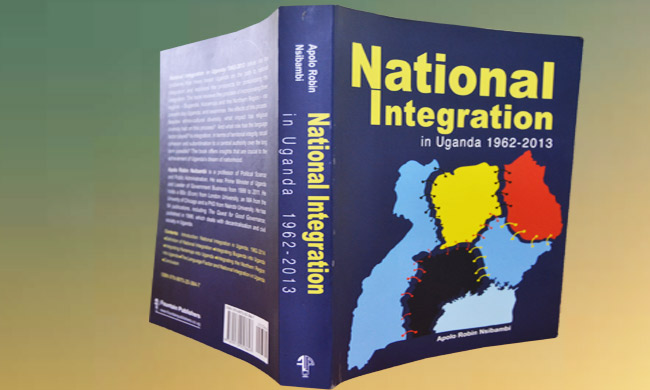
In an interview on the day of the book launch, the author-Professor Apolo Robin Nsibambi said: “I have written this book on national integration to share ideas and knowledge with Ugandans and the world over. When the ideas are read world over, humanity will understand and appreciate what is in Uganda.”
The author is a former Prime Minister of Uganda (1999-2011), Minister of Public Service (1996-1998) and Minister of Education and Sports (1998-1999).
At Makerere University, Professor Nsibambi is respected for his enormous contribution to Makerere University’s transformation and continuity in building for the future. He is distinguished alumnus of Makerere University (Bsc Economics London at Makerere University) who served his alma-mater as member of faculty, Head of Department of Political Science and Public Administration (1978-1990); Dean of Faculty of Social Sciences (1978-1983, 1985-1987), and Director- Makerere Institute of Social Research (1993-1996), and Chancellor (2003-2007).
On Friday 26th September 2014, Professor Nsibambi presented to Ugandans and the world at large, another book titled, National Integration in Uganda 1962-2013, published by Fountain Publishers, Kampala, Uganda. Professor Nsibambi renown for encouraging people to publish has 54 publications including a book on decentralization and civil society in Uganda: The Quest for Good Governance,1998.
In his 337 page book, Professor Nsibambi examines the problems and prospects of national integration since 1962 when Uganda achieved independence to 2013. He presents seven chapters: Introduction: National Integration in Uganda (1962-2013); Definition of National Integration; Integrating Buganda into Uganda (1962-2013); Integrating Karamoja into Uganda; Integrating the Northern Region into Uganda; the Language Factor and National Integration in Uganda; the book ends with Chapter VI, which draws together the main themes of the work and provides some reflections by way of conclusion.
The book concludes by asking a question: ‘What is the main obstacle to the integration of Buganda,Karamoja and the Northern region into Uganda?’
To answer the question, Prof. Nsibambi provides historical evidence and lessons that can be learnt, uses the available literature/research on the evolution of Uganda, and he asserts that the Central Government has established central authority over Buganda, Karamoja and the northern region. He equally points out that the failure of the Government to take adequate deliberate steps to make English and Swahili, two official languages, to be widely understood national languages, has reduced the realization of trans-ethnic integration.
Launching the book, H.E Edward Kiwanuka Ssekandi, the Vice President of the Republic of Uganda congratulated Prof. Apolo Nsibambi on yet another milestone in his very long and distinguished career as an Academician and a person who has made tremendous contribution in extending the boundaries of knowledge to a sizeable number of people.
“Prof. Nsibambi is eminently qualified to write this book because he is a not only strong academic but an experienced Political Leader. I discovered Prof. Apolo Nsibambi when he was a Member of the Constituent Assembly which made our Constitution. He was articulate on constitutional and political issues; and a wordsmith of sorts. You all remember words like “lugubrious,” said the Vice President drawing applause from Senior Citizens in this country, religious and political leaders, civil society, leaders of political parties, academia, media who attended the book launch at Sheraton Hotel, Kampala.
Arch Bishop Emeritus Livingstone Mpalanyi Nkoyoyo thanked the Almighty God for blessing Professor Nsibambi with wisdom to write the book on national integration. He also appealed to the Almighty God to equally bless audience and all Ugandans with a reading culture.
The Managing Director, Fountain Publishers, Mr. James Tumusiime welcomed Prof. Nsibambi’s book as a timely addition to Uganda’s knowledge. Acknowledging Prof. Nsibambi as a great lover of knowledge and an advocate for the reading culture and publishing, Mr. Tumusiime thanked authors in Uganda and world over for writing books to bridge the knowledge gaps.
The Vice President, H.E Kiwanuka Ssekandi pointed out that the absence of national integration had caused Ugandans to fight religious and tribal wars. He reiterated the NRM Government’s commitment to the promotion and realization integration at National, Regional and Continental levels; for socio-economic transformation of our people, from Peasantry to Modernity.
“Government, therefore, will continue to emphasise the importance of unity and need for a common vision based on the desire to fight poverty, and improve the social wellbeing of the people. I, therefore, wish to take this opportunity to call upon all Ugandans to appreciate the importance of integration and unity if we are to overcome, the challenges of our times,” he said.
This valuable book published by Fountain Publishers Limited costs only Thirty thousand shillings only (30,000/=).
Kampala, 15 December 2025 — Makerere University on Monday held a reflective and inspiring Certificate Award Ceremony at the CTF 2 Auditorium , Yusuf Lule to award academic staff who completed the Graduate Supervision and Mentorship Course and PhD Students who successfully undertook the University’s compulsory cross-cutting doctoral courses. The event was presided over by the Deputy Vice Chancellor – Academic Affairs, Prof. Sarah Ssali.
The ceremony honored the efforts and achievements of 58 academic staff members, 39 men and 19 women from various colleges including CEDAT, CAES, CEES, COVAB and COBAMS, who completed a rigorous three-week Graduate Supervision and Mentorship programme.
Additionally, PhD students were recognized for completing cross-cutting courses in Philosophy of Methods, Scholarly Writing and Communication, and Advanced Research Methods.
Left to Right: Prof. Julius Kikooma, Prof. Sarah Ssali and Dr. Dorothy Sebbowa Kyagaba follow proceedings.
In her keynote remarks, Prof. Sarah Ssali, the Deputy Vice Chancellor–Academic Affairs, delivered a message of encouragement and renewed commitment to research excellence at Makerere University.
“It is both an honor and a privilege to be here today to celebrate a significant academic milestone, the completion of the PhD Cross-Cutting Courses by our students and the award of Supervision Certificates to our academic staff.”
“Your completion of this course is not just a personal achievement, but a critical contribution to strengthening the research and mentoring capacity of Makerere University.”
To the PhD students, Prof. Ssali offered warm congratulations and encouragement. “These courses have equipped you with essential tools to conduct high-quality, ethical research and to engage with complex academic questions. This achievement reflects your hard work, intellectual growth, and commitment to excellence.”
She reaffirmed Makerere University’s commitment to research advancement. “As a University, we remain deeply committed to fostering a culture of research excellence. We will continue to invest in both our students and our staff, ensuring that we uphold the highest standards in research and academic supervision.”
The Director of Graduate Training, Prof. Julius Kikooma, challenged the PhD students to approach research with urgency, intentionality, and a clear sense of purpose.
Prof. Julius Kikooma, the Director of Graduate Training.
“Completing the crosscutting courses in Philosophy of Methods, Advanced Research Methods, and Scholarly Writing and Communication has not been an easy task. However, the certificate alone is not the end goal. Don’t simply compile these certificates. Make them meaningful.”
Prof. Kikooma emphasized that the value of the courses lies in applying the knowledge gained. “These certificates give you the foundation knowledge. The question now is: Can we see the application of that knowledge in your different fields?”
He further urged doctoral students to begin producing serious academic work now, not at the end of their studies. “If you are becoming someone to be listened to, start now. It means the course is becoming useful. Write about issues that speak to societal challenges. Produce thinking pieces. Produce better outputs. “Look for low-lying fruits that can make your PhD journey more exciting and impactful.”
Prof. Kikooma also reminded students that while the PhD journey is shared by the academic community, its weight is uniquely felt by the candidates. “Your PhD journey is ours as a group. But you feel the heat. Speak to us so we understand your challenges. “You cannot be here for more than three years. Why are some of you still here? Is the journey heavy? How can we support you to complete it?” He asked.
He encouraged students to build thought leadership through the PhD Forum, adding that the forum is a strong voice for the students. A PhD is automatic leadership in the knowledge domain. Why doesn’t the PhD Forum come up with periodic writings that reflect what communities are experiencing? Start now so that by the time you finish the course, you hit the ground running.”
The Ag. Director of the Centre for Teaching and Learning Support (CTLS), Dr. Dorothy Ssebowa Kyagaba, gave a message to the academic staff who completed the Graduate Supervision and Mentorship Course, speaking with admiration for their dedication and high level of engagement.
Dr. Dorothy Sebbowa Kyagaba, the Ag. Director of the Center for Teaching and Learning Support (CTLS).
“I congratulate all the academic staff who have completed the three-week Graduate Supervision and Mentorship Course. Your commitment, hard work, and enthusiasm have been evident throughout the training.”
She described the course as a cornerstone of Makerere’s commitment to strengthening graduate supervision. “This course is a key component in Makerere University’s drive to strengthen the quality of graduate training, research supervision, innovation, and strategic partnerships.”
She highlighted the thematic richness of the training; covering Knowledge Production Perspectives, Supervisory styles, Supervisory meetings and conversation skills, Research Ethics, Intercultural supervision and diversity, Scholarly writing and feedback as well as Examination processes and Doctoral Viva. She expressed gratitude to the Directorate of Graduate Training led by Prof. Kikooma, and to Prof. Ssali for providing leadership that advances graduate training across Makerere University.
Makerere University today hosted a delegation of members from the European Union (EU) for a high-level engagement aimed at reviewing the University’s involvement in EU cooperation programmes. The meeting focused on the linkages between the Erasmus+ Programme, Makerere University’s internationalization strategy, and the related institutional management and coordination structures.
The delegation was received by Deputy Vice Chancellor (Academic Affairs) Professor Sarah Ssali, provided an overview of how EU cooperation programmes are coordinated across different offices within the University. She highlighted Makerere’s integrated institutional approach to managing EU-funded initiatives, emphasizing collaboration among academic units, administrative offices, and support departments to ensure effective implementation and sustainability of projects.
Professor Sarah Ssali presenting to the delegation.
Prof. Sylivia Antonia Nakimera Nanyonga-Tamusuza presented an overview of how grants are handled at Makerere University, with particular emphasis on the role of the Grants Management and Support (GAMSU) Office. She explained that the office provides end-to-end support for externally funded projects, including proposal development, grant negotiation, compliance, financial accountability, reporting, and capacity building for project teams. The GAMSU Office plays a critical role in ensuring transparency, efficiency, and compliance with donor requirements, including those of the European Union.
Prof. Sylivia Antonia Nakimera Nanyonga-Tamusuza(R) interact with the delegation.
The University Secretary, Mr. Yusuf Kiranda, addressed the meeting and outlined how the University’s resources are managed to support academic programmes and international cooperation initiatives. He further explained the role of the Office of the University Secretary in supporting students, including policy oversight, governance, student welfare, administrative coordination, and ensuring that institutional systems effectively support teaching, research, and international partnerships.
Ms. Betty Nabisubi
Ms. Betty Nabisubi from the International Relations Office (IRO) provided a comprehensive overview of how Erasmus+ programmes are coordinated within her office. She explained that the IRO supports Erasmus students and staff from the time they arrive at Makerere University until their departure. This includes orientation, immigration support, accommodation guidance, academic coordination, cultural integration, and continuous student support. She also highlighted additional services offered by the office, such as partnership development, mobility coordination, and facilitation of international collaborations.
Following the institutional presentations, project representatives were allocated 30 minutes for structured discussions with EU project contact persons. The session began with short presentations focusing on project results, impact, and sustainability, followed by an interactive discussion and question-and-answer session. The representatives presented their projects clearly and confidently, demonstrating strong outcomes and long-term impact aligned with both Makerere University and EU cooperation objectives.
Overall, the engagement was highly productive and fruitful, providing a valuable platform for knowledge sharing, reflection on best practices, and strengthening collaboration between Makerere University and the European Union. The discussions reaffirmed Makerere University’s commitment to effective internationalization, accountable project management, and sustained partnerships under EU cooperation programmes.
On 4th December 2025, more than 70 participants gathered at Mountains of the Moon University (MMU) in Fort Portal for a three-day comprehensive leadership training targeting youth, young women, and local council leaders.
Organised by the Julius Nyerere Leadership Centre (JNLC) in partnership with the United Nations Development Programme (UNDP), the training aimed to strengthen practical leadership skills and nurture a new generation of community-centered, ethical, and solution-oriented leaders.
The first day introduced participants to foundational themes such as servant leadership, the meaning of power in leadership, self-leadership, emotional intelligence, mental well-being, and effective communication. Through these sessions, participants gained practical tools to engage and influence communities responsibly, mobilize resources, and contribute effectively to sustainable development.
Honouring Nyerere’s Legacy of Transformative Leadership
In her remarks, Dr. Nansozi K. Muwanga, Executive Director of JNLC, urged young leaders from higher education institutions across Uganda to embrace their central role in shaping the country’s future. She stressed that Uganda’s developmental trajectory—and that of the wider East African region—will be determined by empowered, ethical, and visionary youth.
Dr. Muwanga reminded participants that the Julius Nyerere Leadership Centre draws inspiration from the leadership values of Mwalimu Julius Kambarage Nyerere, who championed youth as drivers of Africa’s development. Established in 2018 by H.E. President Yoweri Kaguta Museveni as a Presidential Initiative hosted by Makerere University and the Uganda Management Institute, JNLC continues this legacy by equipping young Africans with the intellectual, moral, and practical leadership skills required in a fast-changing world.
Expanding Impact Through the JNLC–UNDP Youth Leadership Programme
Dr. Muwanga highlighted that since 2021, the JNLC–UNDP Leadership Training Programme has empowered more than 700 youth leaders from Uganda and beyond. The programme cultivates a growing network of community-centered changemakers capable of influencing governance and driving sustainable development.
To address challenges faced by alumni—such as limited visibility, resource constraints, and weak mentorship—JNLC launched the Alumni Impact Activation Strategy. The initiative supports alumni-led projects aligned with UNDP’s G4D priorities through mentorship, empowerment, and visibility. This approach amplifies our investment in Uganda’s youth and ensures that leadership development translates into sustainable solutions in climate resilience, women’s economic empowerment, and digital innovation,” she noted.
Youth at the Heart of Africa’s Development
Reflecting on Africa’s demographic landscape, Dr. Muwanga noted that a youthful population presents both immense opportunity and profound responsibility. Realising this potential requires intentional nurturing of leaders who value justice, unity, ethical conduct, and collaborative governance.
“This is the aspiration that guides our work at JNLC,” she affirmed. “We aim to equip young people with the skills to think critically, lead responsibly, and contribute meaningfully to Uganda’s development and Africa’s broader ambitions.”
Ms. Roselyne Ssali, Dean of Students, representing Vice Chancellor Prof. Pius Coxwell Achanga of @MMU_Uganda, expressed gratitude to @TheJNLCand @UNDPUgandafor choosing @MMU_Ugandato host the Comprehensive Youth, Young Women and Local Councillor’s Leadership Training.
“You Are Today’s Leaders” — Message from Mountains of the Moon University
Representing the Vice Chancellor, Prof. Pius Coxwell Achanga, Mrs. Roselyne Ssali—the Dean of Students—affirmed the university’s strong commitment to cultivating ethical, capable, and community-oriented leaders.
She emphasized the value of inter-institutional collaboration, noting that leadership thrives on shared learning and collective growth. She encouraged participants to engage actively, exchange ideas, and learn from one another.
Addressing the youth directly, Mrs. Ssali underscored that leadership is not a distant possibility but a present responsibility.
“You are not here by mistake,” she said. “The saying that you are ‘tomorrow’s leaders’ does not apply. You are today’s leaders, and that is something we cannot take for granted.”
She commended the JNLC–UNDP collaboration for expanding leadership opportunities and equipping young people with practical, real-world skills.
Ms. Asuman Nasike, Resident City Commissioner (RCC) Fort Portal City, officially opened the UNDP/JNLC Comprehensive Youth, Young Women and Local Councillor’s Leadership Training.
Leadership, Intellect, Capacity, Health, and Safety — Insights from the RCC
Officially opening the training, Ms. Asuman Nasike, Resident City Commissioner of Fort Portal City, shared her inspiring journey from Youth Councillor to RCC. She encouraged participants to treat every leadership role as a “nursery bed” for growth and reminded them that leadership is driven by intellect and capacity—not age or physical size.
“In your roles as local, youth, and women leaders, remember that leadership is defined by capacity, not size. It is about the mind, not the stature. I may be small in size, yet I lead this city. Let my example prove to you that young people can lead and make a difference,” she said.
She highlighted essential leadership qualities: integrity to earn trust, effective communication through feedback, leading by example, decisiveness in difficult moments, and resilience in the face of setbacks. She also emphasized personal well-being, responsible health practices, and surrounding oneself with mentors and peers who inspire growth.
Mr. Ivan Ssegawa Sebastian, former EAC Youth Ambassador to Uganda.
Learning from Nyerere’s Leadership Ideals
Drawing from the life and leadership of Mwalimu Julius Nyerere, Mr. Ivan Ssegawa Sebastian, former EAC Youth Ambassador to Uganda, outlined enduring values that shaped Nyerere’s leadership: human dignity, collective responsibility, unity and cultural identity, and service above self.
These ideals, he noted, remain essential foundations for ethical and people-centered leadership today.
Leadership trainer and clinical psychologist Mr. Ronald Ssaazi.
Principles of Servant Leadership
Leadership trainer and clinical psychologist Mr. Ronald Ssaazi guided participants through the principles of servant leadership, drawing insights from leaders like Nyerere, Nelson Mandela, Martin Luther King Jr., and Gamal Abdel Nasser.
He emphasized that leadership begins with self-leadership—self-reflection, self-regulation, and deliberate goal-setting. Quoting John Maxwell’s famous line, “Leadership is influence—nothing more, nothing less,” he reminded participants that they must influence themselves before they can influence others. “You cannot claim to be a leader if no one wants to follow you. Leadership begins when you influence people through your direction, ideas, and example—and that influence must start with self-leadership,” he stressed.
Mr. Ssaazi highlighted that servant leadership is rooted in service—lifting others, meeting them where they are, and helping them grow. He underscored the importance of character, emotional intelligence, meaningful relationships, and consistent action.
He also shared the “Three R’s” framework—Requirements, Returns, and Rewards—encouraging participants to focus on high-impact actions and remain motivated as they pursue purposeful leadership.
Emotional Intelligence & Mental Wellness for Effective Leadership
Dr. Gardner Herbert Rwakiseta, Programme Coordinator at JNLC, underscored that effective leadership is impossible without mental and emotional balance. He explained that clarity, creativity, and inner peace form the foundation of impactful leadership.
Using a powerful analogy, he noted:
“A smartphone may look perfect on the outside, but without a functioning battery, it cannot operate.” He likened mental health to a leader’s battery—indispensable to performance. Dr. Gardner explained that mental wellness is more than the absence of illness; it determines how leaders think, relate, and make decisions. He outlined common mental health challenges and their symptoms and provided practical tools for maintaining emotional balance, including exercise, sleep hygiene, healthy relationships, journaling, and setting digital boundaries.
On digital discipline he advised:
“The small screens were not designed to control you. Manage distractions by limiting unnecessary notifications and practicing intentional use of technology.”
The Power of Effective Communication
Mr. Henry Kasacca, Director of Dialogue and Democracy, emphasized that communication is at the heart of leadership. His session equipped participants with public-speaking skills, active listening, strategies for giving and receiving feedback, and tips for crafting impactful elevator pitches.
He reminded participants that public speaking is not merely addressing a crowd—it is connecting with people, informing them, and motivating them to act. “Preparation, positive non-verbal communication, and confidence are key. Knowing your audience, understanding the purpose of your speech, and structuring your message ensure that it resonates,” he explained.
He noted that leaders often have only a minute to capture attention, stressing the importance of clarity, relatability, and confidence. He also emphasized constructive feedback as an essential tool for growth.
The Meaning of Power in Leadership
Mr. David Nyaribi, Leadership and Governance Specialist at ActionAid International, emphasized that leadership is not defined by position but by the ability to influence, mobilize, and transform communities.
He distinguished authority from power, noting that while authority is granted, power—knowledge, confidence, action—is accessible to everyone.
He outlined four essential types of power:
Power Over – traditional authority
Power To – capacity to act and implement
Power Within – inner confidence and resilience
Power With – collective strength through collaboration
Mr. Nyaribi urged participants to use power responsibly and be mindful of who they grant influence over them. He also explained the different spaces, levels, and sources of power, from households to global diplomacy, and highlighted the difference between mobilizing (short-term energy) and organizing (long-term structure). “Mobilizing gets people to the table; organizing makes the table productive,” he noted.
Youth Voices: Picking Up the Droplets of Leadership
Bringing a youth perspective, Mr. Ivan Hurira, Speaker of the Regional Youth Parliament, shared the story of a brave hummingbird dropping water on a burning forest, insisting, “I am doing the little I can.” He likened this to the role of young Ugandans—small but consistent actions can spark meaningful change.
“When the forest of Uganda is burning, we, the young people, can do the little we can,” he said.
He encouraged participants to treat the knowledge and skills gained during the training as droplets of leadership—resources they should carry back to their communities to contribute to transformation.