Connect with us

General

Good News for Jobless Makerere Graduates

Published

on

The biggest challenge facing both the country and the university is the increasing number of unemployed youths who have acquired higher education.

Speaking on Monday 6th June, 2011 during a media briefing held at Makerere University Main Building, Council room, the university’s Vice Chancellor Prof. Venansius Baryamureeba revealed that the university intends to impart vocational skills to its jobless graduates. He said that, “Graduates can engage in vocational jobs better than non-graduates and that is why it is important to train and impart them with the required skills.”

“By provision of vocational training to jobless graduates, Makerere will help them get self employed since they will be in a better position to start their own businesses or engage in providing services in sectors such as tourism, leisure and hospitality”, said Prof. Venansius Baryamureeba. Besides the training by AIESEC, some of the training to be done in Uganda will include; machine repair and maintenance, microfinance, manufacturing, road maintenance and food processing.

As observed, it’s only the skilled graduates that can start up their own businesses and with that, Makerere University will work with companies and government to create skilled graduates. The government shall therefore, in collaboration with Makerere University, set up regional incubation facilities that will be used for business incubation. It’s worth mentioning that many successful spin-off private companies have been registered by former students of the University incubations projects.

Upon completion of the vocational training, with the skills acquired, graduates can work in the relevant sectors. Prof. Baryamureeba gave an example of graduates working in beauty saloons. Although people may argue that the job is not fit for graduates, the Vice Chancellor argued that graduates doing vocational jobs will stand a chance of attaining better higher profile clients such as Ministers. The earnings the students get will help sustain them and make them useful to the country in their participation to nation building.

With the provision of quality education the country will therefore be in a better position of developing its economy. Knowledge is power, and with Institutions like Makerere in place, a powerful country shall be revived.


Article by Grace K. Magare, Intern, Public Relations Office, Makerere University

The biggest challenge facing both the country and the university is the increasing number of unemployed youths who have acquired higher education.

Speaking on Monday 6th June, 2011 during a media briefing held at Makerere University Main Building, Council room, the university’s Vice Chancellor Prof. Venansius Baryamureeba revealed that the university intends to impart vocational skills to its jobless graduates. He said that, “Graduates can engage in vocational jobs better than non-graduates and that is why it is important to train and impart them with the required skills.”

“By provision of vocational training to jobless graduates, Makerere will help them get self employed since they will be in a better position to start their own businesses or engage in providing services in sectors such as tourism, leisure and hospitality”, said Prof. Venansius Baryamureeba. Besides the training by AIESEC, some of the training to be done in Uganda will include; machine repair and maintenance, microfinance, manufacturing, road maintenance and food processing.

As observed, it’s only the skilled graduates that can start up their own businesses and with that, Makerere University will work with companies and government to create skilled graduates. The government shall therefore, in collaboration with Makerere University, set up regional incubation facilities that will be used for business incubation. It’s worth mentioning that many successful spin-off private companies have been registered by former students of the University incubations projects.

Upon completion of the vocational training, with the skills acquired, graduates can work in the relevant sectors. Prof. Baryamureeba gave an example of graduates working in beauty saloons. Although people may argue that the job is not fit for graduates, the Vice Chancellor argued that graduates doing vocational jobs will stand a chance of attaining better higher profile clients such as Ministers. The earnings the students get will help sustain them and make them useful to the country in their participation to nation building.

With the provision of quality education the country will therefore be in a better position of developing its economy. Knowledge is power, and with Institutions like Makerere in place, a powerful country shall be revived.


Article by Grace K. Magare, Intern, Public Relations Office, Makerere University

Denis Wamala

Continue Reading

General

Call for Research Support Applications from Master’s Students who have Completed their First Year of Taught Classes at Makerere University

Published

on

Call for Research Support Applications from Master’s Students who have Completed their First Year of Taught Classes at Makerere University. Photo: Nano Banan 2

Makerere University, in partnership with Norwegian University of Life Sciences, Independent University of Bangladesh, Eduardo Mondlane University, and Pokhara University, with funding from Norwegian Programme for Capacity Development in Higher Education and Research for Development (NORHED), is implementing a project: ‘Co-creating Knowledge for Local Adaptation to Climate Change in LDCs (COLOCAL).

The expected outputs of the project include strengthened educational and research capacity, improved knowledge on inclusive Locally Led Adaptation (LLA) and Community Based Adaptation (CBA) including delivering skilled knowledge co-creators, and partnerships to support needs-driven, locally-based and contextually sensitive adaptation. The outputs are anticipated to influence policy, planning and practice around LLA and CBA through collaborative learning and knowledge translation.

In line with targets and activities for 2026/2027, COLOCAL project is offering research support for three (3) Master’s students who have completed their first academic year of taught classes at Makerere University and are interested in undertaking research under one of the following thematic areas. The students MUST have undertaken the course offered under the auspices of the project on Disability, Social Justice and Climate Resilient Development.

Requirements:

  • A first degree from a reputable university in a field related to the focus of the project
  • Ugandan citizen below 35 years
  • Good command of English (spoken and written)
  • Demonstrated interest in inclusive and climate resilient development
  • Evidence of practical experience in conducting relevant research during and after undergraduate level
  • Evidence of full payment of all university fees for the first academic year
  • The Masters programme being undertaken MUST have explicit content on climate change mitigation and adaptation
  • Special consideration will be given to students with disabilities, financial challenges, students from ethnic minority groups, internally displaced students, among others

Scholarship and study/research conditions

Availability to complete all research activities in a maximum of 10 months.

Scope of the scholarship

The project will specifically cover stipends and support for field activities only. Support with tuition fees, for the research year, will be provided for students who will complete and submit the research thesis for examination within 10 months from the date of receiving the scholarship offer letter.

How to apply

Interested and eligible candidates should submit the following documents: Application letter, research concept note of not more than 2 pages, academic transcripts/certificates, an updated CV (including contacts of at least two referees) and two recommendation letters.

Send applications via email to: colocal.caes@mak.ac.ug, not later than 20th May, 2026. This contact can as well be used for inquiries, where necessary.

Mak Editor

Continue Reading

General

Makerere University Waste Management Boosted by Centenary Bank

Published

on

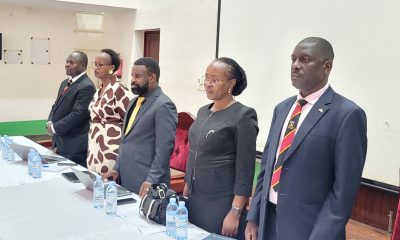
Prof. Barnabas Nawangwe (3rd L) shakes hands with Centenary Bank's Mr. Sunday Julius (C) as L-R: Mr. Simon Kizito, Prof. Sarah Ssali, Prof. Henry Alinaitwe, Mr. Paul Agaba and SSP Kaheebwa Geoffrey applaud on 11th May 2026. Donation of 30 waste bins by Centenary Bank’s Makerere Branch as part of ESG objectives, 11th May 2026, Freedom Square, Makerere University, Kampala Uganda.

Waste Management efforts at Makerere University have been boosted by a donation of 30 waste bins by Centenary Bank’s Makerere Branch. The bins received on Monday 11th May 2026 in the Freedom Square by the Vice Chancellor, Prof. Barnabas Nawangwe in the company of the Deputy Vice Chancellor (Academic Affairs), Prof. Sarah Ssali, Deputy University Secretary, Mr. Simon Kizito and other officials were handed over by the Branch Manager, Mr. Sunday Julius.

Appreciating the donation from Centenary Bank on behalf of University Management, Prof. Nawangwe noted that Makerere University strives to maintain “the cleanest environment in Kampala”, especially as a good example to future leaders, the students.

Donation of 30 waste bins by Centenary Bank’s Makerere Branch as part of ESG objectives, 11th May 2026, Freedom Square, Makerere University, Kampala Uganda.
Some of the 30 bins donated by Centenary Bank Makerere Branch.

Acknowledging earlier donations to the Halls of Residence by Centenary Bank, Prof. Nawangwe described the ceremony as “the beginning of a long journey of collaboration in environmental stewardship,” with separation of plastics from biodegradable waste earmarked as the next step in user education.

In his remarks, Mr. Sunday noted that the donation was in line with the Bank’s Environmental, Social and Governance (ESG) objectives, particularly the Social component, where supporting institutions with waste management facilities to enhance hygiene is key. “It is important for Centenary Bank to give back to the society where it makes money”, he emphasized.

Officials pose for a group photo after the donation ceremony. Donation of 30 waste bins by Centenary Bank’s Makerere Branch as part of ESG objectives, 11th May 2026, Freedom Square, Makerere University, Kampala Uganda.
Officials pose for a group photo after the donation ceremony.

Describing Makerere University as the “main institution that Centenary Bank operates a branch”, Mr. Sunday recognised the donation as a step in the right direction with a valuable partner.

The newly-donated bins will be placed in various public locations under supervision of the Estates and Works Directorate.

Mark Wamai

Continue Reading

General

Bachelor of Laws Pre-Entry Examination Results 2026/2027

Published

on

The office of the Academic Registrar has released the results for Bachelor of Laws Pre-Entry Examination 2026/2027 held on Saturday 18th April, 2026.

Candidates who scored 50% and above passed the examination and have been recommended to the Admissions Committee for consideration. However, the candidates who passed have to submit an application where Bachelor of Laws is among the programme choices in the application system here: https://apply.mak.ac.ug.

Candidate who are not satisfied with their results may appeal within two weeks from the date of the release of results.

Follow the links below for the candidate lists showing results of the categories of candidates respectively:

Mak Editor

Continue Reading

Trending