The Academic Registrar, Makerere University invites applications from E. Africans and international Degree/Diploma Holders to apply for admission to undergraduate degree Programmes for the 2024/2025 Academic year.
EITHER
Each applicant should possess at least a Credit or Second Class or equivalent Diploma in a relevant field( as specified in the Diploma Requirements Document) from a recognised Chartered Institutions. Certified copies of academic transcripts and certificates (not photocopies of certified copies) from the awarding Institutions and one Passport size photography MUST be submitted to Office 315, Level three (3) Senate Building after applying online.
Further details of the Diploma holders’ admission requirements for the 2024/2025 academic year can be viewed on the Notice Board of the Undergraduate Admission Office.
OR
BE A GRADUATE FROM A RECOGNISED CHARTERED UNIVERSITY. Certified copies of academic transcripts and certificates (not photocopies of certified copies) from the awarding Institutions and one Passport size photography MUST be submitted to Office 315, Level three (3) Senate Building after applying online.
Further details including Undergraduate Programmes advertised in the different Colleges in can be found in the document below:
The closing date for submitting the application forms and certified copies of the academic documents to the University is Thursday 29th February, 2024.
Makerere University, through the Great Lakes Center for the Study of the United States under the College of Humanities and Social Sciences (CHUSS), hosted a public lecture in the Main Hall to commemorate the 250th anniversary of the United States of America’s independence.
Nation building is a cumulative process
Delivering the keynote address, Prof. Gilbert Khadiagala, Professor Emeritus of International Relations at the University of the Witwatersrand, South Africa, described the United States’ 250-year journey as a cumulative process of nation-building in which successive generations built upon institutions and achievements established by those who came before them.
Prof. Khadiagala said the American experience demonstrates the importance of developing institutions that can survive beyond the individuals who establish them.
“You build on small successes, you build on small achievements in order, in fact, to build big achievements,” he said.
Prof. Gilbert Khadiagala gives his keynote remarks during the public lecture convened in the Main Building at Makerere University.
He traced the country’s institutional development through several historical milestones, beginning with the Declaration of Independence of 1776, the drafting and ratification of the Constitution in 1787 and 1788, the Civil War, the civil rights movement and the emergence of the United States as a major global power.
According to Prof. Khadiagala, the Declaration of Independence established foundational ideas, while the Constitution translated some of those ideas into institutional frameworks that continue to shape the country.
He highlighted figures including Thomas Jefferson, John Adams, James Madison, Alexander Hamilton and Abraham Lincoln, whose contributions, he said, represented different stages in the development and strengthening of American institutions.
Africa can learn from US institution building
Prof. Khadiagala challenged African countries to reflect on their own nation-building experiences, particularly the ideas that guided independence and Pan-Africanism in the 1960s.
He questioned why some of those ideas have weakened decades after independence and urged African countries to examine the relationship between ideas and institutions.
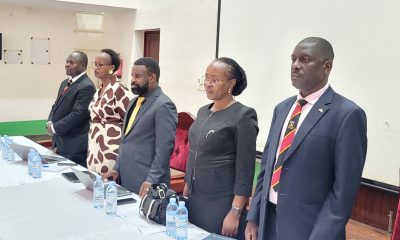
From third left: Prof. Gilbert M. Khadiagala, keynote speaker; third right: Prof. Sarah Ssali, Deputy Vice Chancellor (Academic Affairs), Makerere University; second right; Mikael Cleverley, Chargé d’Affaires, U.S. Embassy in Uganda; and second left: Prof. Helen Nambalirwa Nkabala, Principal, College of Humanities and Social Sciences (CHUSS), pose for a photograph during a public lecture commemorating the 250th Anniversary of U.S. Independence at Makerere University Main Hall on 19 August 2026.
“If we had good ideas in the 60s, for instance, about nation building, about Pan Africanism, where are these ideas today?” he asked.
He said Africa’s abundant natural resources and youthful population can only translate into sustainable development if supported by functional institutions, education systems, infrastructure and effective leadership.
He urged African countries to learn from successful experiences without simply copying them.
“We should avoid copying, but we should not be afraid of learning,” Prof. Khadiagala said.
Understanding America through different lenses
Mikael Cleverley, Chargé d’Affaires at the United States Embassy in Kampala, said understanding the United States requires looking beyond a single historical or foreign policy perspective.
Reflecting on his personal experiences and 27 years of service in the U.S. State Department, Cleverley said his understanding of the United States had evolved through different lenses, including family history, diplomacy, international relations, philanthropy, economic development and foreign assistance.
He said these different perspectives demonstrated the complexity of the United States and cautioned against reducing the country to a single narrative.
Mikael Cleverley, Chargé d’Affaires at the U.S. Embassy in Uganda, delivers remarks on the significance of the United States’ 250 year journey and the enduring partnership between the U.S. and Makerere University
“My appreciation for its complexity has only increased over time and grown,” he said.
Cleverley also reflected on the 1776 Declaration of Independence, noting that those who supported the document could not have known whether the new nation would survive, let alone reach its 250th anniversary.
He described the American story as one that remains unfinished, shaped by generations of citizens who have continued to build, refine and improve their institutions.
“It’s not a finished story, but one in the making,” he said.
He identified innovation, entrepreneurship, transparency, the rule of law, philanthropy and volunteerism among the elements that have contributed to American development and which continue to inform the country’s international partnerships.
Centre to strengthen academic partnerships
Prof. Sarah Ssali, Makerere University Deputy Vice Chancellor for Academic Affairs, representing Vice Chancellor Prof. Barnabas Nawangwe, commended the United States Embassy for its continued partnership with Makerere University.
Prof. Ssali particularly appreciated the support towards the establishment of the Great Lakes Center for the Study of the United States, describing it as an important investment in knowledge generation, academic exchange and mutual understanding between the United States, Uganda and the wider Great Lakes region.
She said Makerere University envisions the centre as a regional hub for the study of the United States and a platform for academic exchange between Africa and the United States.
She noted that the university’s transition towards competence-based teaching and learning provides an opportunity for collaboration with American universities that have experience in implementing similar approaches.
Prof. Ssali proposed staff and student exchanges, joint curriculum development, pedagogical research and the sharing of best practices as some of the areas through which the partnership could be strengthened.
She also highlighted Makerere University’s ambition to become a research-led university, saying the Great Lakes Center could play an important role in strengthening research on relations between the United States and Africa.
Prof. Nkabala calls for continued support
Prof. Helen N. Nkabala commended the United States Embassy and partners for supporting the Great Lakes Center for the Study of the United States and facilitating academic exchanges.
She said the centre had contributed to Makerere University’s engagement in the public space by creating opportunities for researchers and students to participate in important public conversations.
Prof. Nkabala called for continued support for the centre, including increased opportunities for scholars and students to engage in research and academic exchange.
She also encouraged participants to draw lessons from the lecture and use them to contribute meaningfully to conversations about independence, leadership, institutions and development.
Great Lakes Center advances US Africa scholarship
The public lecture forms part of the activities commemorating the 250th anniversary of the independence of the United States.
The event brought together Makerere University academics, students, researchers, United States Embassy representatives and other partners.
The Great Lakes Center for the Study of the United States is also undertaking research examining Uganda United States relations since 1945 under the framework of civilizational relationality.
The research is expected to contribute to scholarship on the historical, political, social and intellectual relations between Uganda and the United States and further strengthen Makerere University’s role in regional scholarship on the United States.
72 undergraduate students of Makerere University have successfully been admitted to the Millennium Fellowship Class of 2026, an initiative of the Millennium Campus Network (MCN) and United Nations Academic Impact. Makerere’s Fellows were selected from a record-breaking 76,000 applicants from over 6,000 campuses across 174 countries to participate in the ambitious programme.
According to the Fellowship website, the programme aims to make the Sustainable Development Goals (SDGs) and UN Academic Impact Principles a reality on campuses, in classrooms and throughout communities. Millennium Fellows are university undergraduates selected for their leadership on sustainable development projects in their communities. As Fellows, they complete a semester-long leadership development programme that strengthens their student organizing, partnership-building and community-impact skills.
In his congratulatory message to the Vice Chancellor, Prof. Barnabas Nawangwe, Sam Vaghar the Executive Director, MCN shared that Over 330 campuses across 60 nations have been selected to host 2026 Millenium Fellows. “Congratulations to you and Makerere University for having a cohort of Millennium Fellows from your student body again this year!”
Below is a sample of the work of the Class of 2026.
At Harvard University, a UN Academic Impact member institution in the United States of America, Millennium Fellows are expanding OpenDoor, an AI-powered platform that helps people navigate retraining, job opportunities and pathways into high-demand careers. The project grew from their work with people experiencing homelessness and from seeing how difficult workforce programmes can be to navigate even when support exists. Advancing SDG 8: Decent Work and Economic Growth, it expects to reach about 7,500 people during the Fellowship.
At the University of Ilorin, a UN Academic Impact member institution in Nigeria, Millennium Fellows are building what they describe as Africa’s first green AI policy framework, helping policymakers and developers understand how artificial intelligence can advance while reducing energy use, pollution and material waste. Aligned with SDG 13: Climate Action, it expects to reach about 75 people during the Fellowship.
At BRAC University, a UN Academic Impact member institution in Bangladesh, a Millennium Fellow is advancing SDG 12: Responsible Consumption and Production through a start-up replacing single-use products with environmentally friendly alternatives. Its current focus is a paper pen that uses roughly 90 per cent less plastic than a conventional pen, with a seed built in so it can grow into a plant when properly disposed of. The project expects to reach about 450 people.
At Nicolae Testemițanu State University of Medicine and Pharmacy, a UN Academic Impact member institution in Moldova, a Millennium Fellow is advancing SDG 3: Good Health and Well-being by studying how environmental conditions such as temperature and humidity may affect recovery after brain surgery. By bringing simple digital monitoring tools into postoperative care, the project aims to help doctors make timelier decisions.
We wish our Millennium Fellows an impactful fellowship.
The Office of Academic Registrar, Makerere University has released admission lists of candidates admitted under the Talented Sports Men & Women, Disability and District Quota Schemes with Government sponsorship 2026/27 Academic Year including appeals and remarked cases.
Other admission lists released include A-Level Applicants with Ugandan and those with Foreign Qualifications, Diploma in Performing Arts, Mature-Age Entry and Bachelor of Education (EXTERNAL Batch 2) for the Academic Year 2026/2027 under self sponsorship.