Connect with us

General

67 Minutes of Community Service for 67 Years of Mandela’s Service

Published

on

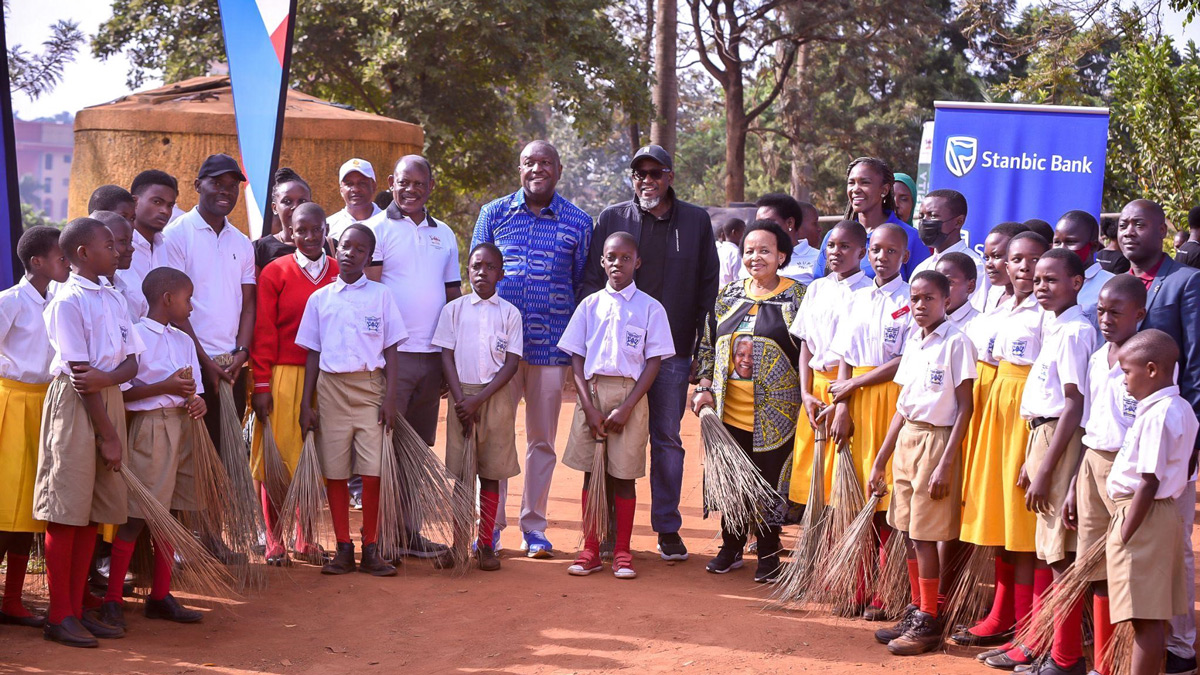
On the 14th of July, 2023, Makerere University in collaboration with the South African High Commission kicked off commemoration of the Nelson Mandela International day with a community service at the Makerere University Primary School. On this day, we honored and celebrated Nelson Mandela’s 67 years of service of selfless service. In so doing, members of the society converged at Makerere University Primary School and conducted a community service for 67 minutes, each minute reflecting the aforementioned 67 years.

The event which started at 9:00am at the Makerere University Primary School begun with a band led by the pupils who welcomed the delegates with a marching procession. Present at the venue were the South African High Commissioner, H.E Lulama Xingwana, the Vice Chancellor of Makerere University, Prof. Barnabas Nawangwe and the Headmistress, Makerere University Primary School, Ms. Nabirye Juliet. Also in attendance were a number of partners to the South African High Commission namely, Stanbic Bank Uganda, Tree Adoption Uganda, Gustro Book Centre, Multichoice Uganda Limited and MTN Uganda Limited.

The team of guests that turned up for the event were welcomed with a quick march by the primary school pupils.

After the band march and welcome, the primary school pupils assembled for an address from the school’s visitors. The Headmistress warmly welcomed the delegates to the school and ushered in the start of the community service. Secondly the assembly was addressed by the Vice Chancellor of Makerere University, Prof. Barnabas Nawangwe who encouraged the pupils to work hard, be disciplined and read their books so that they can join Makerere University and reach heights as great as becoming Vice Chancellors like him.

All assembled then listened to H.E Lulama Xingwana who was very happy to meet the pupils. She started off by introducing them to who Nelson Mandela was and thanked them for singing the South African National Anthem very well.
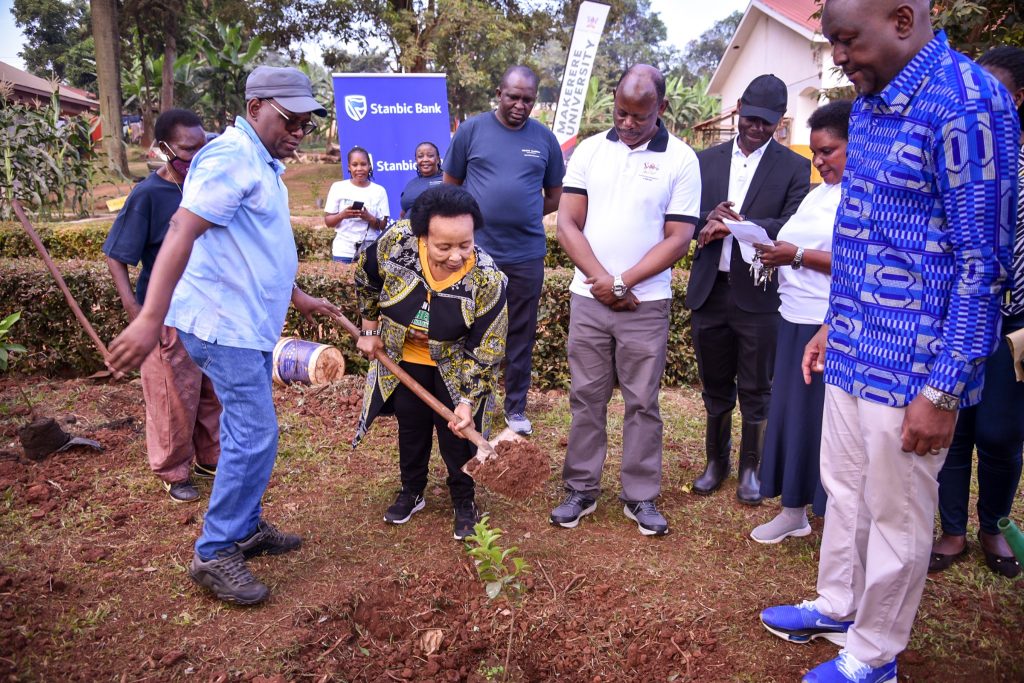
H.E Lulama Xingwana planting a tree as part of the community service activity.

After the school assembly, the visitors and guests planted fruit trees around the school compound. The fruit trees included mangoes, avocados, guavas and oranges. The trees were planted by the following parties; the South African High Commissioner, the Vice Chancellor, COO Stanbic Bank Uganda, KCCA (Kampala Capital City Authority) Administrator, a representative from Multichoice Uganda and lastly the Headmistress of the host school.

The Vice Chancellor Prof. Barnabas Nawangwe planting a mango fruit tree.

The delegates present proceeded to clean the school compound by sweeping, engaging in proper garbage disposal and later painting of the classrooms and pavements along the walkways of the school. The 67 minutes of community service were culminated by session speeches from the various partners present and the school administration.

In her speech, the Headmistress said, “I thank God for the grace and opportunity He has given us to receive you in our school and choosing us as an activity ground for commemorating Nelson Mandela Day. Makerere University Primary School is beautiful in that we have all it takes to make a good school and also have the opportunity to grow because we are accessible, have space, and at the same time connected to Makerere University as an institution of higher learning.

The Headmistress Mrs. Nabirye Juliet delivering her speech.

She further noted, “I would like to thank the Vice Chancellor for the support he always extends to the school through the School of Education and the Estates and Works Department. The School Management Committee has done well in terms of managing the school and Estates Department has contributed tremendously by providing us firewood and recently, it fenced the school with wire mesh and barbed wire. We are really grateful to have you.”

The Vice Chancellor and the South African High Commissioner painting one of the classrooms as part of the community service activities

The various organizations present donated a number of items which were received by the chief guests and the school administration. Among the donations rendered were; 70 trees by Tree Adoption Uganda, Gustro Book Centre which donated 2 boxes of children’s books and primary school textbooks. MTN Uganda donated yellow T-shirts, Coca Cola Uganda limited donated cartons of soda for the pupils, Plascon Uganda donated Paint, and the South African High Commission donated 10 garbage bins, cleaning materials, scholastic items, 100 kilograms of rice to staff, to mention but a few.


Headmistress Mrs. Nabirye Juliet Makerere University Primary school receiving a donation of dustbins from the South African High Commission.

Mak Editor

General

Makerere jumps 200 position in latest global rankings

Published

on

Screenshot of the Makerere University Ranking July 2026 - Webometrics Global Position. Kampala Uganda, East Africa.

Makerere University‘s position in the July 2026 edition of the Webometrics Rankings has improved from 925th to 776th globally and from 13th to 11th on the Continent, compared to the January 2026 edition. Makerere remains the top-ranked University in Uganda and East Africa.

The new rankings are as a result of improved performance in the Impact Rank, which measures the number of external domains referring/linking to Makerere (from 1,593 to 1,185) and the Excellence Rank, which measures Research papers in the top 10% most cited between 2019 and 2023 (from 1,095 to 715).

Please see the attached screenshots for details or view Makerere‘s rankings online using the link below:

https://www.webometrics.org/makerere-university

The Webometrics Ranking of World Universities aims to recognize and promote the digital transformation of higher education institutions by evaluating how effectively they reflect their academic, research, and societal contributions online.

We remain committed to ensuring that all our good work in teaching and learning, research, knowledge transfer, and partnerships continues to be reflected online through various journals and other platforms.

Mak Editor

Continue Reading

General

Call For Applications: ACT-PREP 15 PhD and 10 Postdoctoral Research Fellowships

Published

on

An aerial photo of Clockwise Top Left to Right: St. Francis Chapel, Main Building, CAES, JICA Building, Chemistry Building, Mathematics, School of Statistics, Main Library, Yusuf Lule Central Teaching Facility, CoBAMS, EPRC, IGDS and the Freedom Square. Makerere University, Kampala Uganda, East Africa.

Please find below a call for applications for 15 PhD and 10 Postdoctoral Research Fellowships in Clinical Trials and Epidemic Preparedness and Response (EPR) Research under the ACT-PREP project.

The ACT-PREP project aims to strengthen surveillance, ethics, pharmacovigilance, diagnostics, and policy foundations within Africa’s Emergency Preparedness and Response ecosystem.

The ACT-PREP Secretariat, in collaboration with its partners, is pleased to invite eligible applicants to apply for the fellowships, which are funded under the HORIZON-JU-GH-EDCTP3 programme.

Interested and eligible applicants are encouraged to review the attached call for detailed information on the fellowship opportunities, eligibility requirements, and application process.

Please share this opportunity widely with colleagues and potential applicants who may be interested.

Mak Editor

Continue Reading

General

Makerere Urges New Postgraduates to Drive Africa’s Research and Development Agenda

Published

on

L-R: Dr. Mike Barongo, Dr. Kizito Ongaya, Prof. Julius Kikooma and Prof. Sarah Ssali. Directorate of Graduate Training (DGT) Orientation of newly admitted postgraduate diploma and master’s students, under the theme “Harnessing the Power of Graduate Training to Transform Africa’s Research Trajectory”, 11th August 2026, Main Hall, Main Building, Makerere University, Kampala Uganda, East Africa.

By Moses Lutaaya

Makerere University has challenged newly admitted postgraduate diploma and master’s students to take ownership of their academic journey, produce knowledge that addresses Africa’s challenges and use their training to create opportunities for society.

The call was made on Tuesday, August 11, 2026, during the orientation of postgraduate diploma and master’s students held at the Main Hall, Main Building, Makerere University. The orientation was conducted under the theme “Harnessing the Power of Graduate Training to Transform Africa’s Research Trajectory.”

Addressing the students, Prof. Sarah Ssali, Deputy Vice Chancellor for Academic Affairs, said admission to postgraduate education marked an important transition from undergraduate study and should come with greater independence, critical thinking and responsibility.

“Postgraduate study is not just the accumulation of knowledge. You are now active researchers, critical thinkers and creators of your own knowledge,” Prof. Ssali said.

She said postgraduate training should enable students to deepen their expertise, strengthen their analytical abilities and develop solutions to real-world problems.

Prof. Sarah Ssali. Directorate of Graduate Training (DGT) Orientation of newly admitted postgraduate diploma and master’s students, under the theme “Harnessing the Power of Graduate Training to Transform Africa’s Research Trajectory”, 11th August 2026, Main Hall, Main Building, Makerere University, Kampala Uganda, East Africa.
Prof. Sarah Ssali.

“Through your projects, dissertations, innovations and professional practice, you have the opportunity to contribute knowledge that can influence policies, improve services and transform lives. Your research matters, and your contribution matters,” she said.

Prof. Ssali urged students to see their studies beyond the pursuit of a degree, encouraging them to ask themselves why they had chosen postgraduate education and what contribution they intended to make to their communities and professions.

“See your coursework as an opportunity to develop knowledge and skills that will help you propose new solutions to real-world challenges,” she said.

She also encouraged students to embrace collaboration with communities and non-academic partners, saying many of them were already coming to the University with professional and community experiences that could enrich their research.

“Don’t think that your scholarship is only for those who look academic. Embrace community, embrace networks,” she said.

Prof. Ssali further cautioned the students against wasting time, noting that many postgraduate students have employment, family and other responsibilities alongside their studies.

“Make the most of your time and don’t waste it,” she said, urging students to use available study time productively even when there are changes in their lecture schedules.

She also emphasised the need for students to take responsibility for their progress instead of waiting for lecturers or supervisors to push them.

“Postgraduate education requires independence, independent inquiry, independent research, independent interrogation and also active participation,” Prof. Ssali said.

Prof. Julius Kikooma, Director of Graduate Training, told the students that their admission was a significant achievement given the large number of applicants seeking postgraduate opportunities at Makerere.

“We received over 12,000 applications to our postgraduate programmes, but we are only able to take just a small percentage of that. That means you are just the few people who are able to do this,” Prof. Kikooma said.

He urged the new students to appreciate the opportunity and understand that graduate education carries responsibilities beyond attending lectures and completing examinations.

According to Prof. Kikooma, Uganda and Africa require highly trained human capital capable of driving national and continental development priorities.

“The country needs more highly trained people if it is going to achieve its aspirations and priorities for national development,” he said.

Prof. Julius Kikooma. Directorate of Graduate Training (DGT) Orientation of newly admitted postgraduate diploma and master’s students, under the theme “Harnessing the Power of Graduate Training to Transform Africa’s Research Trajectory”, 11th August 2026, Main Hall, Main Building, Makerere University, Kampala Uganda, East Africa.
Prof. Julius Kikooma.

He challenged the students to consider what Uganda and Africa would look like in the coming decades and to question whether the continent would continue relying on ideas, innovations and creations generated elsewhere.

“Will it still be a country that always depends on ideas, innovations and creations that come from outside?” he asked, before urging the students to become part of the generation that develops home-grown solutions.

Prof. Kikooma said much of what Uganda would need in the future would depend on what the country invests in today, particularly in human capital and research.

He also explained that the Directorate of Graduate Training works with colleges, schools, departments and central University units to strengthen the quality of graduate education.

“We want to make sure that what you are taking away from here is of a certain quality,” he said, adding that the University has established policies, standards and systems intended to create an environment in which postgraduate students can succeed.

However, Prof. Kikooma stressed that the University cannot take responsibility for the entire academic journey on behalf of students.

“We will not replace your programme. We will not replace your lecturers. We will not replace your supervisors. Each of those has a different role to play along your journey,” he said.

He encouraged students to be proactive by understanding their programmes, colleges and the various support services available to them.

“Successful graduates tend to be proactive rather than reactive. So don’t wait until you have a problem, then you start running from it,” Prof. Kikooma said.

He further urged the students to work within the stipulated programme period, noting that most master’s programmes take about two years while postgraduate diploma programmes generally take one year.

Prof. Robert Wamala, Director of Research, Innovations and Partnerships, urged the newly admitted students to use their graduate training to produce knowledge capable of addressing challenges facing their communities, Uganda and Africa.

He challenged them to move beyond consuming knowledge generated elsewhere and instead become producers of knowledge and solutions.

L-R: Dr. Mike Barongo, Dr. Kizito Ongaya, Prof. Julius Kikooma and Prof. Robert Wamala. Directorate of Graduate Training (DGT) Orientation of newly admitted postgraduate diploma and master’s students, under the theme “Harnessing the Power of Graduate Training to Transform Africa’s Research Trajectory”, 11th August 2026, Main Hall, Main Building, Makerere University, Kampala Uganda, East Africa.
L-R: Dr. Mike Barongo, Dr. Kizito Ongaya, Prof. Julius Kikooma and Prof. Robert Wamala.

Prof. Wamala emphasised the importance of connecting research to society, innovation and professional practice, encouraging students to identify problems within their workplaces and communities that could become areas for meaningful research.

He said Africa needed researchers capable of generating evidence, innovations and practical solutions to support development rather than simply importing solutions from other parts of the world.

The Director encouraged the students to build collaborative networks during their studies and to regard the University as an ecosystem in which researchers, professionals, communities and other partners can work together.

Dr. Kizito Ongaya, Deputy University Librarian, introduced the students to Makerere’s extensive library and information resources, urging them to make the library a central part of their postgraduate studies.

He said the University Library operates a hybrid system combining physical collections with electronic resources.

“We have over 200,000 types of books in our library, with 45 e-journal databases,” Dr. Ongaya said.

He encouraged students to make use of the University’s electronic databases, noting that substantial resources are invested in providing access to scholarly journals.

L-R: Dr. Mike Barongo, Dr. Kizito Ongaya, Prof. Julius Kikooma and Prof. Sarah Ssali. Directorate of Graduate Training (DGT) Orientation of newly admitted postgraduate diploma and master’s students, under the theme “Harnessing the Power of Graduate Training to Transform Africa’s Research Trajectory”, 11th August 2026, Main Hall, Main Building, Makerere University, Kampala Uganda, East Africa.
L-R: Dr. Mike Barongo, Dr. Kizito Ongaya, Prof. Julius Kikooma and Prof. Sarah Ssali.

“If you don’t use e-journals, you are unacceptable,” he told the students, emphasising that postgraduate research requires extensive engagement with scholarly literature.

Dr. Ongaya also highlighted the University’s archival collections, specialised libraries and information centres located across its colleges.

He said students would be guided on how to access both physical and electronic resources and encouraged them to explore specialised collections that could support their individual research areas.

Dr. Mike Barongo, Team Leader ICT, Department of the Academic Registrar, told the new students that Makerere had increasingly digitised its academic and administrative processes and urged them to complete their online registration as an immediate priority.

He said students could access their provisional admission letters through the online application system and use the student number provided to activate their student portals.

Dr. Mike Barongo. Directorate of Graduate Training (DGT) Orientation of newly admitted postgraduate diploma and master’s students, under the theme “Harnessing the Power of Graduate Training to Transform Africa’s Research Trajectory”, 11th August 2026, Main Hall, Main Building, Makerere University, Kampala Uganda, East Africa.
Dr. Mike Barongo.

“The student portal is very, very critical,” Dr. Barongo said.

He explained that students must enrol and register in order to access key University services, including institutional email and Wi-Fi.

“Once you enroll, you create an institutional email address. That institutional email address is the gateway for you to access so many things, like Wi-Fi,” he said.

Dr. Barongo also informed students that ICT support centres were available to assist those experiencing challenges with enrolment, registration or access to digital services.

Mr. George Mugabi Turyamureeba. Directorate of Graduate Training (DGT) Orientation of newly admitted postgraduate diploma and master’s students, under the theme “Harnessing the Power of Graduate Training to Transform Africa’s Research Trajectory”, 11th August 2026, Main Hall, Main Building, Makerere University, Kampala Uganda, East Africa.
Mr. George Mugabi Turyamureeba.

He urged students to ensure they enrol and register every semester so that the University systems can accurately capture their academic and financial information.

Others senior members in attendance include the Deputy University Bursar Mr. George Mugabi Turyamureeba and Mr. Henry Nsubuga, the Manager Makerere University Counselling and Guidance Centre.

Mr. Henry Nsubuga. Directorate of Graduate Training (DGT) Orientation of newly admitted postgraduate diploma and master’s students, under the theme “Harnessing the Power of Graduate Training to Transform Africa’s Research Trajectory”, 11th August 2026, Main Hall, Main Building, Makerere University, Kampala Uganda, East Africa.
Mr. Henry Nsubuga.

Mak Editor

Continue Reading

Trending