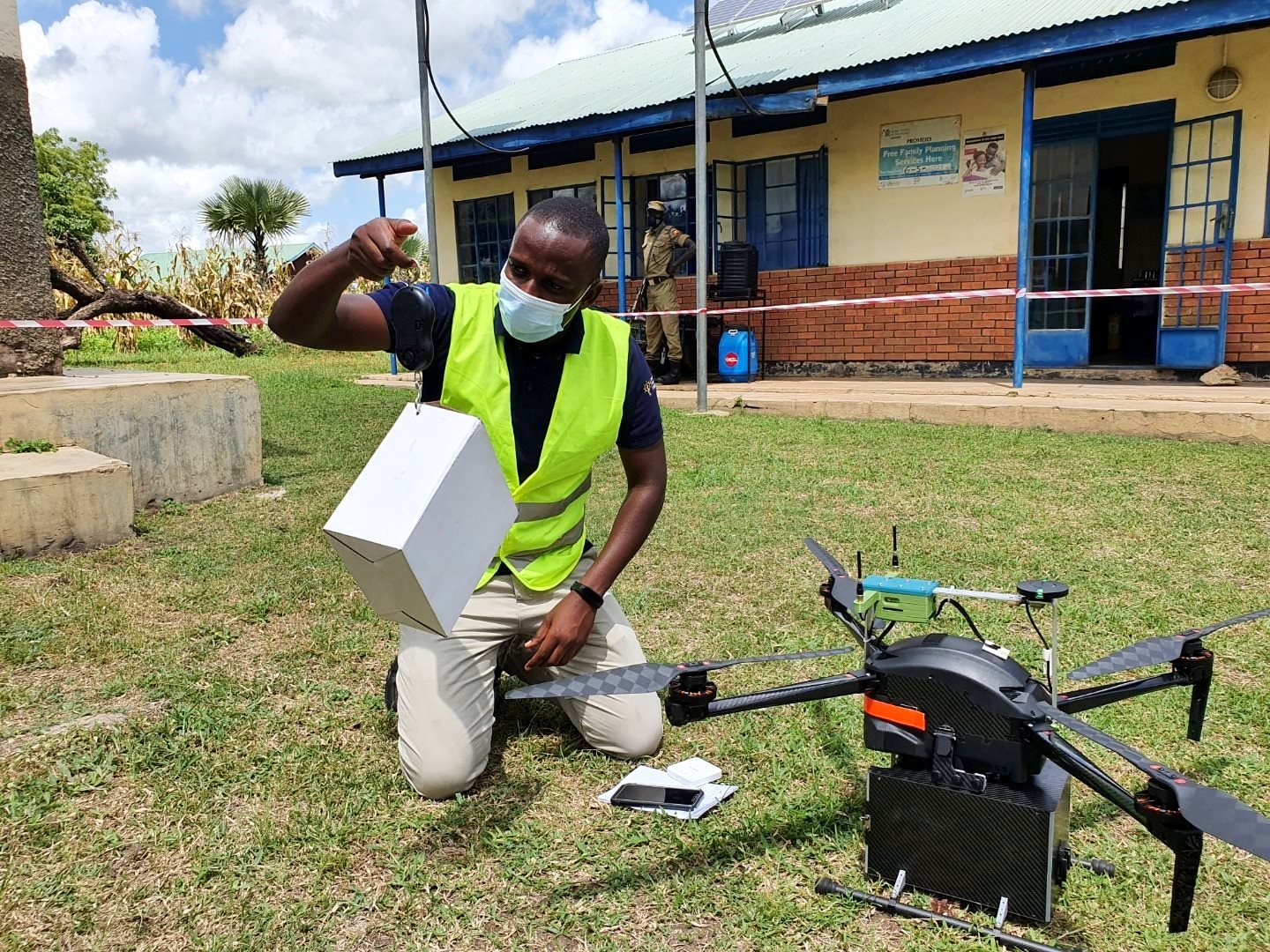
The Infectious Diseases Institute at Makerere University, with funding and technical assistance from the United Nations Capital Development Fund (UNCDF), officially launched a project to pilot the use of medical drone technology in the West Nile districts of Moyo and Adjumani. This project will support surveillance mechanisms, early reporting of any health threats or outbreak indicators within the systems, including rapid response to COVID-19.
Drone technology has the potential to solve several challenges that make the delivery of health care services particularly difficult in the West Nile. With geographical barriers like difficult terrains and very remote areas, drones can solve a piece of the logistical puzzle. They can transport test samples within drastically reduced timelines, kickstarting timely treatments. The project will be using two different drone types; a multi-rotor for short distances, up to 30km, and a fixed-wing drone for longer distances; over 30km.
This research project will assess the efficiency and effectiveness of drone deliveries as a viable solution for Uganda’s health sector. This is done in close collaboration with the health service teams on the ground, to ensure that the drones actually solve part of the puzzle, contributing to the sustainability of this solution.
Livelihood activities such as farming, livestock keeping, construction, and night-time work significantly increase malaria risk in Uganda, according to new research by Dr Kevin Deane, a development economist at The Open University, UK, and Dr Edwinah Atusingwize and Dr David Musoke, a Research Associate and Associate Professor of Environmental Health at Makerere University School of Public Health, respectively.
The study, Livelihoods as a key social determinant of malaria: Qualitative evidence from Uganda, published on December 2, 2025, in the journal Global Public Health, examines how everyday economic activities shape exposure to malaria, often undermining conventional prevention measures such as insecticide-treated nets and indoor residual spraying. The findings are based on qualitative fieldwork conducted in June 2024 in Busiro County, Wakiso District, a peri-urban area with persistently high malaria transmission in Uganda.
Using a qualitative design, the researchers conducted 14 key informant interviews, 10 focus group discussions, and 11 in-depth interviews with households recently affected by malaria, engaging 100 participants from communities, health services, local government, and civil society across Kajjansi, Kasanje, and Katabi Town Councils, as well as Bussi Sub-County, in Busiro South. Their analysis, guided by the Dahlgren–Whitehead social determinants of health model, enabled the researchers to situate malaria risk within the broader social, economic, and environmental conditions shaping how people live and work.
Dahlgren and Whitehead model of the social determinants of health. Source: internet.
In their findings, participants linked malaria exposure to agricultural practices, among which is maize cultivation near homes, which was associated with increased mosquito density during the rainy season. “One of the most common crops cultivated in Uganda, which many rely on as staple foods, creates environments in which mosquitoes are attracted to and thrive, often in settings where maize is grown near homes in rural areas and urban areas. This increases mosquito density around homes and contributes to increased outdoor biting and the number of mosquitoes entering houses,” the study argues.
Its authors say this poses a difficult policy challenge because maize is central to household food security, leaving few practical options for reducing exposure. They argue that proposals to keep maize away from homes are often unrealistic for families with limited land or those farming in urban areas, while targeted control during flowering periods may have limited impact given mosquitoes’ ability to travel beyond cultivation sites.
Screenshot of the open-access research article “Livelihoods as a key social determinant of malaria: Qualitative evidence from Uganda,” published in Global Public Health on December 2, 2025.
Beyond crop farming, the study reports that livestock rearing, especially zero-grazing cattle kept close to houses, attracts mosquitoes into household compounds. Other livelihood activities, including construction and brick-making, created stagnant water-filled pits that served as breeding sites, while night-time livelihoods, such as street vending, guarding, fishing, bar work, and brick burning, among others, prolonged outdoor exposure during peak mosquito biting hours. Gender further shaped risk, with women’s livelihoods and caregiving responsibilities frequently exposing young children alongside them.
“The evidence we present illustrates the unintended health consequences of development strategies intended to promote key livelihood activities, food security, and poverty reduction. There are no straightforward solutions given the complexity of these relationships and the importance of these livelihoods for many households,” the authors assert.
They conclude that malaria elimination efforts will fall short unless livelihoods and development activities are explicitly integrated into malaria prevention strategies, calling for stronger alignment between public health, agriculture, urban development, and economic policy.
Makerere University College of Health Sciences (MakCHS) continues to advance its internationalization agenda by strengthening cross-border partnerships and expanding student and staff mobility in response to global health training needs. Recognizing international collaboration as a cornerstone of contemporary health professional education, the College has established strategic partnerships with leading institutions, including the University of the Western Cape (South Africa), the Medical University of Graz (Austria), and Universitas Syiah Kuala Faculty of Medicine (Indonesia). These collaborations focus on joint research initiatives and the training of dentists and physicians.
Ms. Lydia Kabiri, Department of Nursing giving a lecture to students from Trinity College Dublin.
During the period July–September 2025, MakCHS recorded increased inbound student mobility, hosting 86 short-term international students. The majority (73%) came from eight partner institutions, with Europe accounting for 64% of all inbound students. Norway led with students from the University of Bergen and the University of Agder, followed by Italy and the Netherlands. The College also hosted students from Somalia International University, Moi University (Kenya), and institutions in the United States. Most visiting students were medical trainees, with placements mainly in Paediatrics at Mulago National Referral and Teaching Hospital, as well as Emergency Medicine and Obstetrics & Gynaecology at Kawempe National Referral Hospital.
Masaba Swabra (Left ) and Orishaba Patience (Right) during rotation at Cambridge Institute.
These exchanges demonstrated strong bilateral commitment, notably with the Medical University of Graz, which sent students to MakCHS while simultaneously hosting MakCHS students, even in the absence of Erasmus Mundus Plus funding. Inbound mobility enriched the learning environment through intercultural exchange, inclusiveness, and exposure to diverse clinical and academic perspectives.
Victorious Mangheni (Left), Evelyn Nairuba (2nd Left) and residents in the University of Minnesota Medical center -Fairview Hospital.
Outbound mobility also expanded significantly. MakCHS students undertook clinical rotations in the United Kingdom, the United States, and Austria. Two students completed hematology and oncology rotations at Addenbrooke’s Hospital, Cambridge, while others trained in plastic and reconstructive surgery at the University of Minnesota Medical Center–Fairview. Additional students undertook highly specialized rotations in paediatric surgery, orthopaedics, neurosurgery, and cardiac surgery at the Medical University of Graz, gaining exposure to advanced, patient-centred healthcare systems and strengthening their global clinical outlook.
Left to Right: Iris Topolovec PR Bilateral agreements, Asha Nagawa, Muruhuura Matthias and Eva Weixler Rotations coordinator.
Staff outward mobility was equally notable. Several MakCHS staff and graduate students participated in the Annual Global Health Conference organized by NUVANCE Health, an international partner. MakCHS faculty contributed through presentations, posters, and panel discussions, highlighting research on decolonization in global health education, adolescent health, and global mental health. These engagements provided valuable networking opportunities with global health funders and reinforced the importance of transnational academic partnerships in advancing health equity.
Dr. Muyanja Mark (Left), Prof. Rudy Ruggles (Centre) and Dr. Melanie Magoba, 3rd year Psychiatry resident.
Through sustained partnerships, increased mobility, and active global engagement, MakCHS continues to position itself as a key contributor to global health education, research, and practice.
Makerere University has taken a decisive step in strengthening Uganda’s and Africa’s capacity for public safety, disaster preparedness, and climate resilience with the official launch of the China–Uganda Belt and Road Joint Laboratory on Natural Disaster Monitoring and Early Warning, a flagship collaboration with Tsinghua University of China.
Launched during the Makerere University–Tsinghua University Symposium on Public Safety and Natural Disaster Management, the Joint Laboratory positions Makerere as a continental hub for cutting-edge research, innovation, and policy-relevant solutions in disaster risk reduction, early warning systems, and emergency response. The Laboratory will be hosted by Makerere University and is the only facility of its kind in Africa under this cooperation framework, underscoring its regional and global significance.
A Strategic Partnership Rooted in Research, Policy, and Practice
In his opening remarks, Prof. Barnabas Nawangwe, Vice-Chancellor of Makerere University and Ugandan Co-Director of the Joint Laboratory, traced the origins of the partnership to 2018, when a Makerere delegation visited Tsinghua University and the Hefei Institute for Public Safety Research. He recalled being deeply impressed by China’s advanced capacity in public safety research, disaster monitoring, and emergency management capabilities that directly respond to Uganda’s growing exposure to floods, landslides, epidemics, and other hazards.
The Vice-Chancellor noted that the successful establishment of the Joint Laboratory followed a competitive grant process under China’s Belt and Road Initiative, supported by the Government of Uganda and regional partners, including Nigeria and Côte d’Ivoire. He emphasized that the Laboratory aligns squarely with Makerere’s strategic ambition to become a research-led and research-intensive university, while also advancing its internationalisation agenda.
Prof. Barnabas Nawangwe addressing the Symposium participants.
“This Laboratory will significantly enhance Makerere University’s ability to generate evidence-based research that directly informs government policy and public safety interventions. It will serve not only Uganda, but Africa at large,” Prof. Nawangwe said.
He further underscored the Laboratory’s national importance, noting that similar facilities in China are regarded as national-level laboratories, entrusted with supporting government decision-making and national resilience. Relevant Ugandan institutions, including the Office of the Prime Minister (OPM), UPDF, Uganda Police, Ministry of Health, and humanitarian actors, are expected to actively participate in the Laboratory’s work.
Tsinghua University: Advancing Science Diplomacy and South–South Cooperation
Speaking on behalf of Tsinghua University, Prof. Yuan Hongyong, Dean of the Hefei Institute for Public Safety Research and Chinese Co-Director of the Joint Laboratory, described the initiative as both a scientific milestone and a powerful demonstration of South–South cooperation.
He emphasized that natural disasters transcend national borders and demand collective, science-driven responses. By combining Tsinghua’s technological expertise, including satellite monitoring, AI-driven analytics, and integrated early warning systems, with Makerere’s deep regional knowledge and policy engagement, the Joint Laboratory provides a robust platform for innovation, applied research, and practical solutions tailored to African contexts.
Prof. Yuan Hongyong giving his remarks during the symposium.
The Laboratory will function not only as a research centre, but also as an operational platform for natural hazard monitoring, early warning, risk assessment, and capacity building, supporting Uganda and the wider African region in building more resilient communities.
Government of Uganda: Research as a Pillar of National Resilience
Representing the Office of the Prime Minister, Mr Frederick Edward Walugemba, reaffirmed the government’s strong support for the Joint Laboratory, recognizing research as a cornerstone of effective public safety and disaster management. The OPM highlighted its constitutional mandate to coordinate disaster preparedness and response through institutions such as the National Emergency Coordination and Operations Centre (NECOC).
He mentioned that the Office of the Prime Minister is committed to working closely with Makerere University and its partners, underscoring the importance of multi-agency collaboration, robust data systems, and timely policy advisories to address the complex, multidimensional nature of public safety challenges.
China–Uganda Relations and the Role of Science Diplomacy
Mr. WANG Jianxun, Commercial Counsellor of the Embassy of the People’s Republic of China in Uganda, lauded the Joint Laboratory as a concrete outcome of the growing China–Uganda Comprehensive Strategic Partnership. He emphasized that the collaboration reflects China’s commitment to knowledge sharing, technology transfer, and people-centred development, particularly in areas such as climate adaptation, disaster risk reduction, and sustainable development.
He also highlighted the Belt and Road Initiative as a framework that extends beyond infrastructure to include scientific cooperation, academic exchange, and innovation-driven development, with the Joint Laboratory standing as a model of how universities can advance diplomacy through science.
In his concluding remarks, Prof. Nawangwe reaffirmed Makerere University’s readiness to operationalize the Laboratory through a multidisciplinary research team spanning public health, geography, engineering, computing, artificial intelligence, social sciences, and the built environment.
He stressed that effective disaster management must integrate technology, human behaviour, governance, and community engagement, noting the importance of sociological insights in addressing risk perception and public compliance during disasters. Makerere will also engage emerging universities and regional partners to ensure the Laboratory’s benefits are widely shared.
Mr Frederick Walugembe, representing the Prime Minister at the Symposium.
The Vice-Chancellor also commissioned an interim, multidisciplinary coordination committee to operationalise the Joint Laboratory, drawing expertise from health, climate science, engineering, artificial intelligence, social sciences, and government agencies.
Hon. John Chrysostom Muyingo Officially Launches the Laboratory
The Joint Laboratory was officially launched by the Honourable John Chrysostom Muyingo, Minister of State for Higher Education, who applauded Makerere University and Tsinghua University for securing the prestigious grant and advancing Uganda’s science and research agenda.
Honourable John Chrysostom Muyingo giving his speech at the Symposium.
Hon. Muyingo reaffirmed the Government’s commitment to supporting research that informs national development, public safety, and disaster preparedness. He urged Ugandan researchers to fully leverage the partnership to learn from China’s experience in transforming research into actionable solutions for society.
“This Laboratory is a clear demonstration of how strategic international partnerships can strengthen national capacity, inform policy, and protect lives,” the Minister said, as he formally declared the symposium and laboratory launch open.
Positioning Makerere as a Regional Centre of Excellence
Makerere University already plays a critical role in public safety, disaster preparedness, and early warning through a range of research, training, and operational partnerships. Through the School of Public Health (MakSPH) and the Infectious Diseases Institute (IDI), the University has led national and regional initiatives in epidemic preparedness, emergency response, and early warning, including Field Epidemiology Training, risk prediction modelling, and multi-hazard risk assessments that inform district and national preparedness planning. A national assessment of 716 health facilities conducted by MakSPH revealed widespread exposure to climate-related hazards and systemic preparedness gaps, directly informing the Ministry of Health’s Climate and Health National Adaptation Plan (H-NAP 2025–2030)
Makerere has also been at the forefront of disaster risk reduction innovation and community resilience through the Resilient Africa Network (RAN), which has supported scalable, evidence-based solutions such as EpiTent, a rapidly deployable emergency health facility; RootIO, a community-based radio communication platform used for risk communication and early warning; and RIAP Horn of Africa, which advances climate-resilient water harvesting technologies for drought-prone pastoralist communities.
From Left to Right: Prof. Yuan Hongyong, Honourable John Chrysostom Muyingo, Mr WANG Jianxun, Prof. Barnabas Nawangwe, Prof. Rhoda Wanyeze and Dr. Andrew Kambugu as they officially launched the China–Uganda Belt and Road Joint Laboratory on Natural Disaster Monitoring and Early Warning.
Earlier, the University led the USAID-funded PeriPeri U project (2014–2019) and a disaster management collaboration with Tulane University, strengthening applied research, training, and early warning systems across Africa, efforts that laid the foundation for RAN and Makerere’s current disaster resilience agenda.
In collaboration with government and international partners, Makerere has supported the strengthening of Emergency Operations Centres, including the development of Regional Emergency Operations Centre (REOC) dashboards to improve real-time coordination and situational awareness. IDI has further contributed to epidemic intelligence and early warning, supporting districts to update WHO STAR-based risk calendars, strengthen sub-national preparedness, and enhance real-time decision-making during outbreaks. Makerere teams have also been deployed regionally to support Marburg and Mpox outbreak responses in Rwanda and the DRC, while advancing outbreak modelling as an early warning tool for high-consequence infectious diseases.
Complementing these efforts, the Department of Geography, Geo-Informatics and Climatic Sciences conducts transdisciplinary research on floods, landslides, droughts, soil erosion, and land-use change, using geospatial analysis, earth observation, modelling, and participatory methods to translate complex data into actionable early warning and risk information for policymakers and communities. These ongoing initiatives collectively demonstrate Makerere University’s established capacity in public safety, disaster preparedness, and early warning, providing a strong operational and scientific foundation for the China–Uganda Belt and Road Joint Laboratory.
With strong backing from the Governments of Uganda and China, as well as leading international partners, the China–Uganda Belt and Road Joint Laboratory on Natural Disaster Monitoring and Early Warning is poised to become a regional centre of excellence for disaster risk reduction research, training, and innovation.
The Laboratory will contribute to improved early warning systems, faster emergency response, stronger policy coordination, and enhanced scientific capacity, cementing Makerere University’s role at the forefront of addressing some of the most pressing public safety challenges facing Uganda, Africa, and the global community.
Caroline Kainomugisha is the Communications Officer, Advancement Office Makerere University.