General
Call for Applications: Undergraduate Programmes 2018/2019
Published
8 years agoon

The Academic Registrar, Makerere University invites applications for the undergraduate programmes under the private sponsorship scheme for the 2018/2019 Academic Year.
The details are as follows:
Each applicant should:
EITHER
Have the Uganda Certificate of Education with at least (five passes), or its equivalent and at least two principal passes at Advanced Level obtained at the same sitting. For day programmes, only candidates who sat "A" Level in 2017, 2016 and 2015 are eligible to apply. For Evening, Afternoon, and External programmes, a candidate is not restricted on the year of sitting "A" Level.
OR
Hold at least a Second Class or Credit (or equivalent classification) Diploma from a recognised institution, relevant to the programmes applied for. ( Details of the Diploma Admission requirements can be viewed on the notice boards of the Undergraduate Admissions Office or by following the link: https://www.mak.ac.ug/application-procedures/diploma-holders . Certified copies of academic transcripts and Certificates (not photocopies of certified copies) from the awarding Institutions and one Passport size photography MUST be submitted to Office 315 Level three (3) Senate Building after applying online.
OR
Be a Graduate from a recognised university. Certified copies of academic transcripts (not photocopies of certified copies) from the awarding Institutions and one Passport size photography MUST be submitted to Office 315, Level three (3) Senate Building after applying online.
Non-refundable application fee of UG Shs.50,000/= for Ugandans, East African and S. Sudan applicants or UG Shs.172,500/= for International applicants plus Bank charge of UG Shs.2,750/=should be paid from the following banks using Makerere University Paying-in-slips:
Banks
(A) Any STANBIC BANK BRANCH MUC – FEES COLLECTION ACCOUNT 9030005866749
(B) DFCU BANK MAKERERE BRANCH MUC – FEES COLLECTION ACCOUNT 01083500181477
(C) CENTENARY BANK MUC – FEES COLLECTION ACCOUNT 3740300001
(D) Any POST BANK BRANCH MUC – FEES COLLECTION ACCOUNT 1630037000063
Candidates who hold grades X, Y, Z, 7 and 9 of 'O' Level results should not apply because they are Not eligible for admission.
Diploma holder applicants who hold class three (3) Diploma Certificates are not eligible for admission and therefore should not apply, except where stated in the diploma holders requirements.
WARNING:
Applicants are strongly warned against presenting forged or other people's academic documents to support their applications for admission. The consequences, if discovered, are very grave indeed.
Cut-Off Points for the respective Academic Programmes to guide you in making choices for courses and programmes may be found here.
For further enquiries, please contact the Academic Registrar's Office through the addresses at the link below:
https://www.mak.ac.ug/university-services/academic-registrar
- Applicants should access the Institution's Admissions URL http://admissions.mak.ac.ug
- Signup using full name, e-mail and Mobile No. Please note that your name must be similar to the one on your supporting academic documents for your application to be considered valid. If you changed your names please go to Senate Building Office 301 with an affidavit supporting the name change.
- A password will be sent to both your e-mail and mobile number.
- The system will prompt you to change the password to the one you can easily remember.
- To fill a form the applicant clicks on the APPLY NOW button displayed on the running scheme..
- Obtain a payment advice slip by clicking on "Pay for Form" button (Take note of the Application Number generated by the system, it is required by the Bank to effect payment)
- Make a payment at any of the following Banks:
- Stanbic Bank
- Post Bank
- Centenary Bank
- DFCU Bank
You may like
General
Reflecting on Strides made in Championing Inclusive Education
Published
20 hours agoon
December 1, 2025By
Eve Nakyanzi
Makerere University today joined the global community in marking the International Day of Persons with Disabilities, a moment dedicated to reflection on inclusion and shared responsibility. As the world pauses to honor the dignity and leadership of persons with disabilities, the University is using this year’s commemoration to reaffirm its commitment to building a campus where every individual is supported to thrive. The day is not only a celebration of resilience and contribution, but also a call to the wider community—students, staff, policymakers, and partners—to actively participate in shaping an environment where accessibility, understanding, and respect are woven into everyday practice. Through this observance, Makerere positions itself once again as a champion of inclusive education and a beacon for transformative change.
Tangible gains made
During her address at the event held in the Main Hall, the Chief Guest, Hon. Hellen Grace Asamo, Minister of State for Disability Affairs, paid tribute to Makerere University’s leadership, longtime advocates like Mrs. Safia Nalule, and the many individuals who have advanced disability rights from the early years of mere “talking” to the tangible gains seen today. Speaking candidly, she emphasized that disability is often shaped by societal attitudes rather than physical conditions alone, urging families, institutions, and communities to confront stigma at its roots. Drawing from her own educational journey and the barriers she faced—including inaccessible learning spaces, limited course options, and discriminatory hiring practices—she reminded the audience that inclusion must go beyond numbers to genuine opportunity.

Hon. Asamo’s message to persons with disabilities was equally empowering: visibility and assertiveness are essential in claiming space, shaping policy, and influencing resource allocation. With examples from government reforms, improvements in accessibility, and efforts to standardize sign language interpretation, she underscored that progress is possible when commitment meets intentional planning. Her remarks reinforced a powerful truth—disability inclusion is a right, not a favour—and institutions like Makerere must continue leading the way in creating environments where every individual can participate, contribute, and thrive.
The keynote speaker Hon. Safia Nalule Jjuuko, Chairperson of the Equal Opportunities Commission and a former Member of Parliament representing persons with disabilities for 15 years, delivered a keynote rich in personal testimony, institutional memory, and policy insight. She reflected on her own journey as a student—navigating inaccessible buildings, exhausting practical sessions, and discouraging attitudes—to illustrate how far the University and the country have come in strengthening inclusion. A proud alumna of Makerere, she celebrated the progress made, including improved infrastructure and increased representation of persons with disabilities in national leadership. She however highlighted that gaps remain, particularly the shortage of appropriately trained lecturers capable of supporting learners with disabilities across all levels of education.

Drawing from her work at the Equal Opportunities Commission, she emphasized the constitutional mandate to eliminate discrimination, promote affirmative action, and ensure a just and fair society for every Ugandan. Hon. Nalule unpacked the theme of the day by highlighting the global shift toward disability-inclusive development, stressing that concepts like intersectionality, “leaving no one behind,” and cross-cutting inclusion all speak to the same truth: inclusive planning is central to sustainable progress. She reminded the audience that disability is an evolving concept shaped by environmental barriers, negative attitudes, and lack of social support—and that participation, consultation, and awareness must always place persons with disabilities at the centre as experts of their own experiences.
Citing national statistics, policy frameworks, and ongoing reforms such as gender and equity budgeting, she challenged institutions like Makerere to engage actively in national planning processes, interrogate the cost of exclusion, and prepare graduates—especially those with disabilities—to benefit from Uganda’s development priorities in agriculture, manufacturing, tourism, and services. Her address was both a celebration of progress and a call to action: a reminder that meaningful inclusion requires attention to detail, responsive planning, and intentional investment so that every student, regardless of ability, can participate fully and contribute to national transformation.

Makerere upholds responsiveness
The Acting (Ag.) Vice Chancellor Prof. Sara Ssali reaffirmed Makerere University’s commitment to building an inclusive campus that models the kind of responsive institutions needed for social progress, stressing that inclusion requires both empowering marginalized people and adapting institutional structures so they no longer have to “fit in.” Drawing on Makerere’s long record of intentional policies—from improved physical accessibility and the Disability Support Centre to inclusive teaching practices, staff training, and collaborations—she highlighted practical steps the University has taken while acknowledging more work remains, especially around intersectionality and tailored support for diverse disabilities.

Prof. Ssali urged departments to mainstream disability concerns in planning and budgeting, praised the everyday care provided by wardens and support staff, and called for research, innovation and accountability so that students and staff with disabilities can fully participate and contribute. She closed by renewing Makerere’s pledge to remove barriers and nurture the next generation of inclusive leaders.
Mr. Amon Muteganda, who represents staff living with disabilities on the University Council, reaffirmed Makerere’s identity as an inclusive institution, noting that whenever disability-related concerns are raised in Council, members listen attentively and respond with genuine commitment. He expressed appreciation to University Management for consistently acting on issues brought forward, highlighting recent improvements such as the introduction of dedicated transport for students and staff with disabilities—a proposal he and colleagues championed and which has now come to fruition. He highlighted the importance of representation at multiple levels of the institution, demonstrating that Makerere’s inclusivity efforts are not symbolic but actively shaping policy, practice, and everyday experiences for persons with disabilities.

Dr. Winifred Kabumbuli, the Dean of Students, highlighted Makerere University’s deliberate efforts to foster a campus where every learner feels supported and able to thrive. She spoke about the active implementation of the University’s policy for persons with disabilities, alongside the safeguarding policy, both aimed at ensuring the welfare and dignity of all students. Dr. Kabumbuli pointed to the expanding range of accessible accommodation—such as designated halls for students with disabilities and the newly refurbished Mary Stuart Hall equipped with an elevator—as well as campus-wide additions like ramps, elevators, and accessible pathways.

She also emphasized the growing availability of assistive devices, including wheelchairs, Braille materials, and white canes, together with academic support measures such as extra time and readers during examinations. Her remarks captured Makerere’s intentional approach to inclusion, one that enables students with disabilities to navigate university life with comfort, confidence, and equal opportunity.
A student speaks out
First-year architecture student Sabiri Mungufeni shared a heartfelt account of his transition into university life, describing both his initial worries and the encouragement he found upon arriving at Makerere. He recalled fearing how his disability would fit within the demanding academic environment of the College of Engineering, Design, Art and Technology, especially when he discovered that much of the work in architecture is still done manually. Yet through determination and the support of staff and peers, he quickly realized he could excel. Sabiri noted that seeing other students with disabilities walking confidently across campus inspired him to believe he, too, belonged. He expressed hope that, as inclusion continues to deepen, students with disabilities will be able to pursue a wider range of academic programs beyond the usual pathways, demonstrating—like many trailblazers before him—that ability is not defined by limitation but by opportunity and support.

Personal accounts urge sustained momentum
The event also featured a dynamic panel discussion moderated by Dr. Diana Ateenyi Ahumuza, offering a blend of academic, experiential, and advocacy-based perspectives on disability inclusion. The panel brought together Dr. Naboth Rwakazwaire, founder of Hope for People with Disabilities; Prof. Anthony Mugagga, Principal of the College of Education and External Studies (CEES); Lord Councillor Peace Sserunkuma; and Ms. Catherine Nakibuuka, a second-year law student. Their conversation explored practical solutions, policy gaps, personal experiences, and the role of institutions like Makerere in shaping a more inclusive society.

Prof. Frank Norbert Mwiine, the Ag. Deputy Vice Chancellor (Finance and Administration) and Principal of the College of Veterinary Medicine, Animal Resources and Biosecurity (CoVAB), delivered the closing remarks by thanking all participants for their thoughtful contributions and the spirit of unity shown throughout the commemoration. He emphasized that inclusion is not a one-day event but an ongoing responsibility that requires empathy, patience, and deliberate action from every member of the Makerere community.

Drawing from personal experience and lifelong lessons of compassion, he encouraged staff and students to cultivate genuine sensitivity toward the needs of persons with disabilities and to champion inclusion in both mindset and practice. Prof. Mwine acknowledged the progress made—including accessible infrastructure, strengthened policies, and dedicated support services—while urging continued investment, collaboration, and accountability to ensure that Makerere becomes a place where all individuals can thrive without barriers. He ended by calling on the University to sustain the momentum built during the commemoration and to work together in building a more inclusive Makerere and Uganda.

General
From Mastercard Foundation Scholar to Changemaker: Dr. Ekwaro Ronald’s Vision for Eye Health in Uganda
Published
1 day agoon
December 1, 2025
Dr Ekwaro Ronald, a Mastercard Foundation Scholars Program Alumni at Makerere University, is committed to enhancing eye health in Uganda. He plans to establish the country’s first Myopia Control Centre, dedicated to safeguarding the eye health of young people in Uganda and neighbouring nations. This goal is within reach, given his experience and commitment. At present, he is gaining valuable experience in the Optometry Department at Mengo Hospital, one of Uganda’s largest private hospitals. His dedication and efforts were recognised last year when he received the hospital’s best optometrist award.
His Early Life
Ronald was born on May 5, 1997, in the Oyam District of Northern Uganda. He is the youngest of eight siblings, comprising six boys and two girls. Tragically, Ronald’s father, a primary school teacher, passed away just two months after his birth. This loss placed Ronald and his seven siblings under the care of their mother, a single parent and smallholder farmer, who became the sole provider for the family.
Early Education
Ronald took a unique path in his education, starting school at the age of seven at Alutkot Primary School in his neighbourhood. With his elder brother’s encouragement and support, he completed Primary Five. He then moved on to Masindi Army Day Primary School for Primary Six, where he was supported and lived with his other elder brother, who served in the army at the time. For Primary Seven, Ronald returned to his village home and completed his primary leaving examinations at Loro Primary School. Despite the challenge of walking approximately 2 kilometres to attend school, he demonstrated determination and resilience in his pursuit of education.

Secondary Education
Despite the challenges he faced and the frequent changes of educational institutions, he completed Primary Seven with a first-grade distinction. One of his elder brothers, a primary school teacher, provided financial support for his continued education. Consequently, Ronald was enrolled as a boarding student at Blessed Comboni Secondary School in Kiryandongo District. However, due to financial constraints stemming from his brother’s limited income, he transferred to Masindi Army Secondary School in his second year. This transition occurred under the Universal Secondary Education (USE) programme, an initiative of the Ugandan government that offers free secondary education to young individuals from communities facing social and economic barriers.
While attending Blessed Comboni Secondary school, he lived with his elder brother in a military barracks, which exposed him to military life from an early age. This experience of living in an army environment significantly shaped his fearless and resilient character, enabling him to navigate the challenges of growing up without a father.
In 2014, he performed excellently in his Form Four final examinations, earning a first-grade qualification. Afterwards, he received support for his A-Level studies through BRAC-Uganda in partnership with the Mastercard Foundation Scholars Program. He then joined Seeta High School Green Campus in Mukono, where he studied Physics, Chemistry, and Biology (PCB).
Joining Makerere University
In 2017, after excelling in his final A-Level exams, he once again became a Mastercard Foundation Scholar at Makerere University through the Mastercard Foundation Scholars Program, to pursue a Bachelor of Science in Optometry, a four-year eye healthcare programme at the College of Health Sciences.

“I chose Optometry because of my passion for optics and physics. At Seeta High School Green Campus, I was the only student to score an A in Physics in the 2016 Form Six final examinations. I wanted to combine my knowledge of Physics and Biology to help improve people’s vision,” Ronald explains.
While pursuing his studies at Makerere University, Ronald’s life transformed for the better, largely due to the robust support from the Mastercard Foundation Scholars Program. The support provided him with the opportunity to support his family while continuing his education. Notably, he utilised a portion of his monthly stipend to help his elder sister with her tuition for her final semester of nursing school, exemplifying the impact of his journey on his life and his family’s lives.
Ronald took proactive steps to kickstart his career as an Optometrist even before graduating. While studying at the University, he sought out various learning experiences and volunteer opportunities in eye care facilities to enhance his practical skills. His volunteer work at Dr. Agarwal’s Eye Hospital and Lapaire significantly enriched his curriculum vitae and provided invaluable hands-on experience in the field.
“I did not wait for graduation to pursue my career aspirations as an optometrist. From the beginning of my academic programme, I actively sought opportunities and volunteered at Dr Agarwal’s Eye Hospital and Lapaire. These experiences greatly enriched my curriculum vitae. I encourage fellow students at the university to begin exploring opportunities while still enrolled, as gaining relevant experience is vital for meeting the expectations of prospective employers upon graduation.” Ronald advises.
Life After Makerere University
Upon graduating from Makerere University in 2022, Ronald navigated the job market with remarkable ease, thanks to the strategic internships and volunteer positions he pursued during his studies. His proactive networking efforts paid off when he received an invitation to apply for a position at Mengo Hospital. Just two days before graduation, he was among three candidates shortlisted for interviews. This allowed him to celebrate his graduation with a sense of accomplishment, knowing he had already secured a job. He began his new role at the hospital shortly after graduation, marking the start of an exciting new chapter in his career.

His Professional Life as an Optometrist at Mengo Hospital
Over the past three years at Mengo Hospital, Ronald has demonstrated professionalism, a sentiment echoed by his colleagues. His unwavering commitment to prioritising patients’ interests has not only earned him the 2024 Best Optometrist award at the Eye Department but also emphasised the positive impact of his work. Beyond his clinical duties, Ronald has developed a strong research interest. He is currently in the advanced stages of securing a grant from the World Council of Optometrists to study the progression of myopia (commonly known as short-sightedness) in children. He is optimistic that the findings will significantly aid advocacy efforts for myopia intervention strategies, ultimately helping to ease the challenges this condition poses for children in Uganda.

His Impact on the Community
With his siblings’ support, he successfully built a house for his mother in Oyam district, demonstrating his commitment to his family. He is also contributing to the tuition expenses of one of his nephews currently attending university, emphasising his dedication to education and the next generation. In 2024, he took part in a Mengo Hospital outreach team that screened and provided post-surgical care for over 100 patients who received free cataract surgeries, made possible by the generous support of Christian Blind Mission. The surgeries were performed at PAG Mission Hospital in Lira. Through his efforts, he mobilised numerous community members to take advantage of this initiative, leading to many people having their sight restored and enhancing the overall well-being of his community.

Looking into the Future
Ronald is on a mission to establish the first Myopia Control Centre in Uganda, aiming to make a significant impact on children’s eye health in the region. Currently, he is pursuing a Pediatric Optometry Fellowship at the Indian Academy of Optometry, where he is gaining valuable knowledge and expertise in myopia control. This training will empower him to lead a specialised centre dedicated to reducing the progression of myopia among children in Uganda. The centre will implement evidence-based interventions, including orthokeratology lenses and low-dose atropine eye drops, to effectively manage myopia.
Additionally, it will serve as a vital resource for identifying and addressing other childhood eye disorders that can hinder academic performance, such as squints, amblyopia (lazy eye), heterophorias, accommodative disorders, and convergence insufficiency. Through these efforts, Ronald envisions a brighter future for children’s vision and learning in Uganda.

Message to Fellow Young People
Ronald encourages other young people to establish clear developmental goals and set specific timeframes for each one. He emphasises the importance of discipline and focus, urging them to stay committed and continuously strive for progress.
Words of Gratitude to the Mastercard Foundation Scholars Program at Makerere University
“I would like to express my profound gratitude to the Mastercard Foundation Scholars Program at Makerere University and the entire Mastercard Foundation team for their pivotal role in transforming my life and providing opportunities that were previously unimaginable. Your support not only facilitated my education but also reinstated my hope, dignity, and sense of purpose in my journey. As someone who faced barriers to opportunity, the Mastercard Foundation Scholars Program has served as a significant turning point, shaping my future and empowering me to become the individual I am today.” Ronald remarks.
Ronald emphasises that through the Mastercard Foundation Scholars Program, he gained access to quality education, mentorship, leadership training, and a community that believes in the power of young people to change the world. The Mastercard Foundation Scholars Program enabled him to devote himself fully to his studies and to support his family during critical moments, demonstrating both academic focus and a strong sense of responsibility.
“I am especially grateful for the values the Mastercard Foundation Scholars Program instilled in us: service, humility, leadership, and the responsibility to uplift our communities. These values continue to guide my professional journey and my commitment to improving eye health in Uganda.” Ronald pointed out.
The writer is the Principal Communication & Public Relations Officer for the Mastercard Foundation Scholars Program at Makerere University
General
Makerere University Hosts Ambassador Judyth Nsababera for Strategic Dialogue Advancing Uganda–China Engagement
Published
6 days agoon
November 26, 2025
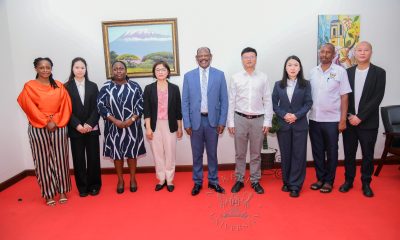
Makerere University, in a Top Management meeting chaired by Prof. Sarah Ssali, the Acting Vice Chancellor, hosted an important engagement with Uganda’s Consul General to China, Amb. Judyth Nsababera. The meeting brought together university leaders, innovators, students, and heads of departments and Units. Discussions centred on innovation, commercialisation, branding, and international collaboration, particularly with China, while also showcasing Makerere’s growing role as a national and continental engine for research, entrepreneurship, and transformative ideas.
This dialogue came at a symbolic moment as Makerere recently concluded its centenary celebrations, positioning the institution not just as a historical leader in higher education but as a forward-looking university ready to shape Africa’s place in global knowledge, trade, and innovation ecosystems.
Showcasing Innovation and Student Enterprise
The engagement highlighted the work of the University Centre for Entrepreneurship and Innovation, which champions student-led innovations, particularly from the Makerere Coffee Club. The Coffee Club, a student-led innovation focused on value addition to coffee, served their products during the top management meeting, demonstrating how academic training is being translated into real, market-ready solutions.

Prof. Sarah Ssali emphasized the importance of ensuring that innovation does not remain confined to laboratories or “junk” backrooms, but progresses into structured systems that support commercialization, intellectual property (IP) protection, and market penetration.
The presence of officers from the University Intellectual Property Office reinforced the need for stronger collaboration to safeguard student innovations and maximize their economic potential.
The university’s investment in barista training and coffee branding was cited as a model of practical, inclusive innovation, with training open not only to students but also to wider communities. This was further strengthened by the role of the Uganda Coffee Development Authority (UCDA), which donated a professional coffee machine to support student training and practical exposure within the Makerere Coffee Club, reinforcing the importance of national institutions in strengthening the coffee value chain.
The meeting highlighted the establishment of a Coffee Museum at the University, led by the School of Food Science, Nutrition and Bioengineering. The Museum will be the first of its kind in Uganda. Amb. Judyth Nsababero highlighted the fact that it would serve as an intellectual, cultural, and societal tool for preserving and elevating Uganda’s coffee heritage on the world stage. Beyond preservation, the museum was framed as a strategic branding platform that would connect Uganda’s coffee narrative to global audiences and align it with China’s fast-growing coffee consumption culture, positioning it as both a knowledge centre and a symbol of national identity.
Education, Language, and Capacity Building
The strategic engagement also underscored the need to strengthen the Chinese language teaching capacity at Makerere University.
Strong emphasis was placed on Chinese language acquisition as a tool for trade, diplomacy, and innovation. Prof. Mugaga Muwanga stressed that while Uganda remains focused on local languages, there is an urgent need to empower lecturers to become Chinese-trained educationists who can cascade this knowledge across the education system. Strong emphasis was placed on Chinese language acquisition as a tool for trade, diplomacy, and innovation. Prof. Mugaga Muwanga, Principal, CEES, Makerere University, underscored this need, stating:
“The language Chinese is becoming key in world trade. As educationists, we are still focused on teaching Ugandan languages. We need to be empowered to train Chinese-trained educationists. This value chain has to start with capacity building of the lecturers, who will teach the future teachers to roll out the language across various levels of education.”
His remarks reinforced the urgency of investing in structured capacity building for lecturers as the foundation for sustainable introduction of Chinese language education across Uganda’s learning system.

The Ambassador committed to supporting scholarships and training opportunities for staff and academicians, particularly at CEES, to build capacity in Chinese language and culture. This initiative will equip beneficiaries with the skills needed to teach Chinese and strengthen meaningful international engagement in key fields such as law, medicine, business, and technology.
Dr. Zahara Nampewo highlighted growing interest by Chinese students in studying law at Makerere University, opening opportunities for reciprocal exchange and joint legal training. The Ambassador also proposed training Ugandan lawyers to better understand the Chinese legal system to strengthen negotiation and international business competence.
Broader Strategic Partnerships
Ambassador Judyth Nsababera highlighted several strategic partnership opportunities aimed at strengthening Makerere University’s global engagement and innovation capacity. These include collaboration with UNDP, which is already supporting commercialisation, skilling, and capacity building, including benchmarking Ugandan enterprises with Chinese packaging companies to enhance product competitiveness and scale production.
She also referenced Yunnan University (China’s coffee province) as a critical academic partner, citing its pioneering coffee degree programme, integrated innovation model, and student-led branding system as a benchmark Makerere could learn from and engage with in developing its own coffee ecosystem and museum.
Additionally, the Ambassador pointed to Koti Coffee (China’s fastest-growing coffee chain) as a potential industry partner, noting its rapid expansion and influence in the global coffee market as an entry point for promoting Ugandan coffee and strengthening market linkages. She further encouraged exploration of collaboration with corporate entities such as Huawei, particularly in areas of student mobility, technological advancement, and academia-industry integration.
Together, these proposed partnerships represent strategic avenues for academic exchange, innovation transfer, market access, and international positioning, laying the groundwork for sustainable and mutually beneficial engagement between Makerere University and global institutions.
Strategic Engagement as a Pathway to Sustainable Partnerships

The engagement between Makerere University and Ambassador Judyth Nsababera marked a defining moment in advancing strategic dialogue and relationship-building as a foundation for future Uganda–China academic and innovation cooperation. It reinforced the need for structured branding systems, scalable production, commercialisation pathways, language capacity building, and strong university-industry linkages.
As Makerere continues to evolve as a national engine of innovation, research, and thought leadership, this visit provided a clear roadmap for how the institution can assert its rightful place within China’s expanding academic, technological, and economic ecosystem, transforming Uganda’s heritage, creativity, and intellectual capital into global influence.
Caroline Kainomugisha is the Alumni and Partnerships Communications Officer, Advancement Office, Makerere University.
Trending
-
General1 week agoIn Honor of the Life and Legacy of Mr. Francis Seletze Ngabirano-A Steady Hand through the Storms
-
Health5 days agoIDI launches the Sewankambo Training Program for Global Health Security in Africa
-
Engineering, Art & Tech1 week agoErasmus Exchange Prof.’s Mak Photo wins Poland National Prize
-
Agriculture & Environment2 weeks agoStrengthening Capacity and Shaping Policy: Makerere University Reviews Progress of MERIT and Environmental Risk Research Programs
-
General6 days agoMakerere University Hosts Ambassador Judyth Nsababera for Strategic Dialogue Advancing Uganda–China Engagement