Connect with us

General

Mak Releases Another New Soybean Variety Maksoy 6N

Published

on

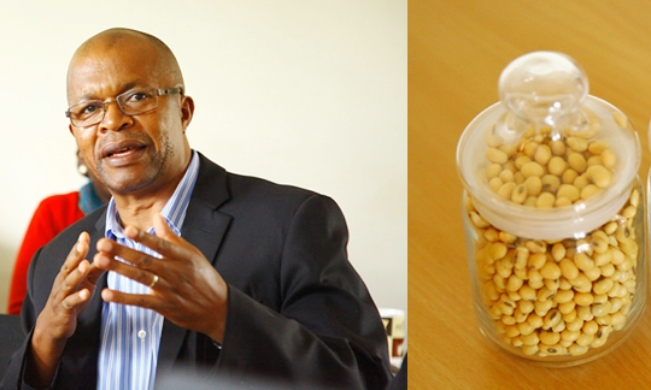
A new soybean variety Maksoy 6N has been released to the public.

  • The new variety is resistant to soybean rust disease, harsh conditions, lodging and pod shuttering.
  • It is also high yielding, early maturing with high protein and oil content of 41% and 20 % respectively.
  • This variety matures in less than 120 days and produces over 20 tons per hectare.
  • The new variety was released by the National Variety Release Committee at the Department of Crop protection at Namalere under the Ministry of Agriculture, Animal Industry and Fisheries (MAAIF) on Friday 24th November 2017.
  • It is the sixth soybean variety released by Makerere University’s Department of Agricultural Production since 2004.

The National Variety Release Committee chaired by Dr. Joseph Kikafunda was satisfied by the data presented by Prof. Phinehas Tukamuhabwa –Makerere’s Plant breeder and the brain behind the breeding and development of the new soybean variety.

Maksoy 6N is a cross between Nam 2 and GC 00138-29. Nam 2 was developed and released in Uganda (1992) while GC 00138-29 is a rust resistant parental line from AVRDC, Taiwan.

Presenting his application to the Variety Release Committee Prof. Tukamuhabwa said the breeding process started in 2012 with making selections.

“Today I am very pleased to inform you that we have gone through the process that has enabled us release another soybean variety for Uganda which has been named Maksoy 6N for Makerere University and for Uganda at large.

This is very important because in our breeding system, we have to keep developing new varieties because the varieties we have, keep on getting pests and diseases which make them susceptible. So today, we have successfully defended and released a new variety that is highly resistant to soybean rust which is the major disease of soybean in Uganda and the world at large.” The professor explained.

The crosses that were developed into this new variety according to the professor were developed into populations, later selected and  tested in over eight locations in the different districts of Uganda where soybean is highly grown.

He said  in all the trials, it turned out that this variety is outstanding compared the varieties present,  the reason  the committee was convinced  and was able to release this new variety.

The Professor’s claims were validated by the officials from MAAIF represented by Mr. Siraje Nyende who said the assessment done re-affirmed the Distinctiveness, Uniformity and Stability of the new variety recommending it for the release.

“When we make crosses and develop population, we test them because we are not breeding for people at Makerere University or around Kabanyolo but we are doing it for the whole country and world. So we test these new varieties that we develop in several locations.

Most of these are in Northern Uganda where soybean is widely grown and this is especially in Ngetta, West Nile and Eastern Uganda in Jinja, Iki-Iki in Budaka district, in Hoima and Kasese. However in the regions where soybean is grown on large scale, we also choose specific farmers where we have tested on farmers’ fields so that farmers are capable of telling us that they like them” He added.

Prof. Tukamuhabwa explained that the protein in the in the Soybean is without cholesterol and is an opportunity to some sections of the population which does not take meat because all the amino acids necessary for the body are available.

“Of course it does not mean eating soybean alone but eating food blended with soybean. And you know it is meat grown from the soil. Any Ugandan can grow this soybean and what they need is knowledge how to process it”. Prof. Tukamuhabwa noted.

This soybean according to Prof. Tukamuhabwa is also good because it is high yielding and it has high oil and protein content which are very useful for factories to process soybean oil and soybean meal used in the livestock industry.

“It is also good news to see that at Makerere University we don’t only stop at teaching plant breeding but also develop new varieties that can be used by farmers who are the end users and also factories that process soybean into products.

The variety is able to withstand harsh conditions and is resistant to podshuttering. The genes contained in this variety are very important ergonomically and it is on this basis that they are being released,” Tukamuhabwa explained.

The Assistant plant breeder Mr. Tonny Obua said the seed companies are interested in oil and protein content because that is what gives them more income.

“The lowest  they should receive is 36% protein  then oil 18% minimum and we feel more confident  this variety”.

Mr. Obua added that the university has been producing adequate foundation seed ranging between 25-30 tons per season culminating to  over 50 tons annually.

“we are already  increasing  bulk seed for this new variety. Our last release in 2013 was Maksoy 3N and 4N and no seed company  in Uganda  has said they lack foundation seed”, Obua said.

He added that Busoga and South Western Hills of Mbale  that used not to grow soybean were now engaged in soybean growing.

Soybean – a “Miracle crop”.

Soybean has been defined as a “Miracle crop” of many uses by American Soybean Association.

Others call it the golden crop – the gold that develop from the soil and the crop of the future.

Soybean produces more usable protein per hectare than any other crop and costs less in relative terms.

In Uganda soybean is used as human food, cooking oil, livestock feed and income earner. It also improves soil properties.

According to the American Soybean Association, whole soybean has 22 products; soybean oil has 53 products while soybean meat or flour has 48 products. The products are used as human food, for technical, industrial and animal feeds.

“If Ugandans or policy makers knew, they would adopt soybean as a crop to get us from real poverty.  Because from these soybean, you can get soy milk, soy yoghurt and ice cream and that already tells you that this is really an extra ordinary crop.

After we have extracted oil we also get the most priced cake among all protein cakes in the crops processed all over the world. This is an internationally traded commodity you can never have”, Prof.  Tukamuhabwa said.

Tukamuhabwa noted that here in Uganda soybean production can contribute to food security and industry growth.

“When you grow soybean and blend it with maize you will develop the animal industry, and by so doing you also have food, the animals are well-fed then you improve food security. So the sure way is to develop the soybean sub sector and you blend it with other crops”. He said

He observed that Brazil and Argentina’s economies are dependent on soybean because they have purposely selected soybean to advance their economies. He added that soybean has properties that can develop any economy even better than coffee.

“In Uganda soybean grows very well so it is up to our choice and you will not get another crop that can outcompete soybean in the type of products that you can get.

It is a crop with self sustaining properties because it will improve soils, improve agribusiness, increase food security at house level and improve all factories that have mushroomed.

When factories come up people get work and there is total benefit by everybody when you invest in soybean”. Prof. Tukamuhabwa stated.

He challenged citizens to reflect on how they choose commodities to invest in saying, there is enough evidence that those who have invested in soybean, its incomparable.

“So it is up to our people and our countries to make choice but soybean is a crop for the future that we must invest in. It is a challenge to us as a country”. The Makerere Don advised.

Report compiled by:
Jane Anyango
Communication Officer, CAES

Read more

Mark Wamai

Continue Reading

General

Press Release: Government of Uganda and Partners Launch SAY Plus+ to Scale Youth Sexual Reproductive Health & Rights (SRHR) Impact in Underserved Regions

Published

on

Hon. Margaret Muhanga assisted by Dr. Charles Olaro officially launches the SAY Plus+ Programme as L-R: Amb. Signe Winding Albjerg, Amb. Frederieke Quispel, Ms. Kristine Blokhus and Prof. Henry Alinaitwe witness. The Government of Uganda, through the Ministry of Health officially launches the SAY Plus+ Programme, a Sexual and Reproductive Health and Rights (SRHR) initiative designed to strengthen adolescent and youth rights, empowerment, protection and access to quality services in Uganda's underserved regions, Backed by a USD 50 million pooled fund from the Governments of Iceland, Denmark, the Netherlands, and Sweden, scheduled to operate between 2024 and 2030. 7th May 2026, Freedom Square, Makerere University, Kampala Uganda, East Africa.

USD 50 million national programme moves into full implementation, strengthening
adolescent and youth rights, empowerment, protection and access to youth-responsive
services in 13 districts across five sub-regions

KAMPALA, 7 MAY 2026: The Government of Uganda, through the Ministry of Health, today officially launched the SAY Plus+ Programme, a Sexual and Reproductive Health and Rights (SRHR) initiative designed to strengthen adolescent and youth rights, empowerment, protection and access to quality services in Uganda’s underserved regions.

The launch, held at Makerere University‘s Freedom Square under the theme “My Voice Matters: Youth Voices for SAY Plus+” and the tagline “Nothing for us, without us”, marks the programme’s transition into full implementation.

SAY Plus+, formerly known as Strengthening Adolescents and Youth Rights and Empowerment: Scaling Impact, is led by the Ministry of Health, in coordination with other Ministries, with UNFPA Uganda serving as the Managing and Technical Agency.

Backed by a USD 50 million pooled fund from the Governments of Iceland, Denmark, the Netherlands, and Sweden, the initiative is scheduled to operate between 2024 and 2030. It is currently being rolled out across thirteen districts within five sub-regions, providing targeted assistance to regional referral hospitals in Jinja, Mbale, Moroto, Yumbe, Arua, and Gulu. Furthermore, the programme supports the Human Capital Development goals established in Uganda’s National Development Plan IV.

“SAY Plus+ represents a shift from fragmented interventions to a coordinated national effort that meaningfully places young people at the centre of both design and delivery. Through our partnership with the Government of Uganda, development partners, and implementing partners, we are investing not only in services, but in the systems, communities, and environments that enable adolescents and young people to thrive not only today but also in the future,” said Ms. Kristine Blokhus, Representative – UNFPA Uganda.

Officially launched by the Minister of State for Health Hon. Margaret Muhanga, the SAY Plus+ programme targets adolescents and young people aged 10 to 24 years, with particular focus on adolescent girls and young women, refugees and host-community youth, out-of-school young people, those not in employment, education or training, adolescents with disabilities, and young people in humanitarian and post-conflict settings.

“For many of us, things like this one are designed without listening to what we go through every day, think or even feel. SAY Plus+ feels different because it starts with our voices and gives us a real role in shaping solutions. It is not just about information, it is about being supported to make decisions, access services, and build the future we want.” – Jovia Dranzoa, Young person.

SAY Plus+ operates through three pillars. First, it empowers youth to exercise their rights and make informed choices. Second, it engages families, communities, and leaders to address harmful social norms. Third, it strengthens youth-responsive SRHR, HIV, and gender-based violence services via health facilities and community platforms, aiming to reach over 2.3 million direct and indirect beneficiaries.

The SAY Plus+ initiative stands as a model of international cooperation and multi-sectoral synergy. Through the combined support of the Governments of Iceland, Denmark, the Netherlands, and Sweden, and the technical leadership of UNFPA, Uganda is now equipped to scale-up critical interventions in HIV prevention, gender-based violence response, and reproductive health. With implementation now in high gear through 2030, the programme is poised to make a lasting contribution to the nation’s human capital development goals.

— ENDS —

Photos from the event

Prof. Henry Alinaitwe addresses participants at the launch. The Government of Uganda, through the Ministry of Health officially launches the SAY Plus+ Programme, a Sexual and Reproductive Health and Rights (SRHR) initiative designed to strengthen adolescent and youth rights, empowerment, protection and access to quality services in Uganda's underserved regions, Backed by a USD 50 million pooled fund from the Governments of Iceland, Denmark, the Netherlands, and Sweden, scheduled to operate between 2024 and 2030. 7th May 2026, Freedom Square, Makerere University, Kampala Uganda, East Africa.
Prof. Henry Alinaitwe addresses participants at the launch.

Ms. Kristine Blokhus. The Government of Uganda, through the Ministry of Health officially launches the SAY Plus+ Programme, a Sexual and Reproductive Health and Rights (SRHR) initiative designed to strengthen adolescent and youth rights, empowerment, protection and access to quality services in Uganda's underserved regions, Backed by a USD 50 million pooled fund from the Governments of Iceland, Denmark, the Netherlands, and Sweden, scheduled to operate between 2024 and 2030. 7th May 2026, Freedom Square, Makerere University, Kampala Uganda, East Africa.
Ms. Kristine Blokhus.

Part of the audience at the event. The Government of Uganda, through the Ministry of Health officially launches the SAY Plus+ Programme, a Sexual and Reproductive Health and Rights (SRHR) initiative designed to strengthen adolescent and youth rights, empowerment, protection and access to quality services in Uganda's underserved regions, Backed by a USD 50 million pooled fund from the Governments of Iceland, Denmark, the Netherlands, and Sweden, scheduled to operate between 2024 and 2030. 7th May 2026, Freedom Square, Makerere University, Kampala Uganda, East Africa.
Part of the audience at the event.

Some of the young people that attended the event. The Government of Uganda, through the Ministry of Health officially launches the SAY Plus+ Programme, a Sexual and Reproductive Health and Rights (SRHR) initiative designed to strengthen adolescent and youth rights, empowerment, protection and access to quality services in Uganda's underserved regions, Backed by a USD 50 million pooled fund from the Governments of Iceland, Denmark, the Netherlands, and Sweden, scheduled to operate between 2024 and 2030. 7th May 2026, Freedom Square, Makerere University, Kampala Uganda, East Africa.
Some of the young people that attended the event.

Prof. Henry Alinaitwe signs the commemorative piece. The Government of Uganda, through the Ministry of Health officially launches the SAY Plus+ Programme, a Sexual and Reproductive Health and Rights (SRHR) initiative designed to strengthen adolescent and youth rights, empowerment, protection and access to quality services in Uganda's underserved regions, Backed by a USD 50 million pooled fund from the Governments of Iceland, Denmark, the Netherlands, and Sweden, scheduled to operate between 2024 and 2030. 7th May 2026, Freedom Square, Makerere University, Kampala Uganda, East Africa.
Prof. Henry Alinaitwe signs the commemorative piece.

L-R: Prof. Henry Alinaitwe, Dr. Charles Olaro, Hon. Margaret Muhanga, Amb. Signe Winding Albjerg, Amb. Maria Håkansson, Amb. Frederieke Quispel, Amb. Unnur Orradottir Ramette, Ms. Kristine Blokhus and a young lady during the press interviews. The Government of Uganda, through the Ministry of Health officially launches the SAY Plus+ Programme, a Sexual and Reproductive Health and Rights (SRHR) initiative designed to strengthen adolescent and youth rights, empowerment, protection and access to quality services in Uganda's underserved regions, Backed by a USD 50 million pooled fund from the Governments of Iceland, Denmark, the Netherlands, and Sweden, scheduled to operate between 2024 and 2030. 7th May 2026, Freedom Square, Makerere University, Kampala Uganda, East Africa.
L-R: Prof. Henry Alinaitwe, Dr. Charles Olaro, Hon. Margaret Muhanga, Amb. Signe Winding Albjerg, Amb. Maria Håkansson, Amb. Frederieke Quispel, Amb. Unnur Orradottir Ramette, Ms. Kristine Blokhus and a young lady during the press interviews.

Mak Editor

Continue Reading

General

Notice: Medical Review Exercise for Persons with Disability 2026/2027

Published

on

Makerere University Students in a discussion group.

The Academic Registrar, Makerere University invites persons with disability who applied for admission to public universities under the disability entry scheme for 2026/2027 Academic Year to appear for medical/review exercise at Makerere University, Senate Building, Level Four Conference Hall.

NOTE: Only those who have the minimum entry requirements of at least two principal passes at A’ Level or its equivalent and at least five (5) passes at O’ Level or its equivalent will be interviewed.

 Only candidates who sat ‘A’ level in 2025, 2024 and 2023 are eligible for admission.

THE EXERCISE WILL BE CONDUCTED ON 18th, 19th, 20th, 21st and 22nd May, 2026 respectively from 9.00 A.M – 1.00 P.M each day.

See details below:

IMPORTANT:

(i) If you fail to appear on any of the given days above, there will be no other chance for you this year.

(ii) Applicants with other Government Scholarships are not eligible for admission through the Disability Entry Scheme

Prof. Mukadasi Buyinza
ACADEMIC REGISTRAR

Mak Editor

Continue Reading

General

Leading with Purpose: Guild President Ssentamu Churchill James Reflects on His Term

Published

on

H.E. Uhuru Kenyatta (2nd Right) poses for a group photo during the courtesy call on the Vice Chancellor with Left to Right: Prof. Barnabas Nawangwe, Ms. Sarah Kagingo and Guild President-H.E. Churchill James Ssentamu. Second Annual Guild Leaders’ Summit, organized by the Guild Presidents Leadership Academy, keynote address by Former President of Kenya, H.E. Uhuru Kenyatta, 24th April 2025, Main Building, Makerere University, Kampala Uganda.

By Betty Kyakuwa and Carol Kasujja

In this exclusive quick chat, we spoke to the 91st Guild President, Ssentamu Churchill James, a third-year student pursuing a Bachelor of Social Sciences. He shares insights into his leadership journey, key achievements, challenges, and his vision for the student community.

What inspired you to run for Guild President?

My background and personal leadership journey played a big role. Growing up, I saw my father and uncle actively involved in politics, which shaped my interest in leadership.

I also held leadership roles in high school—serving as Sports Minister at O-Level and later as Head Prefect at St. Juliana High School, Gayaza, during my A-Level. These experiences built my confidence and passion for representing others.

Ssentamu Churchill James and Kadondi Gracious inaugurated as the 91st Guild President and Vice President, 21st March 2025, Main Hall, Main Administration Building, Makerere University, Kampala Uganda, East Africa.
Prof. Buyinza Mukadasi with the H.E. Ssentamu, H.E. Kadondi, Dr. Winifred Kabumbuli and family members of the Guild Leadership.

Seeing former Guild President Vincent Lubega Nsamba win also motivated me. We come from the same high school, and I succeeded him as Head Prefect. That gave me the belief that I, too, could lead at that level.

What was your vision when you assumed office, and how much of it did you achieve?

My vision was to amplify students’ voices and ensure their needs were prioritized. While it wasn’t easy due to bureaucracy, we made progress.

We improved students’ social welfare by engaging management, which led to greater flexibility in organizing events like the Bazaar and Freshers’ Ball. We also addressed the issue of missing marks. Previously, it could take semesters to resolve, but now, through the Office of the Academic Registrar, such issues can be handled much faster.

What is your biggest achievement?

One of the biggest milestones was allowing students to sit for examinations after paying at least 60% of tuition. This has reduced the number of students dropping out due to financial constraints.

Left to Right: MD and CEO NEC-Lt. Gen. James Mugira conducts a symbolic handover of keys to the Vice Chancellor-Prof. Barnabas Nawangwe as 91st Guild President-H.E. Ssentamu Churchill James, Principal CEES and Ag. DVCFA-Prof. Anthony Muwagga Mugagga, Deputy University Secretary-Mr. Simon Kizito and Deputy Dean of Students-Dr. Rodney Rugyema witness on 25th July 2025. The National Enterprise Corporation (NEC) hands over fully refurbished Mary Stuart Hall. The renovation, which cost UGX 10.5 billion, began on 26th July 2024 and was completed exactly a year later, on 25th July 2025. Makerere University, Kampala Uganda, East Africa.
Left to Right: MD and CEO NEC-Lt. Gen. James Mugira conducts a symbolic handover of keys to the Vice Chancellor-Prof. Barnabas Nawangwe as 91st Guild President-H.E. Ssentamu Churchill James, Principal CEES and Ag. DVCFA-Prof. Anthony Muwagga Mugagga, Deputy University Secretary-Mr. Simon Kizito and Deputy Dean of Students-Dr. Rodney Rugyema witness on 25th July 2025.

We also saw the lifting of the ban on social events, which has gradually revived campus life. Additionally, leadership roles such as ministers and Guild Representative Councillors (GRCs) have become more functional, with clearer responsibilities and greater impact.

What key lessons have you learned?

One key lesson is the importance of daring to take action. Things may seem impossible, but once you step out and try, you realize they are achievable.

I also learned that leadership begins with influence. For example, when class representatives raised concerns about not being paid, I had to engage and influence them to understand the situation while working toward solutions.

Leadership also requires teamwork. You cannot lead alone—you need a support system. When you delegate, trust people and avoid micromanaging.

H.E. Ssentamu Churchill James and H.E. Kadondi Gracious welcome freshers in typical Makerere style. Makerere University officially kicks off 2025/2026 academic year with a Freshers’ Orientation at the Freedom Square on Monday 4th August 2025, Kampala Uganda, East Africa.
H.E. Ssentamu Churchill James and H.E. Kadondi Gracious welcome freshers in typical Makerere style.

Another lesson is the importance of effective communication with management. Building strong relationships increases your chances of influencing decisions.

On a personal level, I have learned discipline—keeping time, improving how I present myself, and becoming more mindful in how I engage with others.

What do you attribute your success to?

First and foremost, God, who gave me the wisdom and understanding to lead.

I also attribute it to the strong working relationships I built with University leadership, especially the Vice Chancellor and the Dean of Students. Without that collaboration, it would have been difficult to achieve much.

How did you balance academics and leadership?

It required intentional planning and prioritization. When meetings clashed with tests, I delegated to the Vice President or Prime Minister. This ensured continuity while giving them an opportunity to grow.

H.E. Churchill James Ssentamu alongside other Student Leaders hold the "Strides for Change" banner at Mary Stuart Hall. Makerere University in partnership with Embassy of Sweden in Uganda and UNFPA in Uganda hosted the "Strides for Change" Activism walk and official unveiling of the 2025 16 Days of Activism campaign on Monday 24th November, 2025.
H.E. Churchill James Ssentamu alongside other Student Leaders hold the “Strides for Change” banner at Mary Stuart Hall. Courtesy Photo.

However, I made it a point to attend critical engagements, such as Council meetings, because I was entrusted with representing students’ voices. I was also selective about external engagements to remain focused on my academics.

What challenges did you encounter?

Managing high expectations from students was a major challenge. Even small delays could attract criticism. For example, when students’ upkeep delayed by a week, some assumed I was not advocating for them.

I learned to remain calm and not react emotionally, instead using feedback as motivation to improve.

Another challenge was handling sensitive cases, such as advocating for students who had been suspended. Even when I did not agree with their actions, it was my duty to seek fair consideration on their behalf.

Prof. Barnabas Nawangwe, Mr. Ian King and H.E. Ssentamu Churchill James (Standing before Banners) are joined by officials in a group photo in the Daycare Centre, located on the Ground Floor of the Institute of Gender and Development Studies (IGDS) on 7th August 2025. Makerere University, in collaboration with UNDP Uganda launch of Daycare and Breastfeeding Centre at the Institute of Gender and Development Studies (IGDS) and state-of-the-art Multimedia Studio at the Frank Kalimuzo Central Teaching Facility, 7th August 2025, Kampala Uganda, East Africa.
Prof. Barnabas Nawangwe, Mr. Ian King and H.E. Ssentamu Churchill James (Standing before Banners) are joined by officials in a group photo in the Daycare Centre, located on the Ground Floor of the Institute of Gender and Development Studies (IGDS) on 7th August 2025.

Was there a difficult decision you had to make?

Yes. Just a month into office, I made the decision to relieve a minister of their duties because they did not align with the cabinet’s vision and values. Leadership requires making tough decisions to maintain unity and integrity.

Is there anything you would have done differently?

I feel I could have engaged more with the administration. At times, I was occupied with activities outside the University, which limited my interaction with management. With more engagement, I believe I could have achieved even more.

What will you miss most?

I will not necessarily miss the office itself. Leadership is about service, and it is now time for others to take on that responsibility as I move on to the next chapter of my life.

H.E. Churchill James Ssentamu enjoys a light moment with officials as he endorses the dummy of the policy. The Third Deputy Prime Minister and Minister without Portfolio, Right Honourable Lukia Isanga Nakadama, has commended Makerere University for crafting a policy aimed at creating a safe, inclusive, and respectful environment for all members of the University community. 4th April 2025, Main Hall, Kampala Uganda, East Africa.
H.E. Churchill James Ssentamu enjoys a light moment with officials as he endorses the dummy of the policy.

How would you like to be remembered?

As a selfless leader who went the extra mile to serve others and always put students’ interests first—even when it required personal sacrifice.

For instance, during the Freshers’ Ball, we wanted to host a musician whose fee was UGX 4 million, yet we only had UGX 2 million. I personally covered the balance to make it happen for the students.

Betty Kyakuwa
Betty Kyakuwa

Continue Reading

Trending