Connect with us

General

Mak Sida Annual Review Meeting Reveals Good Progress

Published

on

Over the last 15 years of collaboration, the Swedish Government has invested US$ 73.3 million in Graduate Training and the scientific environments of five public Universities in Uganda, with the main recipient being Makerere University (Mak). The latest phase of collaboration (2015-2020) will contribute US$ 32million to training over 240 students over the five year period.

These figures formed a good basis for this year’s Sida (Swedish International Development Cooperation Agency) Annual Review Meeting’s theme “Investing in Research and Innovating for Society”.  Launched on 10th October 2016 in the Main Hall, the meeting also marked the first official visit to Makerere University by the new Swedish Ambassador to Uganda H.E. Per Lindgärde.
Ambassador Lindgärde who arrived in the country only a week prior to the Annual Review Meeting thanked Makerere University for the warm reception accorded to him.
H.E. Amb. Per Lindgärde (2nd R), Dr. Gity Behravan (R), Vice Chancellor-Prof. John Ddumba-Ssentamu (2nd L) and Director DRGT-Prof. Mukadasi Buyinza (L) listen to presentations during the Sida Annual Review Meeting
“The Annual Review Meeting brings together Ugandan and Swedish partners to assess the past year. I understand that some of you are new to the program, while others have much experience from previous collaboration phases. But what you all have in common is that you have been successful in the competition to get a project approved for this collaboration,” commended Ambassador Lindgärde.

He further drew attention to the uniqueness of the Swedish funding to research collaboration, noting that “The Swedish strategy is based on funding institution building, post-graduate education, and research in one single effort. No part can function without the others. It is a holistic approach” shared the Ambassador.

The Director, Directorate of Research and Graduate Training (DRGT) and Head of the Mak-Sida Intuitional Collaboration Programme, Prof. Mukadasi Buyinza thanked the Swedish Government for the dedicated support to Mak which has led to the training of 325 academics since 2000. Prof. Buyinza took note of two shifts that have since taken place in the new collaboration period.
Dr. Gity Behravan (R) reacts to one of the presentations as Prof. Mukadasi Buyinza (L) listens intently
“Firstly, whilst the program previously was only based on sandwich students, 105 PhD students are now locally trained. Only 20 PhDs are going to be on sandwich, based on capacity need.” He observed that this was indeed a great testimony of the strengthened research capacity achieved by Mak over the 15 years of collaboration.

“Secondly, local training will take place in multidisciplinary teams, based on multidisciplinary themes. The previous model of primarily singular PhD projects has thus been shifted, as per Mak’s research policy,” shared Prof. Buyinza. He however noted that translating scientific findings into the language that policy makers can easily understand remains a challenge, which the new collaboration period will seek to address.

In his welcome remarks, the Vice Chancellor Prof. John Ddumba Ssentamu thanked the H.E. Amb. Per Lindgärde, the First Secretary and Senior Research Advisor, Dr. Gity Behravan as well as Swedish and Ugandan partners for taking time off their schedules to attend the meeting.
Some of the Swedish Partners that attended the Annual Review Meeting listen to the day's proceedings
“This Annual Review Meeting symbolises the nature and character of the relationship between Makerere University and the Royal Government and People of Sweden. It is an opportunity to take stock of our performance within our agreement for joint research cooperation,” remarked the Vice Chancellor.

Prof. Ddumba-Ssentamu appreciated the fundamental role played by Swedish Government support in strengthening the University’s capacity to deliver her core functions. “This support has indeed greatly contributed to our visibility and status. I wish therefore, on behalf of Makerere University, to extend our sincere gratitude to the Royal Government of Sweden for this continued support,” underscored the Vice Chancellor.

In her remarks, Dr. Gity Behravan stressed that support to Mak is in line with the institutional Research Agenda which is also generated from Uganda’s National Development Plan (NDP). This, she said, will strengthen all efforts of knowledge production and use. She therefore called upon all presenters at the Annual Review Meeting to take note of the importance of highlighting the research results that can be used in knowledge generation to improve focus areas as outlined in the 2014-2018 Sida bilateral cooperation strategy for Uganda. These include; strengthening of democracy and human rights, better maternal and child health, increased employment and reduced violence against women.
One of the presenters Dr. Jamil Ssenku (L) answers questions from the audience. Second Right is MUST Vice Chancellor-Prof. Celestino Obua and Right is Deputy Director DRGT-Prof. David Owiny
Emphasizing the need to communicate research findings, Dr. Behravan noted that “today’s research is tomorrow’s welfare and this needs to be better known and seen and felt.” She restated the Swedish Government’s appreciation of the link between research and development and expressed hope that the Ugandan Government commitment to University research and research training would be demonstrated by an increased share of the national budget.

The Government of Uganda under the new cabinet has introduced a Ministry of Science, Technology and Innovation. Representing the line Minister Hon. Dr. Elioda Tumwesigye at the Annual Review Meeting, the Executive Director, Uganda Industrial Research Institute (UIRI), Prof. Charles Kwesiga reassured all gathered of the Government’s full support through the new fully fledged ministry.

A Science Day is one of the activities that traditionally constitute the Sida Annual Review Meeting. This year’s presentations included: Could secondary metabolites from cruciferous vegetables serve as a source of industrial chemicals in Uganda? by Assoc. Prof. Steven Nyanzi; Using Mathematical Models for Policy Making by Dr. Betty Nanyonga Kivumbi; and Nutri-medicinal plants used in the management of HIV/AIDS opportunistic infections by Dr. Savina Asimwe.
Director DRGT Prof. Mukadasi Buyinza meets some of the PhD student beneficiaries under the current phase of funding
Other presentations were: What is the place for transdisciplinary Research in our University Setting by Dr. Kenneth Arinaitwe; Mathematical Modeling for Infectious and Non-infectious Diseases by Dr. John Kitayimbwa; and Bioactivity, Toxicity and Phytochemistry of selected plant species by Ms. Adia Mohammed Madina. Two other presentations were delivered by Mr. Alex Tumwesigye on One-Dimensional Dynamical Systems and Commutativity Commuting Elements in Non-Commutative Algebras, and Dr. Jamil Ssenku on Potential for phtoremediation of acid mine waste degraded sites by selected tree species in Kasese District.

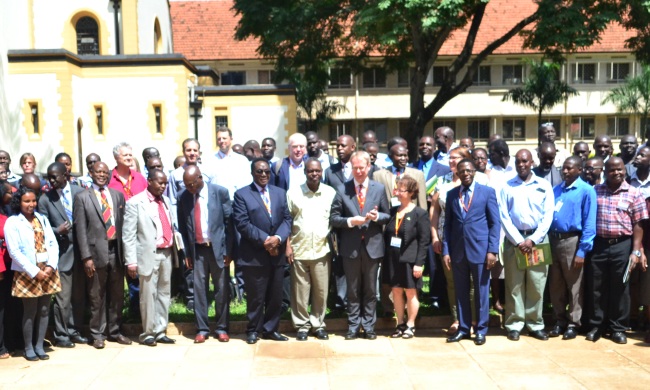
The Annual Review Meeting was attended by the Leadership, Staff and Students of; Busitema University, Gulu University, Kyambogo University and Mbarara University of Science and Technology (MUST).

Article by Public Relations Office

Mark Wamai

Continue Reading

Agriculture & Environment

Makerere Hosts Inaugural Falling Walls Lab Competition as Innovators Pitch Solutions to National Challenges

Published

on

Students and researchers from Makerere University and other institutions pitched 12 innovations addressing challenges in healthcare, clean energy, agriculture, waste management and community resilience during the inaugural Falling Walls Lab Kampala, held at the School of Public Health Auditorium, Makerere University.

The competition brought together emerging innovators to present solutions to practical challenges through a three minute pitch, followed by questions from a panel of judges.

Modelled on the Falling Walls format that originated in Berlin, the event required each participant to identify a “wall” a problem or barrier, and demonstrate how their innovation seeks to break it down.

Mudhasi wins with newborn jaundice screening device

Andrew Mudhasi of Makerere University emerged as the overall winner with a score of 90 per cent for a low cost medical device designed to improve newborn jaundice screening across different skin tones.

Overall competition winner Andrew Mudhasi (left) receives his first Place award certificate for his innovation

Mudhasi explained that the device uses optical sensor technology and a skin tone targeting algorithm to provide a rapid reading, with the aim of helping nurses and clinicians identify jaundice more efficiently.

During questions from the jury, Mudhasi said the device had not yet been tested on actual babies but had undergone laboratory testing using simulated skin tones.

He reported an accuracy rate of 94 per cent when the device was compared with laboratory spectrophotometers.

The innovation is intended initially for use in clinics and hospitals, with Mudhasi saying the team is also considering a version that could eventually allow mothers to screen babies at home.

Mudhasi’s innovation has previously received recognition at the African Business Concept Challenge and the iF Design Student Award, according to his presentation.

Rhonda’s innovation tackles diaper waste

Rhoda John of the University of Nairobi emerged in second place with 89.6 per cent for an innovation addressing the problem of used diaper waste.

Rhondah John pitches her innovation repurposing diaper waste into soil moisture retention

Under the theme “Breaking the wall of diaper waste and drug soils,” Rhonda explained that her team extracts sodium polyacrylate, the absorbent polymer found in diapers, and replaces the sodium with potassium.

The resulting potassium based superabsorbent material is designed to act as a “water battery” in soil by absorbing and retaining water for plants during dry periods.

John said testing showed a 99 per cent increase in germination and a 23 per cent increase in drought resistance.

The innovation also seeks to reduce the amount of used diapers ending up in landfills and the environmental effects associated with their decomposition.

During the question and answer session, John explained that her team was working with government environmental officials in Nairobi on a pilot collection system to address the challenge of gathering used diapers at scale.

Mahera takes third place with herbal peptic ulcer treatment

Stuart Mahera of Makerere University finished third with 86.2 per cent for a herbal formulation targeting peptic ulcers.

Stuart Mayira (left) receives his 3rd Place award certicate at the school of Public Health Auditorium.

Presenting under the theme “Breaking the wall of Nature and Modern Medicine,” Mahera argued that conventional treatment for peptic ulcers can involve multiple medicines and may be associated with side effects and antimicrobial resistance.

His proposed formulation, MARAC capsules, is intended as a monotherapy, combining properties required for peptic-ulcer treatment in a single capsule.

Mahera said his team had carried out quality control work, including characterisation and dose quantification, and had conducted preclinical trials on laboratory mice.

He also told the jury that an application had been submitted to the National Drug Authority as the team awaits the next stage of the regulatory process.

According to Mahera, the proposed seven day treatment would cost about Shs21,000, compared with the existing 14 day treatment approach.

Innovators present solutions to practical challenges

The remaining presentations covered a wide range of challenges.

Esther Nakungu of Utamu University presented Agri-Track, a digital record keeping solution intended to improve visibility, accountability and management of farm operations and financial information.

Dr. Jimmy Chachiga, a Makerere University participant, presented a solar photovoltaic cooker with a heat storage system designed to provide a cleaner and more reliable cooking option during both sunny and non sunny periods.

His presentation focused on reducing dependence on biomass fuels and addressing the challenges associated with intermittent solar energy.

Abdul Noor Luttamaguzi, a PhD student and senior government fisheries officer, presented a mobile application aimed at helping fish farmers and extension officers report, track and manage disease outbreaks.

Henry Duke Tamale presented a herbal cream targeting antibiotic resistant biofilm infections associated with diabetic foot ulcers.

Marvin Seruwu proposed adapting existing near infrared brain monitoring technology to help detect extra-axial brain bleeds in health facilities where access to CT and MRI equipment is limited.

His proposal seeks to repurpose existing technology towards a diagnostic need that could be particularly important in settings where advanced imaging facilities are not readily available.

Kennedy Kisame presented a poultry alert and diagnosis system combining satellite weather information with computer vision disease detection. The proposed system could be accessed through a smartphone application, SMS or USSD, making it potentially usable by farmers with limited internet access.

Frank Atwiine proposed a solar powered mobile diagnostic van designed to bring ultrasound and other diagnostic services closer to rural communities.

Johnson Makmot, a software and blockchain developer, presented a platform that combines GPS tracking and blockchain-based tokens to incentivise and verify plastic-waste collection in Kampala.

Dr. Nelson Ndugu, from a partner university, presented an artificial intelligence tool designed to translate agricultural research publications into local Ugandan languages and generate voice notes for radio-based extension delivery.

The final presentation came from Dr. Juliet Akola, a Ugandan post doctoral researcher at Mangosuthu University of Technology in South Africa.

Akola presented a community digital resilience initiative focused on mapping risks in Kampala’s informal settlements, including flooding, fire, poor sanitation, waste management and inadequate infrastructure.

Her proposal seeks to combine local community knowledge with geographical information systems and link identified risks to action plans involving municipalities and other stakeholders.

Nawangwe calls for more investment in innovation

Closing the event, Prof. Nawangwe congratulated all the participants and described their presentations as an important beginning for Makerere University, Uganda and the wider region.

Vice Chancellor, Prof. Banabas Nawangwe giving his remarks

Drawing on his experience attending the Falling Walls conference in Berlin, the Vice Chancellor said initiatives of this nature are important because innovation will play a major role in determining the future of countries.

He encouraged participants to make their pitches more precise by clearly identifying the problem they are addressing, explaining their proposed solution and demonstrating what they have already achieved.

Prof. Nawangwe also welcomed the participation of innovators from other universities and countries, noting that the Kampala event had attracted participants beyond Makerere.

He thanked the Africa Office of the Falling Walls Foundation for its role in bringing the initiative to Makerere and encouraged continued support for innovation.

The Vice Chancellor further linked innovation to Uganda’s growing youth population and the need to develop home-grown solutions to address challenges such as youth unemployment.

The inaugural Falling Walls Lab Kampala ultimately provided a platform for innovators to move ideas beyond the classroom and laboratory and demonstrate how research, technology and creativity can be applied to challenges affecting communities.

PositionWinnerInstitutionScore
1stAndrew MudhasiMakerere University90%
2ndRhoda JohnUniversity of Nairobi89.6%
3rdStuart MaheraMakerere University86.2%

Allan Ainematsiko

My name is Ainematsiko Allan. I am a student of Makerere University and currently in my final year. I am pursuing a Bachelors in Journalism and Communication.

Continue Reading

General

Prof. Sarah Ssali urges the Makerere University Community to embrace local philanthropy

Published

on

Scholars showcasing their national colours to celebrate diversity at the event on 5th September 2026. Community Open Day for Mastercard Foundation Initiatives at Makerere University, where Prof. Claire Mack Mugasa represented the Deputy Vice Chancellor (Academic Affairs) Prof. Sarah Ssali as Guest of Honour, 5th September 2026, Freedom Square, Kampala Uganda, East Africa.

On Saturday, 5th September 2026, the Deputy Vice Chancellor for Academic Affairs urged the Makerere University community to actively engage in local philanthropy as a vital way to support vulnerable members of our society. Prof. Ssali shared this message during the Community Open Day for Mastercard Foundation Initiatives at Makerere University, where Prof. Claire Mack Mugasa, Dean of the School of Biosecurity, Biotechnology, and Laboratory, represented her and served as the guest of honour.

At the event attended by Mastercard Foundation Scholars (Mak Students and Alumni), mentors, partners, and the broader university community, Prof. Ssali emphasised the importance of giving back to the community. She expressed her appreciation for the Mastercard Foundation Scholars at Makerere University, highlighting their commitment to generosity. Prof. Ssali encouraged the entire university community to adopt similar practices, fostering a culture of social responsibility that shall positively influence and uplift surrounding communities.

Prof. Claire Mugasa, who represented the DVC AA as the Chief Guest, delivering her remarks at the event. Community Open Day for Mastercard Foundation Initiatives at Makerere University, where Prof. Claire Mack Mugasa represented the Deputy Vice Chancellor (Academic Affairs) Prof. Sarah Ssali as Guest of Honour, 5th September 2026, Freedom Square, Kampala Uganda, East Africa.
Prof. Claire Mugasa, who represented the DVC AA as the Chief Guest, delivering her remarks at the event.

“We gather here today not simply for an event, but for a statement of intent. The Community Open Day is a platform built on the conviction that education, paired with a spirit of national service, can transform not only individual lives but entire communities,” Prof. Ssali remarked. “I therefore call upon the Makerere University community to embrace the spirit of giving back to our communities. It is one of the ways through which the university will positively impact the less advantaged amongst us,” Prof. Ssali added.

Ms. Maria Mugerwa, the Head of Finance at the Mastercard Foundation Scholars Program, who represented the Foundation at the event, emphasised that giving back to the community is at the core of everything the Foundation does.

“I thank you, the Mastercard Foundation Scholars community at Makerere University, for bringing us together for this Community Open Day, one of the activities that sits at the heart of Mastercard Foundation: using opportunities to create opportunities for others.” Ms. Mugerwa remarked.

Ms. Maria Mugerwa, the representative of Mastercard Foundation speaking at the event. Community Open Day for Mastercard Foundation Initiatives at Makerere University, where Prof. Claire Mack Mugasa represented the Deputy Vice Chancellor (Academic Affairs) Prof. Sarah Ssali as Guest of Honour, 5th September 2026, Freedom Square, Kampala Uganda, East Africa.
Ms. Maria Mugerwa, the representative of Mastercard Foundation speaking at the event.

“Today is about community, connection and giving back. Giving back doesn’t require big projects or significant resources; it simply requires identifying a problem in your community and asking yourself what I can do about it.” Ms. Mugerwa pointed out.

Rotarian Francis Wangi, the day’s keynote speaker, reminded the scholars and guests present of the importance of giving back to the community. He noted that individuals’ success is tied to others’ well-being.

“Let us always think about others: ‘I am because we are.’ Our individual success is tied to the well-being of our neighbours, our villages, and our nation.” Wangi noted.

Rotarian Francis Wangi, the Keynote Speaker, delivering his address at the event. Community Open Day for Mastercard Foundation Initiatives at Makerere University, where Prof. Claire Mack Mugasa represented the Deputy Vice Chancellor (Academic Affairs) Prof. Sarah Ssali as Guest of Honour, 5th September 2026, Freedom Square, Kampala Uganda, East Africa.
Rotarian Francis Wangi, the Keynote Speaker, delivering his address at the event.

Mr. Wangi reminded the gathering that giving back to the community was not an act of Charity; rather, it was a fundamental responsibility of leadership.

“Giving back to the less advantaged in our communities is not an act of charity; it is a fundamental responsibility of leadership. True influence is measured by how much we lift others as we rise.” Wangi emphasized.

Prof. Justine Namaalwa, Program Director of the Mastercard Foundation Scholars Program, represented by Ms. Jolly Okumu, stated that the Foundation considers education as equipping and empowering transformative leaders, a means to prepare young people to use their skills and networks for meaningful contributions to their communities.

Ms. Jolly Okumu, who represented the Program Director, Prof. Justine Namaalwa, speaking at the event. Community Open Day for Mastercard Foundation Initiatives at Makerere University, where Prof. Claire Mack Mugasa represented the Deputy Vice Chancellor (Academic Affairs) Prof. Sarah Ssali as Guest of Honour, 5th September 2026, Freedom Square, Kampala Uganda, East Africa.
Ms. Jolly Okumu, who represented the Program Director, Prof. Justine Namaalwa, speaking at the event.

“The Mastercard Foundation believes that education goes beyond acquiring knowledge and qualifications; it is also about developing young people who are prepared to apply their knowledge, skills and networks to contribute meaningfully to their communities.” Prof. Namaalwa remarked.

Prof. Namaalwa applauded the Mastercard Foundation Scholars (Mak Students and Alumni) for embracing the spirit of giving back through tangible community projects. Highlighting that the community open day was an opportunity to celebrate the community impact to date and launch a journey of change for yet another disadvantaged community.

“As we gather today, we celebrate the long-term community impact through the many transformative projects delivered since 2015, and we, the Scholars Program Community at Makerere University, are here to continue on the same journey with yet another community; we are here to demonstrate that every individual has something to offer in the transformation of our communities,” Prof. Namaalwa noted.

Paul Wandera, the Chairperson of the Scholars Association addressing the gathering during the event. Community Open Day for Mastercard Foundation Initiatives at Makerere University, where Prof. Claire Mack Mugasa represented the Deputy Vice Chancellor (Academic Affairs) Prof. Sarah Ssali as Guest of Honour, 5th September 2026, Freedom Square, Kampala Uganda, East Africa.
Paul Wandera, the Chairperson of the Scholars Association addressing the gathering during the event.

Mr Paul Wandera Makhulo, the Chairperson of the Mastercard Foundation Scholars Association at Makerere University, used the occasion to remind his fellow young people of the importance of giveback as one of the ethos of Mastercard Foundation.

“To my fellow Scholars, I make a special appeal: Let us own Giveback. Let us not see it as an initiative belonging only to your nominated Executive Committee or the Giveback Committee; let us see it as our responsibility as Scholars.” Wandera pointed out.

Mr. Elphas Khamala, the representative of the Scholars Council and Chairperson of the Giveback Committee, used the event to raise awareness of the 2026 Scholars Giveback Project. He said the project aims to raise UGX 86 million to build a two-classroom block with 60 bench desks, improve sanitation by constructing a ventilated pit latrine, and install a water-harvesting system at Eastern Gate Nursery and Primary School in Amuru District.

Elphas Khamala, the Mastercard Foundation Scholars Council representative speaking at the event. Community Open Day for Mastercard Foundation Initiatives at Makerere University, where Prof. Claire Mack Mugasa represented the Deputy Vice Chancellor (Academic Affairs) Prof. Sarah Ssali as Guest of Honour, 5th September 2026, Freedom Square, Kampala Uganda, East Africa.
Elphas Khamala, the Mastercard Foundation Scholars Council representative speaking at the event.

The school is in Pacilo parish, Atiak subcounty, Amuru district, about 8-10 km from the South Sudan border.  It was established in 2023 as a community initiative and has not received external funding. It currently has about 164 learners, from nursery to Primary Seven, and 10 teachers, including children from the refugee communities.

The Mastercard Foundation Scholars Program and its partner initiative, the Africa Climate Collaborative, organised the Scholars Community Open Day in collaboration with DFCU Bank and other partners, including FINCA Bank, Tamani Solutions, and Katumba Estates.

A cross-section of Scholars who attended the event. Community Open Day for Mastercard Foundation Initiatives at Makerere University, where Prof. Claire Mack Mugasa represented the Deputy Vice Chancellor (Academic Affairs) Prof. Sarah Ssali as Guest of Honour, 5th September 2026, Freedom Square, Kampala Uganda, East Africa.
A cross-section of Scholars who attended the event.

Held under the theme “Together for Impact: Celebrating Innovations and Giveback,” the event brought together Scholars (Mak Students and Alumni), the university community, partners, and members of the public to celebrate community initiatives and gather support for the 2026 Scholars’ Annual Day of Service.

Of the targeted UGX 86 million, undergraduate and graduate Scholars and Program Team members will raise at least UGX 30 million, while the remaining funds will be mobilised from partners; university leadership and alumni are expected to mobilise the remainder. The funds will finance a two-classroom block estimated at UGX 63.5 million, 60 bench desks at UGX 6 million, a staff latrine at UGX 8 million, and a 10,000-litre water tank with a water-harvesting system estimated at UGX 8.5 million.

Scholars and officials cutting cake to celebrate the day. Community Open Day for Mastercard Foundation Initiatives at Makerere University, where Prof. Claire Mack Mugasa represented the Deputy Vice Chancellor (Academic Affairs) Prof. Sarah Ssali as Guest of Honour, 5th September 2026, Freedom Square, Kampala Uganda, East Africa.
Scholars and officials cutting cake to celebrate the day.

Background

The Mastercard Foundation Scholars Program began its first phase in 2013 at Makerere University, marking the start of an impactful partnership. In 2023, this collaboration was renewed with the launch of Phase Two of the Scholars Program. Central to this initiative are activities focused on community engagement and giving back, which play a vital role in fostering leadership development among scholars.

Bernard Buteera is the Principal Communication and Public Relations Officer for the Mastercard Foundation Scholars Program at Makerere University.

Bernard Buteera

Continue Reading

General

Undergraduate Admissions: Students allowed to Change Programs/Subjects 2026/27

Published

on

The Office of the Academic Registrar has released lists of students whose applications for change of Programme/Subjects have been approved for the Academic Year 2026/2027.

The lists can be accessed by following the inks below:

Update: 11th September 2026

Mak Editor

Continue Reading

Trending