Connect with us

General

The 64th Mak Graduation-A ceremony of Firsts

Published

on

The 64th graduation ceremony at Makerere University has smoothly continued for the second day running, with 2,318 students from the College of Computing and Information Sciences (CoCIS) and the College of Business and Management Sciences (CoBAMS) graduating. 
 
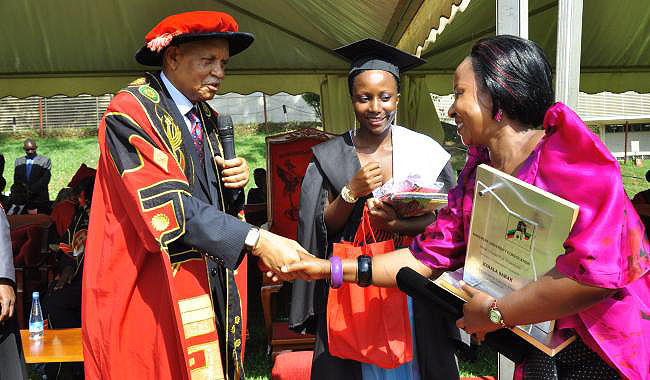
The best student in Sciences, Sarah Kimala (Pictured Centre), with a CGPA of 4.83 graduated today and received a plaque and a cheque of 1m shillings from The Convocation. The Association of Chartered Certified Accountants (ACCA) also presented an award to the best student in Bachelor of commerce, Yiga Henry Matovu, who obtained a CGPA of 4.53. The plaque he received is the first of its kind and will henceforth mark the beginning of subsequent ones.      
 
A jubilant PhD Graduate takes to the skies with Students of Performing Arts and Film (PAF), CHUSS, at the 64th Graduation Ceremony, Makerere University, Kampala Uganda
 
The ceremony also saw the first cohort of students offering a Bachelor of Science in Software Engineering from CoCIS graduate. As noted by the Vice Chancellor, Prof. John Ddumba- Ssentamu, the first cohort of students from Makerere University Jinja campus also graduated, in this highly unique ceremony. 
 
Professor John Ddumba-Ssentamu, Vice Chancellor, at the 64th Graduation Ceremony 28th-31st Jan 2014, Makerere University, Kampala Uganda"The 64th graduation ceremony is unique in three ways: One, for the first time, students from Somaliland who have been pursuing their studies from Sheik Technical Veterinary School with support from the College of Veterinary Medicine, Animal Resources and Biosecurity (CoVAB) are receiving diplomas of Makerere University in absentia. We congratulate the College for this initiative. Second, 67 of the pioneer students at our Jinja Campus will receive degrees in Information Technology, Business Administration and Development Studies. Of the 67, four [4] will receive first class degrees. We congratulate the pioneer students, the Coordinator of Jinja Campus, Professor J. B. Nyakaana together with his team. Third, ten [10] pioneers of the Female Scholarship Foundation [FSF] who benefitted from tuition waiver offered by the University are graduating. The Female Scholarship Foundation was established in November 2010 and as a sign of commitment and ownership, Makerere University offered 20 scholarships per year in form of tuition waiver starting with the academic year 2010/2011. This is a gesture of our social responsibility and efforts to ensure equitable access to higher education in Uganda,” he emphasized.
 
The Vice Chancellor was grateful to Makerere University members of Staff for the job well done in preparing graduates. “I would like to thank all members of staff of Makerere University for your dedicated service despite the challenges we face. You have played a positive role in the development of higher education as well as the transformation process of this country,” he said.  
 
Professor George Mondo Kagonyera, The Chancellor, at the 64th Graduation Ceremony, Makerere University, Kampala UgandaAs part of the highlights for the day, the Department of Performing Arts and film (PAF) and the Uganda Police Band gave energetic performances that saw some parents join them to dance in the Freedom Square.
 
This was before the Chancellor’s Procession joined the Freedom Square to officially start the ceremony. Chancellor Prof. Mondo Kagonyera challenged the graduates to be relevant to society. “Today you graduate into a community faced with multiple opportunities and challenges. Your success or failure will depend on how you view the world before you. To a great extent your destiny lies squarely on your shoulders. When faced with challenges, quickly ask yourself how you can use your knowledge and skills to turn them into opportunities. Likewise, when you encounter opportunities, ask yourself how you can harness them to serve humanity at large and not just your own interests. Often people do not realize that service to others leads to personal satisfaction. I am happy and proud to note that Makerere University’s biggest contribution to the region and beyond has been the ability to produce key human resource to serve humanity both at political levels and in large corporations. Graduates of Makerere University have distinguished themselves in the business world,” he said.
 
L-R: Arch. Dr. Barnabas Nawangwe (DVC FA) and Dr. Ernest Okello Ogwang (DVC AA) at the 64th Graduation Ceremony, Makerere University, Kampala UgandaThe highly colourful 64th graduation ceremony is organized by the Makerere University Ceremonies Committee, under the leadership of Assoc. Prof. Steven Nyanzi. Previous successful graduation ceremonies have been organized by the same committee. 

 
 
By Marion Alina, Public Relations Office
 
Related Articles 
 

Mark Wamai

Continue Reading

General

Celebrating a Life of Loyal and Distinguished Service

Published

on

Celebrating Pastor John M. Ekudu-Adoku, Dean of Students (1995-2010). Makerere University, Kampala Uganda, East Africa

The Makerere University community has with great sadness received the news of the passing on of our long serving Dean of Students, Father figure and Mentor to thousands of our alumni, Pastor John Ekudu. Please accept our sincerest condolences.

If loyal and distinguished service had a face, that face would be Pastor John Ekudu. A concurrent graduate of the Bachelor of Science (Botany/Zoology) and Diploma of Education of Makerere University in 1974, he, like many in that turbulent era, could have chosen to flee, but he didn’t.

Instead, he chose to stay, and along with many fresh graduates and senior staff, graciously accepted the title of “economic war lecturers/professors”, whose selflessness kept Makerere’s gates open during unpredictable times. In 1982 he was appointed Warden of Kabanyolo Hostel and thereafter Warden of University Hall in 1989, where he was promoted to the rank of Senior Warden.

In 1995 he was promoted to Dean of Students and whereas this would marked the beginning of a time to seat back and relax, it turned out to be a baptism of fire. The introduction of private sponsorship and cost-sharing which dealt away with “boom” incensed students. And then came the nightmare serial killings of students in 1996 and 1997.  Dealing with strikes became his daily bread but still he chose to stay.

But he did more than stay. He thrived, improving students’ meals with the introduction of much-needed animal protein, not to mention the daily dose of bread and rice. Pastor Ekudu was the true embodiment of taking the stumbling blocks that life throws at you and trusting God to help you turn them into stepping stones.

We therefore stand with the family during this trying time and pray that the God Almighty, who knows the plans He has for each and every one of us will continue to comfort and strengthen you.

May Pastor John M. Ekudu-Adoku’s soul rest in eternal peace.

Mak Editor

Continue Reading

General

RIMS Implementation to End Supervision Delays, Enhance Transparency, Close Gaps and Boost Research Excellence at Makerere University

Published

on

Prof. Julius Kikooma and Prof. Ruth Nsibirano during the visit to IGDS on 27th March 2026. Directorate of Graduate Training (DGT) digital transformation in graduate education with the implementation of the Research Information Management System (RIMS), a platform expected to end supervision delays, enhance transparency, close long-standing gaps, and boost research excellence, 27th March 2026, Institute of Gender and Development Studies (IGDS), Makerere University, Kampala Uganda, East Africa.

By Moses Lutaaya

Kampala, Uganda27th March 2026: Makerere University has intensified its push toward digital transformation in graduate education with the implementation of the Research Information Management System (RIMS), a platform expected to end supervision delays, enhance transparency, close long-standing gaps, and boost research excellence.

Leading this shift, the Director of Graduate Training at Makerere University, Prof. Julius Kikooma, emphasized that the initiative is part of ongoing collaboration with academic units.

“Our visit to the Institute of Gender and Development Studies is part of continuous engagement to strengthen graduate training,” Prof. Kikooma said. “RIMS is not just about technology—it is about improving how students and supervisors work together, how progress is tracked, and how the university ensures quality and timely completion.”

He noted that the university is already making strides in graduate output, citing a recent milestone of over 200 PhD graduates, with 40 percent female representation—an indicator of progress toward gender equity.

“We want to push that to 50 percent,” he said. “RIMS will help us get there by providing data, improving coordination, and addressing inefficiencies in supervision and monitoring.”

Prof. Kikooma emphasized that the system will also support the university’s broader goals, including internationalization and improved research productivity, by streamlining application, supervision, and reporting processes.

“With digitization now fully underway, we cannot go back,” he said. “RIMS will allow supervisors to track student performance in real time, and management will be able to access accurate reports at the click of a button.”

He added that adoption of the system is mandatory for all academic staff, noting that it will become a key tool for measuring performance and institutional accountability.

Building on this vision, Prof. Ruth Nsibirano, Director of the Institute of Gender and Development Studies, highlighted how RIMS will directly address supervision gaps that have historically affected graduate completion.

“I’m very certain RIMS is going to bridge the gap between supervisors and supervisees,” she said. “It will ensure constant updates, structured engagement, and clear records of progress for every student.”

Prof. Julius Kikooma (L) and Prof. Ruth Nsibirano (R). Directorate of Graduate Training (DGT) digital transformation in graduate education with the implementation of the Research Information Management System (RIMS), a platform expected to end supervision delays, enhance transparency, close long-standing gaps, and boost research excellence, 27th March 2026, Institute of Gender and Development Studies (IGDS), Makerere University, Kampala Uganda, East Africa.
Prof. Julius Kikooma (L) and Prof. Ruth Nsibirano (R).

Prof. Nsibirano explained that one of the major challenges in the past has been the lack of visibility in supervision, where both students and supervisors operated without clear documentation of their interactions.

“Knowledge of what was happening was often missing because supervisors and students remained distant,” she said. “Now, there will be records showing when supervision took place, what was discussed, and who has not been responsive.”

She noted that this transparency will significantly improve efficiency and reduce delays on both sides.

“Both students and supervisors will know that their work is being tracked,” she said. “This awareness alone will improve accountability and reduce unnecessary delays.”

However, she cautioned that while RIMS will strengthen supervision systems, financial challenges facing graduate students remain a critical issue.

“We must also address the reality of limited financial support,” she said. “Even with strong systems, students still need resources to complete their studies.”

Prof. Nsibirano expressed confidence that both staff and students are ready to adopt the digital platform, noting that familiarity with technology is no longer a major barrier.

At the operational level, Dr. Julius Mugisa, Coordinator of Graduate Studies at the Institute, underscored the practical impact RIMS will have on day-to-day supervision.

“In fact, it is a very good system. It will facilitate easy supervision,” Dr. Mugisa said. “Previously, you could send comments to a student and wait five weeks without a response. Now, the system will clearly show who is delaying and who is not.”

He emphasized that the transparency of RIMS will eliminate guesswork and misunderstandings by ensuring that all supervision activities are recorded and accessible.

“There will be clear evidence of engagement—comments, timelines, and responses,” he said. “This removes the blame game and helps everyone focus on progress.”

Dr. Mugisa dismissed concerns that increased monitoring might intimidate supervisors, instead framing it as a positive step toward professionalism.

“We are here to do our work for the university,” he said. “The system is not about punishment—it is about improving efficiency and ensuring that responsibilities are fulfilled.”

He added that the accountability introduced by RIMS will encourage timely feedback and active participation from both supervisors and students.

“When you know the system is tracking progress, it helps you stay on course,” he said. “Monitoring is important, and it benefits everyone.”

Dr. Mugisa also noted that improved supervision and faster feedback could enhance Makerere University’s attractiveness to prospective graduate students.

“Students want assurance that their work will be reviewed on time,” he said. “With RIMS, that confidence will increase, and more students will be encouraged to enroll.”

As Makerere University continues to implement RIMS across its academic units, leaders believe the system will mark a turning point in graduate education—driving efficiency, strengthening accountability, closing supervision gaps, and positioning the institution as a leader in research excellence in Africa.

Mak Editor

Continue Reading

General

Custodians and Wardens trained on Fire prevention in Halls of Residence

Published

on

A male participant puts out a fire during a practical demonstrations on the use of fire extinguishers on 26th March 2026. Office of the Dean of Students hands-on training focused on equipping custodians and wardens with essential skills and knowledge on fire prevention, evacuation procedures and response strategies in case of emergencies in halls of residence, March 26, 2026, at University Hall, Makerere University, Kampala Uganda, East Africa.

Staff members from the Office of the Dean of Students have undergone a hands-on training on fire safety and prevention in halls of residence.

The training, held on Thursday, March 26, 2026, at University Hall, focused on equipping custodians and wardens with essential skills and knowledge on fire prevention, evacuation procedures and response strategies in case of emergencies.

“In our safeguarding initiatives, we want to create an environment that is safe and secure for our students and staff. Given that we have experienced fires at the University, we decided to train custodians and wardens because they are the first responders and decision-makers in case a fire breaks out in any Hall of Residence,” said Dr. Winifred Kabumbuli, the Dean of Students.

Dr. WInifred Kabumbuli addresses participants. Office of the Dean of Students hands-on training focused on equipping custodians and wardens with essential skills and knowledge on fire prevention, evacuation procedures and response strategies in case of emergencies in halls of residence, March 26, 2026, at University Hall, Makerere University, Kampala Uganda, East Africa.
Dr. WInifred Kabumbuli addresses participants.

In 2020, Makerere University’s Main Building, commonly known as the Ivory Tower, caught fire, destroying valuable property. Earlier in 2018, a fire gutted Mary Stuart Hall, a female residence. The fire, which started in the ground-floor canteen, spread to other floors but was successfully contained by the Uganda Police.

Speaking in February 2025 during the release of the 2024 Annual Crime Report at the Police Headquarters in Naguru, the Director of Fires and Rescue Services, AIGP Stephen Tanui, revealed that Kampala Metropolitan recorded the highest number of fire incidents in the Country with 933 cases in 2024.

Participants pose for a group photo at the University Hall Staircase. Office of the Dean of Students hands-on training focused on equipping custodians and wardens with essential skills and knowledge on fire prevention, evacuation procedures and response strategies in case of emergencies in halls of residence, March 26, 2026, at University Hall, Makerere University, Kampala Uganda, East Africa.
Participants pose for a group photo at the University Hall Staircase.

He warned that Uganda’s rapid urbanisation would increase fire incidents unless deliberate prevention measures are adopted.

“We have had fire incidents at Africa Hall, Nsibirwa and Livingstone. Some students also prepare their own meals, which increases the risk of fire outbreaks. It is therefore timely for our staff to acquire basic knowledge on fire prevention and how to respond effectively when a fire occurs,” Dr. Kabumbuli noted.

Speaking to the participants, Mr. Levi Mwesigye, a certified fire safety trainer with NCOSAH Consults (Occupational Safety and Health Administration), emphasized the importance of proactive fire prevention. He explained that three elements, heat, fuel and oxygen are necessary for a fire to exist.

Participants follow proceedings during the theoretical part of training. Office of the Dean of Students hands-on training focused on equipping custodians and wardens with essential skills and knowledge on fire prevention, evacuation procedures and response strategies in case of emergencies in halls of residence, March 26, 2026, at University Hall, Makerere University, Kampala Uganda, East Africa.
Participants follow proceedings during the theoretical part of training.

“Always ensure that fire detection systems are in place to identify fires at an early stage. Additionally, ensure fire protection systems such as portable extinguishers are functional and regularly serviced so that fires can be contained promptly,” advised.

In his presentation, Mr. Mwesigye also urged Wardens to install clear directional signage in Halls of Residence to enhance safety and facilitate quick evacuation during emergencies.

“Fires spread much faster than you might think. Always have a backup escape plan in case your main escape route becomes blocked. If you can’t put out the fire in 5 secondsor less, the fire is too large. Get out and always prioritize persons with disabilities, women, the sick, and other vulnerable individuals to ensure they are evacuated safely,” Mr. Mwesigye, said.

Participants listen to instructions from one of the trainers. Office of the Dean of Students hands-on training focused on equipping custodians and wardens with essential skills and knowledge on fire prevention, evacuation procedures and response strategies in case of emergencies in halls of residence, March 26, 2026, at University Hall, Makerere University, Kampala Uganda, East Africa.
Participants listen to instructions from one of the trainers.

Apart from training the staff about fire safety at the University, the staff also received fire prevention tips applicable to their homes such as;  never to sleep in a house without water, to always have a centralized place where they keep the house key so that it is easy to find during evacuation.

“For those who have gas cylinders at home, in case of a leakage, open doors and windows to reduce the concentration of gas. If the cylinder catches fire, soak a towel or blanket in water and use it to cover the cylinder. This can help to put out the fire,” Mr. Mwesigye explained.

When using a fire extinguisher

Participants received practical demonstrations on the use of fire extinguishers and learned how to identify and manage small-scale fires before they escalate into life-threatening emergencies. Tips included:

  • Stand several feet away from the fire, only moving closer once the fire starts to diminish.
  • Use a slow, sweeping motion and aim the fire extinguisher nozzle at the base of the fire.
  •  If possible, use a “buddy system” to have someone back you up or to call for help if something goes wrong.
  • Be sure to watch the area for a while to ensure the fire does not re-ignite.

Deciding to Use a Fire Extinguisher

Before attempting to put out a fire with a portable fire extinguisher, one must quickly answer the following questions:

  • Have the building’s occupants been notified?
  • Has someone called the Fire Brigade?
  • Are the exit routes clear and safely accessible?
  • Do I have the right type of extinguisher for the type of fire?
  • Is the extinguisher large enough for the fire?
  • Is the fire small and containable?

If the Answer to the above is NO, Then;

  • Leave the building immediately.
  • Shut all doors as you leave to slow the spread of the fire.
  • As soon as you get out of the building, call the Police.

Carol Kasujja
Carol Kasujja Adii

Continue Reading

Trending