Greetings from the Infectious Diseases Institute-IDI McKinnell Knowledge Centre at Makerere University Main Campus!
I would like to highlight the evolution of our work, from the vantage point of having been at the Institute since its inception. In nearly two decades, our fundamental mandate of freeing Africa from the burden of IDs has not really changed. However, to maintain relevance to societal needs, particularly here in Uganda, IDI has proactively embraced a strategic shift in the disease areas of focus.
As we envisaged achieving epidemic control of HIV (based on encouraging data from well-conducted surveys), we elected to embark on newer areas of contribution. That is why we created the Global Health Security (GHS) Programme to prevent, detect and respond to diseases like Ebola, and the rising tide of antimicrobial resistance. Our contribution to the prevention and managing HIV has been immense and undisputed. Yet, the whole
HIV/AIDS experience – in its own right a deadly and devastating experience – may just have been a practice opportunity for more devastating infectious diseases. Adversaries such as like Ebola or SARS or the novelSARS-COV-2, the cause of COVID-19!
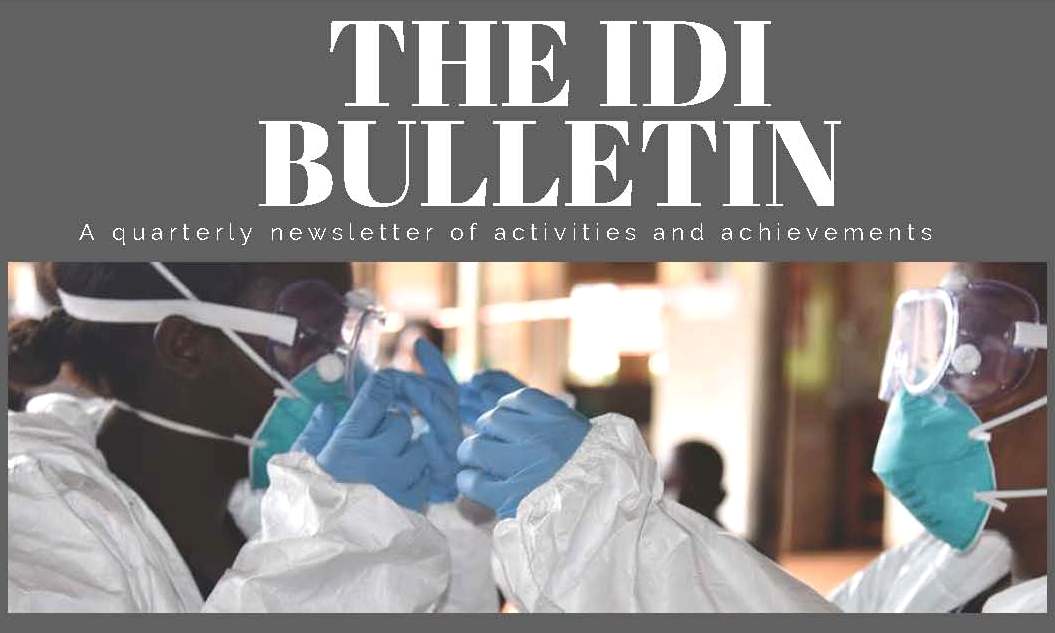
With its long incubation period (anywhere between 7 and 11 years), HIV’s can be viewed as an epidemic in slow motion compared to Ebola and now COVID-19, which has an incubation period of just days. Comparatively, HIV allowed up the opportunity to set-up prevention, surveillance and health care delivery systems. I am convinced more than ever that our HIV experience is highly relevant to the COVID-19 response. Led by our Global Health Security Programme, IDI has supported the Government of Uganda since COVID-19 was anticipated. We have done this by enhancing systems at points of entry and are leading efforts to protect healthcare workers through IPC training, provision of personal protective equipment (PPE) and alcoholbased hand rub. I invite you to read our quarterly newsletter to bring you up to speed with our contributions.
Dr. Andrew D. Kambugu, Sande-McKinnell Executive Director, IDI
72 undergraduate students of Makerere University have successfully been admitted to the Millennium Fellowship Class of 2026, an initiative of the Millennium Campus Network (MCN) and United Nations Academic Impact. Makerere’s Fellows were selected from a record-breaking 76,000 applicants from over 6,000 campuses across 174 countries to participate in the ambitious programme.
According to the Fellowship website, the programme aims to make the Sustainable Development Goals (SDGs) and UN Academic Impact Principles a reality on campuses, in classrooms and throughout communities. Millennium Fellows are university undergraduates selected for their leadership on sustainable development projects in their communities. As Fellows, they complete a semester-long leadership development programme that strengthens their student organizing, partnership-building and community-impact skills.
In his congratulatory message to the Vice Chancellor, Prof. Barnabas Nawangwe, Sam Vaghar the Executive Director, MCN shared that Over 330 campuses across 60 nations have been selected to host 2026 Millenium Fellows. “Congratulations to you and Makerere University for having a cohort of Millennium Fellows from your student body again this year!”
Below is a sample of the work of the Class of 2026.
At Harvard University, a UN Academic Impact member institution in the United States of America, Millennium Fellows are expanding OpenDoor, an AI-powered platform that helps people navigate retraining, job opportunities and pathways into high-demand careers. The project grew from their work with people experiencing homelessness and from seeing how difficult workforce programmes can be to navigate even when support exists. Advancing SDG 8: Decent Work and Economic Growth, it expects to reach about 7,500 people during the Fellowship.
At the University of Ilorin, a UN Academic Impact member institution in Nigeria, Millennium Fellows are building what they describe as Africa’s first green AI policy framework, helping policymakers and developers understand how artificial intelligence can advance while reducing energy use, pollution and material waste. Aligned with SDG 13: Climate Action, it expects to reach about 75 people during the Fellowship.
At BRAC University, a UN Academic Impact member institution in Bangladesh, a Millennium Fellow is advancing SDG 12: Responsible Consumption and Production through a start-up replacing single-use products with environmentally friendly alternatives. Its current focus is a paper pen that uses roughly 90 per cent less plastic than a conventional pen, with a seed built in so it can grow into a plant when properly disposed of. The project expects to reach about 450 people.
At Nicolae Testemițanu State University of Medicine and Pharmacy, a UN Academic Impact member institution in Moldova, a Millennium Fellow is advancing SDG 3: Good Health and Well-being by studying how environmental conditions such as temperature and humidity may affect recovery after brain surgery. By bringing simple digital monitoring tools into postoperative care, the project aims to help doctors make timelier decisions.
We wish our Millennium Fellows an impactful fellowship.
The Office of Academic Registrar, Makerere University has released admission lists of candidates admitted under the Talented Sports Men & Women, Disability and District Quota Schemes with Government sponsorship 2026/27 Academic Year including appeals and remarked cases.
Other admission lists released include A-Level Applicants with Ugandan and those with Foreign Qualifications, Diploma in Performing Arts, Mature-Age Entry and Bachelor of Education (EXTERNAL Batch 2) for the Academic Year 2026/2027 under self sponsorship.
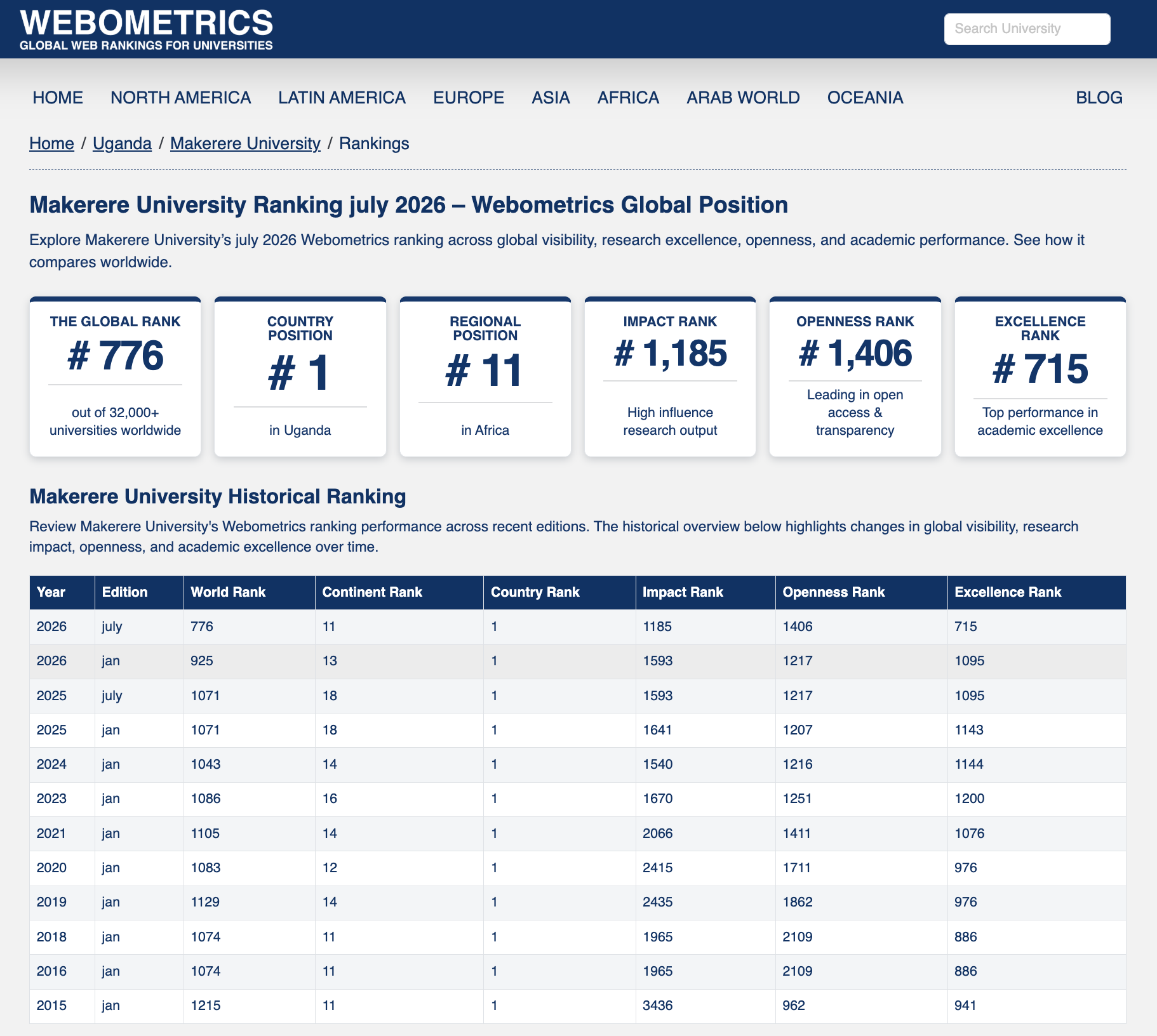
Makerere University‘s position in the July 2026 edition of the Webometrics Rankings has improved from 925th to 776th globally and from 13th to 11th on the Continent, compared to the January 2026 edition. Makerere remains the top-ranked University in Uganda and East Africa.
The new rankings are as a result of improved performance in the Impact Rank, which measures the number of external domains referring/linking to Makerere (from 1,593 to 1,185) and the Excellence Rank, which measures Research papers in the top 10% most cited between 2019 and 2023 (from 1,095 to 715).
Please see the attached screenshots for details or view Makerere‘s rankings online using the link below:
The Webometrics Ranking of World Universities aims to recognize and promote the digital transformation of higher education institutions by evaluating how effectively they reflect their academic, research, and societal contributions online.
We remain committed to ensuring that all our good work in teaching and learning, research, knowledge transfer, and partnerships continues to be reflected online through various journals and other platforms.



 General2 days ago
 General2 weeks ago
 General6 days ago
 Health2 weeks ago