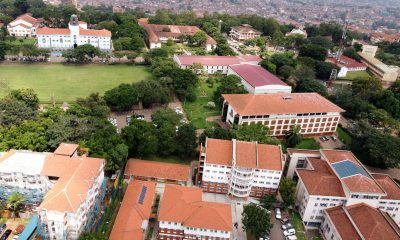
For those who had never been to let alone heard of the St. Francis Students' Centre Upper Hall, the First Makerere University Joint Staff Christian Fellowship held on Thursday 31st October 2019 was the perfect opportunity to discover this venue. Located on the left of the first landing as you descend from the St. Francis Chapel parking lot to the Main Students’ Centre, this venue was hard to miss as the soothing songs from the St. Francis Choir drew and ushered brethren into the atmosphere of worship.
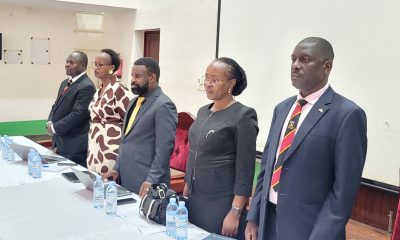
With hands lifted up and souls lost in worship and adoration of their God, staff from almost all Colleges, regardless of rank, staff association or denomination gathered as one to fellowship. The first gathering was organized by Joint Staff Christian Fellowship Steering Committee with the blessing of the Chaplain, St. Francis Chapel, Rev. Can. Onesimus Asiimwe.
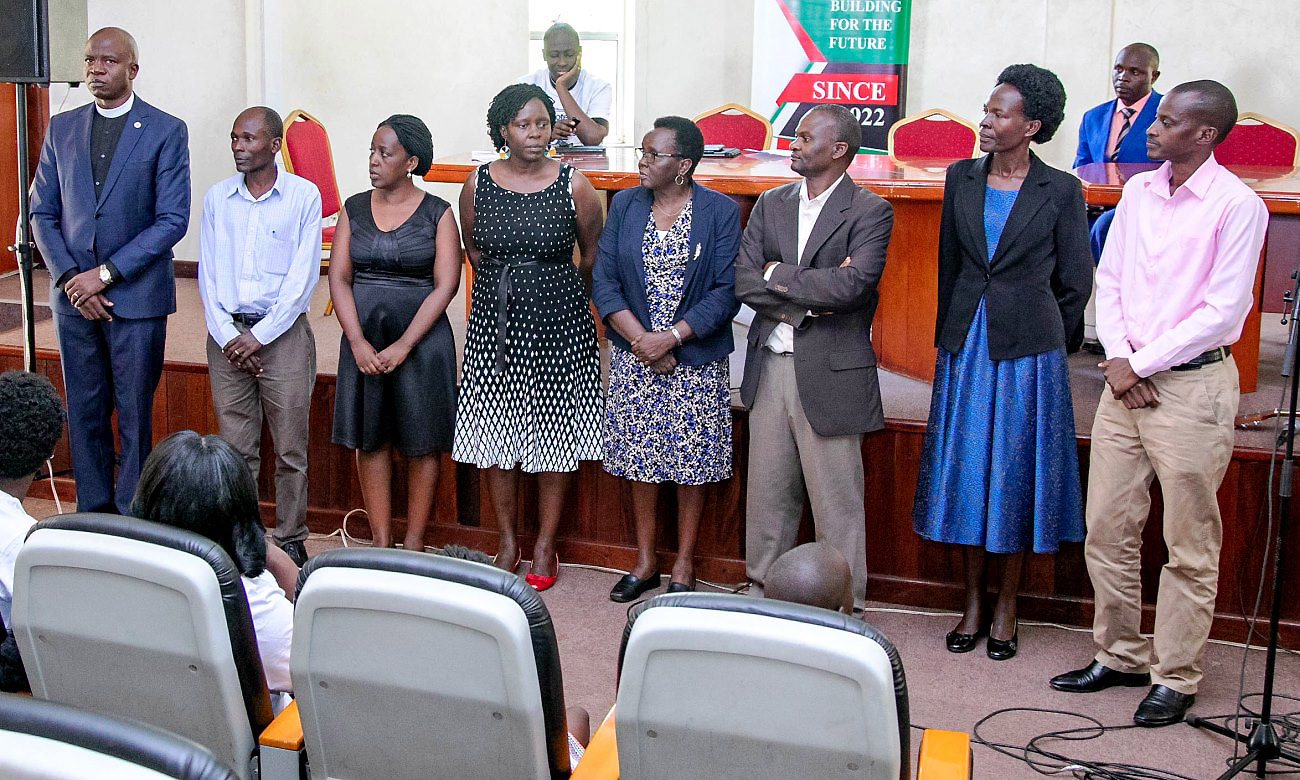
Welcoming brethren, the Chairperson Steering Committee, Makerere University Joint Staff Christian Fellowship, Dr. Chris Tuhirirwe expressed gratitude to God for once again gathering the staff to fellowship as one, in addition to the more regular activities of their unit fellowships. He introduced other members of the Committee present namely; Mrs. Josephine Apolot Opolot (Vice Chairperson), Ms. Christine Ninsiima (Treasurer), Dr. Proscovia Katumba (General Secretary), Mr. Grace Musiime (Publicity Secretary), Mr. Samuel Kapasa and Dr. Barbara Nerima.
He thanked members for volunteering their time and energy to run affairs of the Committee and urged staff to continue praying for the filling of the vacant position of Vice General Secretary.
Ministering to the congregation, Rev. Can. Onesimus Asiimwe thanked staff for sparing time to attend the fellowship, noting that it is important for brethren to meet and break bread as one. He reassured the congregation that the Joint Staff Christian Fellowship was nondenominational and as such, all worshippers of God are welcome to attend.
Preaching from Luke 19:1-10; Jesus’ encounter with Zacchaeus, the Chaplain drew parallels between this man and Makerere University Staff, the former being Chief Tax Collector in Jericho on behalf of the Roman Empire and the latter being Civil Servants acting on behalf of the Government of Uganda.
Rev. Can. Asiimwe shared that whereas Zacchaeus was a man of great stature and wealth in Jericho, he was so moved by what he had heard about the miracles of Jesus that he abandoned his work and scaled a tree, just to catch a glimpse of Him. It was as a result of this act that Jesus spotted him and asked to dine at his house.
“The lesson here is that inconsiderate of our rank as staff of Makerere University, we should never miss our once in a lifetime opportunity to encounter Jesus. Had Zacchaeus missed this opportunity, he would never have found salvation. This was the last time that Jesus ever went to Jericho” he explained.
The Chaplain went on to share that it was because Zacchaeus found salvation that he immediately gave half of his possessions to the poor, and committed to pay back four times the amount to anybody that he had cheated out of anything.
“I want you to turn to your neighbor and ask them when was the last time that they ministered to someone about Jesus Christ…” challenged Rev. Can. Asiimwe.
He therefore urged staff to always be the salt and light in their spheres of influence and to always pray for their institution. “At yesterday’s midweek service, we prayed that the unrest on campus would cease in Jesus’ Name and we thank God that Heard our prayers.”
The Chaplain who confessed to have the gift of giving then invited the congregation to partake of a meal, for it is important for brethren to eat after they meet, especially if they are not fasting. He equally pledged to continue offering lunch to the monthly Joint Staff Christian Fellowship as his humble contribution to the brethren.
College of Health Sciences Quality Assurance (QA) Training in Assessments, Pedagogy and Competence Based Curriculum Held 18–19 June 2026 at Esella Hotel.
Pedagogy, Assessment and Supervision Training Workshop
The College of Health Sciences has embarked on the journey to improve the teaching, assessment and preparation for the adoption of the competence-based curriculum.
The training was held on 18-19 June 2026, at Esella Hotel, Kira, the training targeted the teaching assistants, lecturers’ senior lecturers’ key administrators and some PhD fellows, generally the early career academic staff that are yet growing in the ranks.
Seated L-R: Dr. Peter Ssenkusu, Prof Grace Ndeezi, Prof Idro Richard and Dr. Irene Rebecca Namatende with the participants at Esella Country Hotel.
Objectives
Equip participants with modern pedagogical approaches for effective teaching and learning.
Review and harmonize assessment strategies to ensure quality and fairness in academic evaluation.
Enhance supervisory competencies for guiding graduate students in research and academic progress.
Foster collaboration and shared experiences among facilitators, supervisors, and administrators.
Dr. Peter Ssenkusu facilitating at the Pedagoggy and Assessment workshop on 18 June 2026.
The key focus areas for the training
Guidelines in Assessment & Course Outlines- Dr. Cyprian Misinde -Chief Quality Assurance Officer.
Competence Based Education and Assessment- Dr. Mike Kagawa
Advancing continuous improvement in teaching, learning through teaching styles -Dr. Ssebowa Dorothy.
Teaching methods Knowledge production and acquisition- Dr. Peter Ssenkusu
Graduate Supervision Challenges and Opportunities- Prof. Grace Ndeezi.
Competence Based Curriculum in line with the NCHE- Dr. Innocent Besigye.
Feedback mechanisms in training- Dr. Irene Rebecca Namatende.
Dr. Mike Kagawa, facilitating at the Workshop on 18 June at Esella Country Resort Hotel.
Key Outcomes for this training
The participants gained the understanding of learner-centered teaching approaches and pedagogical principles.
Acquired new skills supervisory skills, particularly in guiding research and addressing student challenges.
Consensus on adopting standardized assessment tools across graduate programmes.
Practical exposure to teaching models and interactive learning methods.
Development of action plans for continuous professional development in pedagogy and supervision.
The participants also acquired more skills in line with the competence-based curriculum as required by the National Council for Higher Education.
Dr. Innocent Besigye presenting the processes for curriculum review on 19 June 2026.
During the Discussion Key important Questions emerged as follows:
Who supervises the supervisor?
What is the difference between notion hours and contact hours?
The 60/40 way of assessments—can it be independent for every course unit taught or allocated differently?
How do we manage difficult supervisors?
How do we Coerce PhD students to be fully involved in departmental activities without them feeling Coerced?
How much time do we need to prepare for the review of the programmes in line with the competence-based curriculum as required by the National Council for Higher Education (NCHE) and the World Health Organization (WHO)?
We truly thank the facilitators and the participants who made this training very informative and enlightened. We also appreciate the Principal/Deputy CHS, the Chief QA Officer, Makerere University and the University Management for the enormous support and for making this activity possible.
Dr. Irene Rebecca Namatende Quality Assurance 0ffice College of Health Sciences, Makerere University
The Deputy Vice Chancellor in charge of Academic Affairs (DVCAA) Prof. Sarah Ssali on 15th July 2026 commended the Research and Education Network for Uganda (RENU)’s Industrial Trainee Program, describing it as the perfect hands-on intervention for the future workforce. She made the comments while on a guided tour of RENU’s on-campus Lab facility where ten undergraduate students from Makerere and other Universities are undergoing a two-month practical training.
Origin of tour
The tour was prompted by a 24th June 2026 meeting with a RENU delegation led by CEO, Mr. Nicholas Mbonimpa, aimed at broadening the existing partnership with Makerere University beyond internet service provision to supporting teaching, learning and research activities. During the said meeting, Prof. Ssali expressed Makerere‘s desire to produce graduates that are not only academically grounded but also cognizant of the needs of the job market.
Seated L-R: Prof. Dorothy Okello, Prof. Sarah Ssali, Mr. Nicholas Mbonimpa and Mr. Samuel Mugabi during the 24th June 2026 meeting.
In his response then, Mr. Mbonimpa expressed RENU’s readiness to continue advancing digital transformation through advancing resilient connectivity, research infrastructure, and innovative initiatives that enhance teaching, learning, and research. He shared that the Senate Building’s computer network had been revamped in line with advancing resilient connectivity, and the initiative would be expanded to the College of Engineering, Design, Art and Technology (CEDAT) buildings and other premises subsequently.
The RENU CEO further highlighted that resilient connectivity forms a good basis for the proposed Open Radio Access Network (RAN) Architecture deployment set to be done within six months, so as to boost training of students in 5G and other technologies. Other initiatives discussed included training staff and students on acquisition of Open Researcher and Contributor ID (ORCID) to improve visibility of their publications and research output.
Training Program Lauded
Addressing student interns during the 15th July guided tour, the DVCAA who was accompanied by the 92nd Guild Speaker Rt. Hon. Trevis Mutatiina Muhwezi urged beneficiaries to harness all the technical and social opportunities accorded by the Program. “Not all students in your respective academic programmes had the benefit of being exposed to this kind of training so please make the most of it and utilize skills gained here beyond the classroom setting”.
Mr. Nicholas Mbonimpa (C) with Prof. Sarah Ssali (L) and Rt. Hon. Trevis Mutatiina Muhwezi (R).
The 2026 Industrial Trainee Program is equipping students with skills on how to diagnose and repair ICT equipment based on old and disused stock.
Prof Ssali was also toured the makerspace where solar-powered routers are manufactured and deployed to extend internet connectivity to both rural and urban locations. In 2023, RENU partnered with Mesh++, a Chicago-based connectivity solutions manufacturer, to manufacture solar-powered internet routers in Uganda. Since inception, over 200 units have been manufactured and deployed across various sites in Uganda, while over 80 units have been shipped to various African countries such as Malawi, Rwanda and South Sudan under the RENUMESH Technologies joint venture.
Prof. Sara Ssali inspects the RENUMESH Technologies router.
Partnerships Inspiring New Prototypes
The RENU CEO nevertheless pointed to a long turnaround time for shipping parts from the U.S. as one of the drawbacks hindering the product’s rapid deployment. As a result, RENU, in response to the Ugandan Government’s call for import substitution and local capacity development is developing a solar-powered internet router with some of the components sourced from Ugandan companies Innovex and Chloride Excide.
“Innovex will supply the Internet of Things (IoT) component to help RENU remotely monitor and control the router while Chloride Excide will provide the batteries” Mr. Mbonimpa explained. He added that some of the current lot of trainees were already running simulations on the prototype and proposing how the device can be further refined so as to increase its portability and reduce its price.
Prof. Sarah Ssali with RENU Leadership and Trainees in the makerspace.
A call for Expansion
At the conclusion of the tour, Prof. Ssali who commended the use of modular Ugandan components for the prototype thanked the RENU team to exposing students to real-world technological deployments. She nevertheless urged the CEO and his team to expand the program’s intake beyond ten trainees and duration beyond the current two months so as to give students a richer experience.
The CEO RENUMESH Technologies Mr. Brian Masiga thanked the DVCAA for following up their 24th June meeting with the visit, which demonstrates that the University Management values students’ development of practical skills. He equally thanked Prof. Ssali for Management’s support to RENU activities and pledged to further refine the prototype to produce a cheaper and more portable proudly Ugandan product.
Mr. Brian Masiga (R) walks Prof. Ssali (L) through the layout of the prototype.
First Deputy Vice Chancellor for Academic Affairs, Prof Sarah Ssali on her Right, Prof. Fredrick Muyodi, and Prof. William Tayeebwa at the launch of the Summer School.
Makerere University has officially launched its inaugural writing summer school, a week long professional development program aimed at equipping students, graduates, researchers and staff with practical writing skills required for academic excellence and success in today’s competitive job market. The program jointly organized by the Makerere University Writing Centre and Makerere University Press (MakPress), reflects the University’s commitment to nurturing graduates with not only academic knowledge but also the communication skills needed to thrive professionally.
Held virtually, the launch attracted more than 280 participants from Makerere University and other higher education institutions, demonstrating the growing demand for structured writing support beyond the classroom.
Building the Next Generation of Writers.
Speaking at the launch, the Director of Makerere Writing Press, Prof. William Tayeebwa, said the summer school represents an important investment in developing writers before their work reaches publication.
“The press has traditionally focused on publishing books, journals and scholarly work. Today, we are expanding that mission by helping and develop the writers who will produce tomorrow’s publication.
He noted that MakPress continues to support the publication of books and scholarly works produced by members of the Makerere Community. Using recently published books authored by a member of staff and a student as examples, he encouraged participants to submit manuscripts for publishing support rather than relying solely on self publication.
Writing as a Foundation for Academic and Professional Success.
Chairperson of the Makerere University Writing Centre, Prof. Frederick Muyodi, said the center was established to strengthen the writing competences among students, researchers and university staff.
” The Writers Center is here to support every stage of the writing process from CVs and application letters to research manuscripts, grant proposals, reports and responsible use of Artificial Intelligence in writing.”
He explained that the Centre supports writing across multiple disciplines and professional contexts, adding that its long term vision is to extend writing support beyond Makerere University to institutions across Uganda and the East African region.
Equipping Graduates for the Labour Market.
Officially launching the summer school, the First Deputy Vice Chancellor for Academic Affairs, Prof. Sarah Ssali, described the initiative as a strategic investment in preparing graduates for an increasingly competitive labour market.
She observed that while universities successfully impart disciplinary knowledge, many graduates leave campus without the practical writing skills required to secure employment and other professional opportunities.
“We teach content very, but many students are never taught how to write an effective CV, application letter, motivation statement or scholarly essay. Yet these are the documents that often determine whether someone secures an opportunity.”
Prof. Ssali said the writing summer school would bridge the gap between classroom learning and professional practice by equipping participants with market ready communication skills.
Reaffirming her office’s commitment to the initiative, she added:
“My office is pleased to support this initiative as we institutionalize the Writing Summer School to ensure that Makerere graduates leave not only with degrees but also with practical competencies needed to thrive professionally,”
She officially declared the inaugural Writing Summer School open and expressed optimism that future editions would attract even more participants and resources.
Participants Gain Practical CV Writing Skills.
The first technical session was facilitated by Mr. Abdul Noor Luttamaguzi, a PhD student in the Department of Zoology, Entomology and Fisheries Sciences within the School of Bio sciences at Makerere University, a Senior Fisheries Officer with Luweero District Local Government, and the founder and director of the ANL Foundation, an organization that supports youth employment and capacity building.
During the session, he guided participants on developing competitive CVs tailored to specific professionals and employer expectations. He emphasized that applicants should customize their CVs to suit each opportunity instead of submitting the same document for every application. Participants also learned how effectively present their education, work experience, leadership roles technical competencies and professional achievements, while avoiding unnecessary personal information. Practical demonstrations using professional specific CVs provided participants with hands on examples of preparing competitive job application documents.
Looking Ahead.
The Writing Summer School continues throughout the week sessions on application letter writing, responsible use of artificial intelligence, professional communication and other essential writing skills aimed at improving academic productivity and employablity.
Through initiatives such as the Writing Summer School, Makerere University continues to strengthen its commitment to producing graduates who are not academically accomplished but also equipped with practical communication skills that enable them to compete and lead in today’s global workplace.