
General
Mak-UC Berkeley-Pathfinder Set To Promote PHE Research & Policy in Uganda

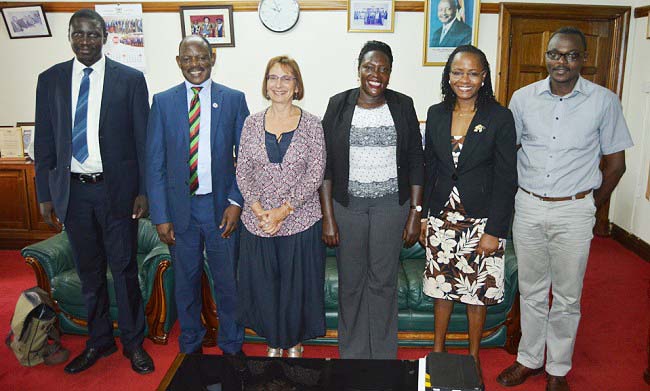
The Vice Chancellor, Prof. Barnabas Nawangwe on Wednesday, 27th June 2018 held discussions with the University of California Berkeley (UC Berkeley)’s Dr. Robin Marsh and Pathfinder International Uganda’s Ms. Nakajubi Jackline on the possibility of integrating the Population, Health and Environment (PHE) approach in Makerere University’s curricular, research and student projects. Dr. Marsh is a Senior Researcher/Socio-Economist with the Institute for the Study of Societal Issues (ISSI), UC Berkeley while Ms. Nakajubi is Pathfinder’s Health of People and Environment in the Lake Victoria Basin (HoPE LVB) Project Coordinator.
Giving a preamble to the discussion, The Principal, College of Business and Management Sciences (CoBAMS), Dr. Eria Hisali noted that the work currently being done by UC Berkely and Pathfinder under the PHE HoPE-LVB project in Mayuge and Wakiso Districts is important to Uganda and as such would greatly benefit students and the community when integrated into the Makerere curriculum.
“We have deliberated on to the possibility integrating PHE into our graduate programmes in a phased approach. PHE is a very multidisciplinary as it touches on Public Health, Gender Studies, Environment, Statistics, Environmental Health, One Health among others” said Dr. Hisali.
He therefore thanked Dr. Marsh and Ms. Nakajubi for reaching out to Makerere University and hoped that the PHE integration would receive the full support of Senate and Management.

Speaking as a socio-economist with over 25 years of experience with a keen interest in how agriculture interacts with the environment, gender equality and reproductive health, Dr. Marsh thanked the Vice Chancellor and staff present for sparing time to discuss the proposed intiative.
“I have taught in the field of Population, Environment and Development at UC Berkeley's College of Natural Resources for over fourteen years. I also coordinate our PHE work in East Africa, supported by Pathfinder International under which we run student practicums for graduate students” Dr. Marsh shared.
She added that the student practicums offer UC Berkeley students the opportunity to work with peers from Makerere University and the University of Dar-es-Saaam, “which enhances two-way learning as the students support each other on ongoing research projects.”
To facilitate PHE integration into the curriculum, Dr. Marsh shared that a two-day Interdisciplinary Faculty Workshop is being proposed for early November; so as to coincide with the International Conference on Family Planning (ICFP) scheduled to take place from 12th to 15th November in Kigali, Rwanda. The proposed workshop will give faculty the opportunity to familiarise themselves with the PHE conceptual framework and current projects, as well as review the curricula of existing courses with the intent of incorporating PHE content.

At the country level, the National PHE Strategy has already been drafted and is expected to be approved this year, with the Ministry of East African Community Affairs as the host and coordinating body, taking into consideration the importance of Lake Victoria to the EAC member countries. Ms. Nakajubi further shared that Pathfinder International Uganda and its partners would work with the National Population Council (NPC) as the lead technical agency to help implement the strategy.
In his remarks, Prof. Barnabas Nawangwe welcomed Dr. Marsh and Ms. Nakajubi to Makerere University and thanked them for sharing their proposal. “This is a very wonderful initiative especially as Population, Health and Environment issues deeply impact every single Ugandan community.”
Citing recent reports that put Uganda’s population estimate at 100million by 2030, Prof. Nawangwe expressed fear that this was a disaster waiting to happen unless measures were taken to adequately plan for increased food production and health provision, especially in the wake of climate change and increasing incidences of diseases such as ebola.
“The rate at which the current population is destroying the environment is alarming! As the population increases, this can only get worse. On the PHE front, almost every discipline in the University has a role to play and as such, Makerere, through the Department of Population Studies would love to take lead in making a contribution” remarked Prof. Nawangwe before reassuring the team of the University Management’s full support for the initiative.
The meeting was attended by the Dean School of Women and Gender Studies-Dr. Sarah Ssali, Head Department of Population Studies-Dr. Cyprian Misinde and Mr. Mfitumukiza David, Climate Adaptation Specialist, Makerere University Centre for Climate Change Research and Innovations (MUCCRI),
Article by Public Relations Office


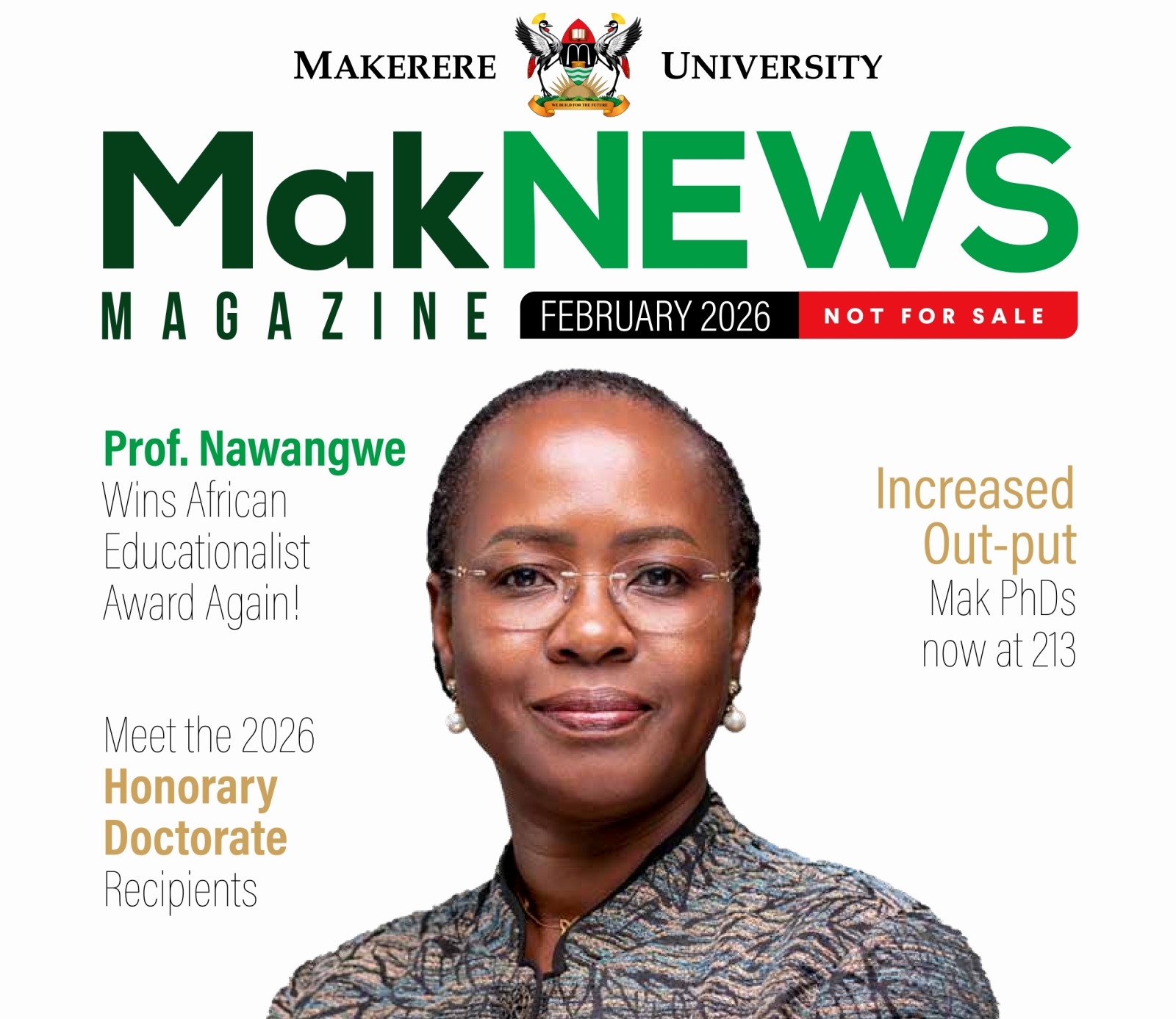


The Board Chairperson of the Makerere University Endowment Fund (MakEF), Dr. Margaret Blick Kigozi, has urged graduands in Health and Life Sciences to uphold professional ethics and serve humanity with diligence and compassion.
Her appeal came during the passing out of graduates from the College of Natural Sciences (CoNAS), the College of Veterinary Medicine, Animal Resources and Bio-Security (CoVAB), the College of Health Sciences (CHS) and the School of Public Health (SPH) on Day Two of the 76th Graduation Ceremony of Makerere University.
“Class of 2026, you are now part of the Makerere legacy. Wherever you go clinics, laboratories, farms, boardrooms, or classrooms, you carry this institution with you. Serve your patients with skill and compassion. Care for animals and communities responsibly. Question boldly and keep learning,” Dr Kigozi, said.
Delivering the commencement address, Dr. Kigozi lauded the graduates for their dedication to careers that directly impact lives and communities. She encouraged them to use their knowledge generously and exercise their power gently.
“Your education has trained you to ask better questions. Your humanity must guide the answers. Never forget that behind every chart, every case, every animal, every experiment, there is life. And life deserves care, patience, and dignity. Give every person you come in contact with care, patience and dignity,” Dr Kigozi, noted.
As the graduates embark on their professional journeys, Dr. Kigozi emphasized the importance of cultivating basic business acumen and financial literacy to ensure sustainability in their work.

“You do not need to become accountants but you must be able to read the essentials: understand simple financial statements, budgets and key metrics so you can judge whether a clinic, lab, or program is sustainable. You are encouraged to start your business. There are numerous investment opportunities in your areas of training. You can provide services to our people and create jobs,” Dr Kigozi, said.
She shared candidly how, when she first stepped into leadership, she realised she did not understand balance sheets or budgets well enough. So, she returned to Makerere for short courses to strengthen herself.
“A well-run Hospital, clinic or lab delivers better outcomes, attracts staff, and secures funding. Business savvy is not only about profit, it’s about sustainability and the freedom to serve ethically and effectively. Carry clinical skill with business sense so your work endures and grows,” Dr. Kigozi, noted.
Quoting renowned writer and producer Shonda Rhimes, creator of Grey’s Anatomy, who once reflected that succeeding in one area of life can sometimes mean falling short in another, Dr. Kigozi encouraged women graduates to intentionally balance professional ambition with family responsibilities.
“When one area thrives, another is often under strain. When Navio was graduating from school I had to manage the Presidential Investor Round Table on the same day as Executive Director Uganda Investment Authority. I chose my job and delegated his siblings to attend Navios graduation. I learnt from this. I choose family always after that thing you achieve once and keep forever,” Dr Kigozi, said.
In his speech, the Prof Barnabas Nawangwe, the Vice Chancellor, informed the congregation that Makerere’s ranking on all university ranking platforms has remained stable, placing Makerere among the top 10 African universities and within the top 4.5% globally.
“In the Times Higher Education global ranking, Makerere University made a formidable jump from the 1200-1500 bracket to the 800-1000 bracket. This was no mean achievement and I congratulate all members of the Makerere Community on this stellar performance,” Prof Nawangwe, said.

-
 Humanities & Social Sciences5 days ago
Meet Najjuka Whitney, The Girl Who Missed Law and Found Her Voice
-

 Health1 week ago
Uganda has until 2030 to end Open Defecation as Ntaro’s PhD Examines Kabale’s Progress
-
 Agriculture & Environment1 week ago
Uganda Martyrs Namugongo Students Turn Organic Waste into Soap in an Innovative School Project on Sustainable Waste Management
-

 General4 days ago
76th Graduation Highlights
-

 General1 week ago
Mastercard Foundation Scholars embrace and honour their rich cultural diversity