Connect with us

General

MAK Vice Chancellor tasks graduands to become change agents

Published

on

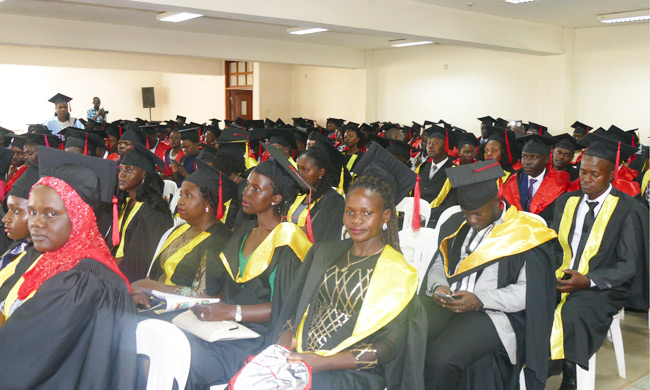
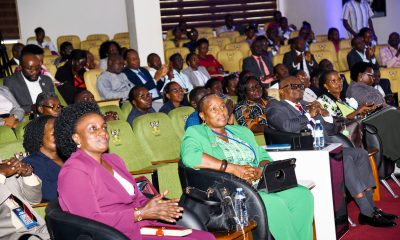
The Vice Chancellor of Makerere University, Prof. John Ddumba-Ssentamu has advised over 500 e-learning students who graduated on Friday 14th July 2017 to become champions of change in their communities.

“This is a golden possession which better positions you to favorably compete for employment or become job creators. You have worked hard and made sacrifices to earn the awards you receive today, you now embark on another phase of your lives as graduates. Use the qualifications acquired to be the champions of change in your respective disciplines,”said Prof. Ddumba-Ssentamu in a speech read by the Principal of Makerere University College of Computing and Information Sciences(CoCIS)-Prof. Constant Okello Obura.L-R Dr. Peter Nabende-Head of Department of Information Systems (CoCIS), Prof. Abhinash Kumar - Director Amity University Directorate of Distance and Online Education, Prof. Constant Okello Obura-Principal CoCIS, Mr Ninshant Singhai- Senior Manager Directorate of Distance and Online Education Amity University and  Assoc. Prof. Agnes Rwashana - Deputy Principal CoCIS

The Vice Chancellor noted that the tele-education programmes at the College of Computing and Information Sciences supported by the Government of India are a direct response to national, regional and international demands to comprehensively expand and strengthen avenues for providing higher education in Uganda and the region. He added that enrollment levels for higher education in Uganda have lagged behind due to the orthodox thinking which confines education to being in the physical presence of a lecturer. According to the Vice Chancellor, the 4th Graduation Ceremony was a great testimony that technology is indeed changing that thinking.

He informed the graduands, parents and invited guests that Makerere University is proud to have successfully carried out online lectures in real time, highlighting that the growing number of students enrolling for such programmes indicated the high demand for higher education and an opportunity to gain more skills necessary for today’s job market. He said that Makerere University continues to improve her teaching, learning and research facilities so as to create the very best environment for the students and staff.

The degrees and diplomas of Amity University and Indira Ghandi National Open University (IGNOU) were awarded premised on an agreement with the Government of India, Telecommunications Consultants India Limited and African Union in association with Makerere University under the Pan African e-Network project.

The Pan African e-Network Project is an initiative of the Indian Government in partnership with African Union to share Indian expertise in the fields of education, information technology and Health care with the African countries in order to accelerate socio-economic development of Africa. This is through providing e-services with priority on Tele-Education, Tele-Medicine and VVIP connectivity (Video conferencing and VoIP).

The Indian High Commissioner to Uganda, H.E Shri Ravi Shankar revealed that over 500 Ugandan students travel to India every year to study at various Universities. With the current trends in technology and e-learning, he said that it is now possible for them to study academic programmes offered in Indian Universities without leaving Uganda.

“With technology today, we can have education across a distance through e-learning. Most universities are embracing this technology. In order to provide education to the young and old people, e-learning will be a great education tool for the future. It is now the way forward,” Mr. Shankar said.

The High Commissioner congratulated the graduands and commended the Government of Uganda and Makerere University for promoting education through e-learning which has started yielding good results. He assured the Makerere University Administration, graduands, parents and invited guests continuous support from the Government of India towards developing the human resource base through the education sector in Uganda.

“Our relationship with Uganda has always been very promising. India is working with Uganda to realize economic development and we have collaborated in a number of areas including investment. We have now focused on human resource development most especially through education sector. The Government of India stands committed to its promise of promoting education in Africa and particularly Uganda and extend education services to a greater number of students mainly through e-learning,” the High Commissioner remarked.

Representing Amity University at the graduation, the Director Amity University Directorate of Distance and Online Education, Prof. Abhinash Kumar informed the graduands that the University was delighted by the excellent performance Ugandan students. He congratulated them upon completing their studies and thanked them for being part of Amity University.

“I am very happy to congratulate and convey greetings to you on behalf of the entire Amity University. We are privileged to have students from African Continent through this e-learning setting. This is a good concept in terms of building education. We are proud to teach and make you convergent to study as you do your best for your country and future. Endeavour to take your candidature to the rest of the world,” Prof. Abhinash Kumar said.

He noted that the e-learning programmes have enabled mature people to take up courses they would not enroll for in the traditional classroom settings full of young students. He said, “This online setting is also helping students who are very mature in age, which indicates that learning never ends and we a proud of that.”

Prof. Constant Okello Obura, Principal College of Computing and Information Sciences remarked that most of the courses offered in the project are outside computing, which is a clear indication that the college is well equipped to support all other programmes provided they are online and there is use of ICT applications. He advised the graduands on the need for professionalism in the different spheres of life.Best performers in Master of Business Administration cohort Ms Enid Katusiime(L), Mr Makubuya Thomas(3rd Right) and Mr Odeke Roberto Onya pose for a photo together with H.E Shri Ravi Shankar

“As you go out, we appeal to you to be professionally assertive and create impact in our communities as you serve. That is when the value of education will be recognized. Use your knowledge to cause positive change in the organizations you will serve, take life systematically and don’t rush,” Prof. Obura advised graduands.

He informed the congregation that when the Pan African e-Network project started in 2009, Makerere University was chosen to serve as the regional center to advance tele-education and technology in the East African Region in order to promote the activities of the project. As a result, the well-equipped E-learning center was set up at the then Faculty of Computing and information Technology, now College of Computing and Information Sciences. He added that the College has put in place strategic directions to partner with different units within Makerere University and outside for knowledge transfer and academic scholarships to significantly contribution to the development of the country.

The Principal thanked the Indian Government, Amity University, IGNOU, the Ministry of Education and Sports in Uganda, and African Union for availing online education through providing the Pan African E-Learning Network. He also thanked the telecommunication consultancy India Limited for executing the online program on behalf of the Indian Government and the staff at the College who have ensured that the program runs smoothly. Other seniour members of the College present were the Deputy Principal, Assoc. Prof. Agnes Rwashana and Dr. Peter Nabende-Head of Department of Information Systems in the College of Computing and Information Sciences.

Mr. Joseph Mary Ssemwogerere, the E-learning Coordinator at the College of Computing and Information Sciences thanked the Indian Government for sponsoring and funding the Pan African e-Network Project that has made it feasible for a number of African scholars attain affordable higher education.

“The degrees being received today were awarded by Amity University and IGNOU of India. We are very grateful for their collaboration with Makerere University. We thank the Indian Government that funds the project and the support towards education,” Mr. Ssemwogerere said.Mr. Joseph Mary Ssemwogerere, the E-learning Coordinator

Representing the graduands, Mr. Madasi Bosco who graduated with a Masters of Business Administration thanked the Indian Government and Makerere University for enabling them fulfill their dream of attaining higher education at a subsidized cost. He urged his fellow graduands to wisely utilize the knowledge obtained for the betterment of society.

“The essence of having knowledge is to apply it. Today, knowledge is power; it is the access to opportunities and advancement but the power is realized only when you put it into good use,” Mr. Madasi mentioned.

He commended the selfless service offered to them by the Programme Coordinators, Mr. Joseph Mary Ssemwogerere and Mr. Ronald Mwanje and requested that the project is extended so as to benefit a bigger number of Africans, particularly in Uganda.

It was noted that out of the 19 countries currently participating in the Pan African e-Network project, most of the medals that were awarded to the best performing students were received by Ugandan students at Makerere University.

The Pan African e-Network Project started at Makerere University College of Computing and Information Sciences in July 2009. The University signed a Memorandum of Understanding (MOU) with Amity University, India. Under this memorandum, Makerere University was selected to serve as the Regional Centre to advance Tele-education in the East African region. In May 2010, Makerere University, represented by the School of Computing and IT signed an MOU with IGNOU and the first students to be taken by IGNOU were enrolled in July 2011.

Starting with three (3) pioneer students in 2010, the number of students has grown tremendously over time. A total of 1,493 have graduated since the commencement of the project.


Article by: Mak Public Relations Office

 

Elias Tuhereze

Continue Reading

General

Hands-On RIMS Training Equips Makerere University College Registrars to Power Graduate Success and Research Excellence

Published

on

Participants pose for a group photo after the training on 10th April 2026. Intensive, hands-on training in the Research Information Management System (RIMS) by the Directorate of Graduate Training (DGT) and Directorate for ICT Support (DICTS) for College Registrars and Senior IT Technicians, 10th April 2026, Lecture Room 4.1 Computer Lab, Yusuf Lule Central Teaching Facility, Makerere University, Kampala Uganda, East Africa.

By Moses Lutaaya

Kampala, April 10, 2026 — College Registrars and Senior IT Technicians at Makerere University have undergone intensive, hands-on training in the Research Information Management System (RIMS), in a move aimed at strengthening graduate training, improving completion rates, and advancing the university’s research agenda.

The training, held on Friday at the CFT 2 Building, Lecture Room 4.1 Computer Lab, brought together key custodians of academic records to gain practical skills in using the system that university leadership says will transform graduate education management.

In his opening remarks, the Director of Graduate Training, Julius Kikooma, underscored the strategic importance of RIMS, linking it directly to the university’s long-standing challenges in tracking graduate students and supporting research progression.

“Graduate training is central to the research mission of this university,” Prof. Kikooma told participants. “Yet for years, we have struggled to answer simple but critical questions, where exactly are our graduate students in their academic journey, and why are many not completing on time?”

He pointed out that the issue has consistently drawn concern from top university leadership, including Council, particularly as Makerere rolls out its new five-year strategic plan. “One of the key priorities identified is improving graduate completion rates,” he said. “But we cannot improve what we cannot measure.”

Prof. Kikooma explained that unlike undergraduate programmes, graduate studies are largely research-driven and therefore more complex to monitor. “The research component of graduate programmes has not been adequately captured in any system,” he noted. “That is why it has been difficult to track progress, supervise effectively, and provide accurate reports.”

Prof. Julius Kikooma. Intensive, hands-on training in the Research Information Management System (RIMS) by the Directorate of Graduate Training (DGT) and Directorate for ICT Support (DICTS) for College Registrars and Senior IT Technicians, 10th April 2026, Lecture Room 4.1 Computer Lab, Yusuf Lule Central Teaching Facility, Makerere University, Kampala Uganda, East Africa.
Prof. Julius Kikooma.

Positioning RIMS as a transformative solution, he emphasized its role in bridging this gap. “RIMS is not just a system, it is the backbone of how we are going to support graduate students and research going forward,” he said. “With it, we can track every stage, from concept development to proposal, to thesis completion in real time.”

He stressed that the system will enhance both efficiency and accountability across the university. “This is the tool that will enable us to confidently assure Council and management that we know the status of every graduate student at any given time,” he said.

However, Prof. Kikooma made it clear that the success of RIMS depends heavily on the commitment of college registrars. “You are the custodians of graduate records. You are central to this process,” he said. “If RIMS succeeds, it will be because of your efforts. If it fails, it will be because you did not play your part.”

He revealed that registrars will now form part of the steering committees overseeing the full implementation of RIMS across university units. “You are not just users of this system, you are its drivers at the college level,” he emphasized.

Calling for seriousness and full participation, Prof. Kikooma set clear expectations for the training. “No one should leave this room without knowing how to use RIMS in their daily work,” he said. “You must understand the kind of data required, the information on students, supervisors, and every stage of the research process.”

He added that incomplete data has already limited the system’s effectiveness in some units. “Graduate students are already on the system, but some of the critical information is missing,” he noted. “That gap must be closed by you.”

In his technical presentation, Juma Katongole, the Manager Information Systems, highlighted the limitations of existing systems and how RIMS is designed to address them.

Mr. Juma Katongole. Intensive, hands-on training in the Research Information Management System (RIMS) by the Directorate of Graduate Training (DGT) and Directorate for ICT Support (DICTS) for College Registrars and Senior IT Technicians, 10th April 2026, Lecture Room 4.1 Computer Lab, Yusuf Lule Central Teaching Facility, Makerere University, Kampala Uganda, East Africa.
Mr. Juma Katongole.

“We can only produce accurate statistics for students on coursework,” he said. “But we cannot tell how many graduate students are at proposal level, concept level, or thesis level. That is a major gap.”

He explained that RIMS will provide comprehensive, real-time tracking of graduate students throughout their academic journey. “This system will enable us to produce accurate reports of which student is where,” Katongole said. “It will help us identify delays and take action.”

On the issue of prolonged completion times, he added, “With reliable data, we can see where students are getting stuck and introduce administrative or strategic measures to address those bottlenecks.”

Describing the system as a turning point, Katongole noted, “We are moving towards having valid statistical information at our fingertips, which is critical for a research-led institution.”

From the administrative perspective, Eleanor Nandutu, Senior Assistant Registrar from MISR, welcomed the initiative, describing it as a practical solution to long-standing inefficiencies.

Eleanor Nandutu. Intensive, hands-on training in the Research Information Management System (RIMS) by the Directorate of Graduate Training (DGT) and Directorate for ICT Support (DICTS) for College Registrars and Senior IT Technicians, 10th April 2026, Lecture Room 4.1 Computer Lab, Yusuf Lule Central Teaching Facility, Makerere University, Kampala Uganda, East Africa.
Eleanor Nandutu.

“RIMS will ease the tracking process and help us know exactly where each student is and how long they take at each stage,” she said. “It will also help us understand where the challenges are and how to better support students.”

She emphasized that the system will improve completion rates by identifying bottlenecks early. “We shall be able to see where we are stuck and take corrective action in time,” she noted.

Addressing concerns about possible conflict of interest between supervisors and students, Nandutu clarified that the system is designed to enhance transparency, not create tension. “This is about ensuring that processes are followed and that students succeed,” she said. “It brings everyone, administrators, supervisors, and coordinators onto one platform.”

She added that the system will even improve interaction between students and supervisors. “It will make follow-ups easier and ensure timely feedback, which is critical for research progress,” she said.

As the university intensifies efforts to strengthen its research output and graduate training, the hands-on RIMS training marks a significant step toward a more efficient, transparent, and data-driven academic environment, one that leaders believe will finally address the long-standing challenge of delayed graduate completion.

Mak Editor

Continue Reading

General

Call for Participants: 2026 Hainan International Youth Cultural Exchange Program

Published

on

Hainan University, China. Courtesy photo.

Applications are hereby invited for the 2026 Hainan International Youth Cultural Exchange Program, hosted by Hainan University.

  • Theme: “Youth Nexus: Bridging Horizons in the Free Trade Port”
  • Dates: May 19 – 26, 2026
  • Location: Hainan Province, China
  • Highlights: The program offers immersive visits to the Free Trade Port, academic exchanges, and cultural explorations (including Wenchang Space Center and China (Hainan) Museum of the South China Sea).
  •  Accommodation, meals, and local transport are fully covered.

Application Deadline: Please submit your application by April 17, 2026.

Eligibility: Students, young faculty, and youth representatives aged 18–40 with proficiency in English are welcome to apply.

Please note: Interested students must purchase their own air tickets.

 Apply Here: https://v.wjx.cn/vm/QsFn61E.aspx#                                

For inquiries, please contact Mr. KONG Zeming (zeming.kong@qq.com).

Mak Editor

Continue Reading

General

New Classroom Block brings Relief to Bwera Primary School

Published

on

Ms. Jolly Okumu speaks at the Mastercard Foundation Scholars Program at Makerere University Giveback to Bwera Primary School, Kabale in partnership with dfcu Bank on 1st April 2026. Mastercard Foundation Scholars Program at Makerere University Giveback, in partnership with dfcu Bank, handover five-classroom block equipped with 60 bench desks, four-stance modern pit latrine, and a 10,000-litre rainwater harvesting system on 1st April 2026 to Bwera Primary School in Kabale District, Uganda, East Africa.

Pupils, parents and authorities at Bwera Primary School in Kabale District were filled with joy as the Mastercard Foundation Scholars Program at Makerere University, in partnership with dfcu Bank, handed over a four-classroom block to the school.

Speaking during the commissioning ceremony, one of the parents, Saison Tumukuratire, expressed gratitude for the support.

The four-classroom block at Bwera Primary School. Mastercard Foundation Scholars Program at Makerere University Giveback, in partnership with dfcu Bank, handover five-classroom block equipped with 60 bench desks, four-stance modern pit latrine, and a 10,000-litre rainwater harvesting system on 1st April 2026 to Bwera Primary School in Kabale District, Uganda, East Africa.
The four-classroom block at Bwera Primary School.

“We thank God for this gesture. Our children can now attend classes without interruptions caused by rain. Previously, whenever it rained, lessons would stop. The old building was on the verge of collapsing, had no windows, and the floor was dusty,” she said.

Uganda has made significant progress in expanding access to education through Universal Primary Education (UPE); bringing millions of children into school. However, in hard-to-reach communities, physical access and the quality of learning environments continue to shape how effectively that opportunity translates into consistent attendance and meaningful outcomes.

The four-stance modern pit latrine. Mastercard Foundation Scholars Program at Makerere University Giveback, in partnership with dfcu Bank, handover five-classroom block equipped with 60 bench desks, four-stance modern pit latrine, and a 10,000-litre rainwater harvesting system on 1st April 2026 to Bwera Primary School in Kabale District, Uganda, East Africa.
The four-stance modern pit latrine.

Bwera Primary School, a government-aided institution located in the remote and hard to reach village in Kahama Sub-County, has an enrollment of 275 pupils. For decades, the school has faced significant challenges related to access and infrastructure.

With no road access and limited infrastructure, the school has long struggled to provide a conducive environment for learning. Efforts to improve facilities have often been constrained by high transportation costs and logistical barriers; with some contractors previously declining to take on construction work due to the difficulty of accessing the site.

The access to Bwera Primary School. Mastercard Foundation Scholars Program at Makerere University Giveback, in partnership with dfcu Bank, handover five-classroom block equipped with 60 bench desks, four-stance modern pit latrine, and a 10,000-litre rainwater harvesting system on 1st April 2026 to Bwera Primary School in Kabale District, Uganda, East Africa.
The access to Bwera Primary School.

“The school structures are not sufficient for our learners, and we do not have a single staff house. We are deeply grateful to the Mastercard Foundation Scholars Program and dfcu Bank for coming to our rescue after the school’s plight was highlighted in the media,” Edson Bikorwomuhangi, the headteacher, said.

On Wednesday, April 1, 2026, the Mastercard Foundation Scholars Program at Makerere University and dfcu Bank officially handed over the new facilities. These include a four-classroom block equipped with 60 bench desks, a four-stance modern pit latrine, and a 10,000-litre rainwater harvesting system.

The 10,000-litre water tank, an integral part of the rainwater harvesting system donated by the Jane Goodall Institute. Mastercard Foundation Scholars Program at Makerere University Giveback, in partnership with dfcu Bank, handover five-classroom block equipped with 60 bench desks, four-stance modern pit latrine, and a 10,000-litre rainwater harvesting system on 1st April 2026 to Bwera Primary School in Kabale District, Uganda, East Africa.
The 10,000-litre water tank, an integral part of the rainwater harvesting system donated by the Jane Goodall Institute.

The new infrastructure is expected to significantly improve the learning environment and support better educational outcomes for the pupils.

Since 2014, Mastercard Foundation Scholars at Makerere University and alumni have contributed to communities across Uganda by constructing classrooms, providing clean water and supporting vulnerable communities.

Speaking at the event, Mr. Nelson Dumba, the Chairperson of the Scholars giveback Committee, noted that the event was not about commissioning structures, it is about celebrating impact, partnership and the power of giving back.

Mr. Nelson Dumba. Mastercard Foundation Scholars Program at Makerere University Giveback, in partnership with dfcu Bank, handover five-classroom block equipped with 60 bench desks, four-stance modern pit latrine, and a 10,000-litre rainwater harvesting system on 1st April 2026 to Bwera Primary School in Kabale District, Uganda, East Africa.
Mr. Nelson Dumba.

“As scholars we are deeply aware that we are beneficiaries of opportunity, and because we have been given a chance, we carry a responsibility to extend that opportunity to others and contribute meaningfully to the communities that shape us,” Mr. Dumba, said.

Mr. Dumba called upon the Bwera community to take ownership, protect the property, and ensure that it continues to serve generations to come.

“To the pupils of Bwera Primary, this investment is for you, use it well, take care of it and believe in your dreams. You are capable of achieving better outcomes,” Mr. Ddumba, said.

Pupils seated on some of the desks. Mastercard Foundation Scholars Program at Makerere University Giveback, in partnership with dfcu Bank, handover five-classroom block equipped with 60 bench desks, four-stance modern pit latrine, and a 10,000-litre rainwater harvesting system on 1st April 2026 to Bwera Primary School in Kabale District, Uganda, East Africa.
Pupils seated on some of the desks.

One of the central pillar of the Scholars Program is community service and giveback, grounded in the belief that leadership is best demonstrated through service to others.The Scholars Program is not only about access to education, it is about transformation and impact.

In her speech, Ms. Jolly Okumu, the Program Operation Lead of the Mastercard Foundation Scholars Program at Makerere University, noted that through mentorship and structured engagement, Mastercard Foundation Scholars are encouraged to initiate community-driven projects, improve livelihoods, promote inclusion and foster sustainable development.

“Today is not just about handing over infrastructure, it is a celebration of partnership, shared purpose and our collective commitment to improving learning environment for young people. It reflects our belief that when institutions and communities come together, we can create lasting impact and open up greater possibilities for the next generation,” Ms Okumu, said.

Pupils perform for guests. Mastercard Foundation Scholars Program at Makerere University Giveback, in partnership with dfcu Bank, handover five-classroom block equipped with 60 bench desks, four-stance modern pit latrine, and a 10,000-litre rainwater harvesting system on 1st April 2026 to Bwera Primary School in Kabale District, Uganda, East Africa.
Pupils perform for guests.

Ms Okumu extended special appreciation to the Jane Goodall Institute for providing a 10,000 litre water tank and dfcu Bank for a financial contribution of UGX 20Million used to renovate two classrooms and purchase desks.

“As we officially hand over this project, we hope these improved facilities will provide a safe environment and a space conducive for learning. Our Scholars are not just beneficiaries, they are committed to building a stronger and more inclusive communities,” Ms. Okumu, noted.

Speaking on behalf of dfcu Bank, Ms Helena Mayanja, the Head of Corporate Affairs and Sustainability, noted that the giveback project reflects the Bank’s commitment to elevate education, financial literacy and health in intended communities.

Ms Helena Mayanja. Mastercard Foundation Scholars Program at Makerere University Giveback, in partnership with dfcu Bank, handover five-classroom block equipped with 60 bench desks, four-stance modern pit latrine, and a 10,000-litre rainwater harvesting system on 1st April 2026 to Bwera Primary School in Kabale District, Uganda, East Africa.
Ms Helena Mayanja.

“The journey to the school itself reflects the realities these children face every day. Improving infrastructure in such communities is essential to ensuring that access to education translates into real learning outcomes,” she said.

dfcu Bank has various partnerships and programs targeting vulnerable and hard to reach communities which are aimed at elevating financial literacy, health and education.

Kabale District Education Officer, Mr. Moses Tumwijukye Bwengye welcomed the development, noting that previous efforts to upgrade the school had failed due to inaccessibility.

Mr. Moses Tumwijukye Bwengye. Mastercard Foundation Scholars Program at Makerere University Giveback, in partnership with dfcu Bank, handover five-classroom block equipped with 60 bench desks, four-stance modern pit latrine, and a 10,000-litre rainwater harvesting system on 1st April 2026 to Bwera Primary School in Kabale District, Uganda, East Africa.
Mr. Moses Tumwijukye Bwengye.

“We thank our partners for renovating this classroom, with these projects, results are going to change because now the learning is conducive. Before contractors were unable to take on the work because of the terrain. Partnerships like this are important in unlocking development in hard-to-reach communities and improving education outcomes,” Mr. Tumwijukye, said.

Parents speak out

Evidence Tumwebaza, who has a child in Primary One noted that the infrastructures are going to help them improve the school’s sanitation.

“The tank is big and I am happy that my child will now study in a conducive environment and will have clean water for drinking,” Tumwebaza, said.

Ann Turyasima, a parent and former pupil said that the project is going to help pupils to stop carrying water from a long distance.

“These pupils have been moving from down the valley to go and fetch water for the school but now everything is here. They can now concentrate in school.”

Carol Kasujja
Carol Kasujja Adii

Continue Reading

Trending