
General
MURBS Prepares Members for Retirement and Launches Biometric Registration

![[L] Mr. Dennis Mugalya - Investment Manager, PineBridge Investments, Second Left is Mr Joseph Njuguna the Schemes Operations Manager, Octagon Africa at the training.](https://news.mak.ac.ug/wp-content/uploads/2016/05/field_image_Nugalya-and-Njuguna.jpg)
“Financial planning leads to financial freedom. A financial plan is very important for every successful worker. Some of us work very hard, but we don’t find time to plan for the money we get. You have to plan for your money to ensure that you have a rest and peace of mind. You should not spend more than what you earn,” highlighted Mr. Joseph Njuguna, the Manager of Scheme Operations at Octagon Africa, a Pension Consultancy firm.
Mr. Njuguna emphasized the importance of a financial plan in the course of preparing for retirement during the Makerere University Retirement Benefits Scheme (MURBS) Sensitization Seminar held on Tuesday 26th April 2016 at Makerere University.
“We all need to do something, save as much as you can in the pension scheme. To continue with the same standards of living before and after your retirement, you must plan now. After retirement, have a residential home and let other assets you have been working for work for you,” Mr. Njuguna emphasized.
Focusing on the theme, Members actively involved in securing their retirement, which was derived from the Board’s strategy to boost accountability and client focus, Members listened to insightful presentations focused on securing a proper retirement.

During the Sensitization Seminar, participants were equipped with valuable knowledge and tips on financial planning, saving now for retirement, investment, the relevance of tracking expenditure, ensuring a proper diet as well as living a healthy life to avoid diseases that would affect them after their retirement. The Members were also enlightened on the MURBS Investment Policy Statement, the current Investment climate and its implication for the MURBS fund.
“I encourage members to undertake investments, most especially, in fixed assets like land, infrastructure, and equipment. These assets are not likely to be converted easily into cash. And their future economic benefit is probable to flow into the entity, whose cost can be measured reliably,” said Mr. Dennis Mugalya, who is an Investment Manager with PineBridge Investments E.A Ltd, and, also, the Chairman of the Investment Management Association of Uganda.
Focusing on the investment climate, Mr. Mugalya revealed that where one invests his/her money, will determine the amount of return to be yielded. He advised members to consider equity investment. This involves buying and holding shares of stock on a stock market in anticipation of income from dividends and capital gains, as the value of the stock rises. He also encouraged members to invest in treasury bills and bonds.
“Investment always comes with risks, including the interest rate. In investment, we have a number of risks. The more risk you take, the more return you expect. Risk is not losing your money, but it is because your return is volatile,” said Mr. Mugalya.
Dr. Paul Kasenene, a qualified Medical Doctor, Nutrition Educator, and a Member of the Technical Working Group of Non Communicable Diseases in the Ministry of Health and Managing Director of Wellcare Health & Wellness Clinic Kampala sensitised members on how to live healthy and prevent diseases that would affect them before and after their retirement.
“To enjoy any aspect of your life, you have to be alive and healthy. Despite more access to information and more advances in research and technology, people are actually getting unhealthier than before,” said Dr. Kasenene.
Dr. Kasenene mentioned that a person’s health is determined by the choices they make every day. “What we do daily either helps us to fight or feed the diseases. Some of us may already have health problems, but the good news is that most of those problems can be slowed, reversed or even stopped. No matter what kind of life you have lived, ill-health is reversible. The solution lies not with doctors, but with you making the right choices in your life,” he said.
He discouraged the habit of going for medical checkups only when people feel sick. He informed participants that such habits have complicated treating diseases like cancer which have no immediate signs and symptoms. He urged members to frequently go for medical tests, eat health diets, take plenty of water and do physical exercises. He appealed to participants to eat plenty of fruits and vegetables. He advised members to focus on the cause of the problem in order to avoid it, than treating the problem or its symptoms.
During the Seminar, the Chairperson of MURBS, Hajati Fatumah Nakatudde, launched a web-based Member Biometric Registration System that will be used to register Scheme members in real time. This was aimed at further streamlining the benefits administration process and improve client self service. . The system will biometrically recognise and verify registered members and avail them with information through the Scheme servers. The members will be able to access information about their benefits from anywhere electronically.
A team of developers from Zedek Pro demonstrated the working mechanism of the Member Biometric Registration System and how the registration can be done in real time. According to the Principal Pension Officer, Ms. Susan Khaitsa, “the pilot registration is planned to commence in May 2016 and, in order to speed up the registration process, Members will be required to pre-fill two forms, that is, the Registration Form 0516A and the Dependants and Nominees (Beneficiary) Form 0516B. The forms will be circulated to Members online.”(The forms can be accessed from the links below)
The Secretary, Board of Trustees, Dr. John Kitayimbwa, shared key updates on the progress of the Scheme since last year. “One of the key updates I should bring to your notice is that, the agreements we had with the Service Providers were expiring in November last year [2015]. We extended their contracts to 31st January 2016 so that we comprehensively review the performance and our agreements with them,” he said.
Dr. Kitayimbwa introduced the new Scheme Service Providers to the Members. Stanbic Bank was appointed the new Scheme Custodian, whose role is to receive and keep in safe hands the funds, title deeds, securities and income accruing to the Scheme; PineBridge Investments Ltd retained its role of Fund Manager and GenAfrica Asset Managers Ltd was appointed Fund Manager – the two investors assist the Board of Trustees to make a prudent investment policy, invest the fund subject to the investment policy of the Scheme and manage the Scheme funds; Octagon Uganda Ltd, a Pension Consultancy firm, was appointed as the Scheme Administrator to handle mainly the Accounting and Benefits Administration.

MURBS was established by Makerere University Council under an irrevocable trust to provide pensions and other benefits for University employees who are admitted to membership under the provision of the Trust Deed and Scheme Rules. On 23rd April 2010, Makerere University Retirement Benefits Scheme was registered as a corporate body under the Trustees Incorporation Act, CAP 165, under certificate T. 37561, C.I. NO.670. Following the establishment of the Uganda Retirement Benefits and Regulatory Authority (URBRA) Act of 2011, MURBS was licensed as a Retirement Benefits Scheme under the new Act and holds license number RBS 0005.
MURBS is a Defined Contribution Scheme where both the employees and the employer contribute a percentage of the employees’ monthly salary.
To be entitled to join this Scheme, an individual must be aged at least 18 years but not more than 50 years old and should be appointed under permanent terms of service at Makerere University. All persons who were in University Service by 31st March 2009 were deemed to have joined the Scheme. Persons who were appointed in University service after 31st March 2009 and to-date are enrolled into the Scheme through the due procedures.
Article and Photos by: Mak Public Relations Office




The Board Chairperson of the Makerere University Endowment Fund (MakEF), Dr. Margaret Blick Kigozi, has urged graduands in Health and Life Sciences to uphold professional ethics and serve humanity with diligence and compassion.
Her appeal came during the passing out of graduates from the College of Natural Sciences (CoNAS), the College of Veterinary Medicine, Animal Resources and Bio-Security (CoVAB), the College of Health Sciences (CHS) and the School of Public Health (SPH) on Day Two of the 76th Graduation Ceremony of Makerere University.
“Class of 2026, you are now part of the Makerere legacy. Wherever you go clinics, laboratories, farms, boardrooms, or classrooms, you carry this institution with you. Serve your patients with skill and compassion. Care for animals and communities responsibly. Question boldly and keep learning,” Dr Kigozi, said.
Delivering the commencement address, Dr. Kigozi lauded the graduates for their dedication to careers that directly impact lives and communities. She encouraged them to use their knowledge generously and exercise their power gently.
“Your education has trained you to ask better questions. Your humanity must guide the answers. Never forget that behind every chart, every case, every animal, every experiment, there is life. And life deserves care, patience, and dignity. Give every person you come in contact with care, patience and dignity,” Dr Kigozi, noted.
As the graduates embark on their professional journeys, Dr. Kigozi emphasized the importance of cultivating basic business acumen and financial literacy to ensure sustainability in their work.
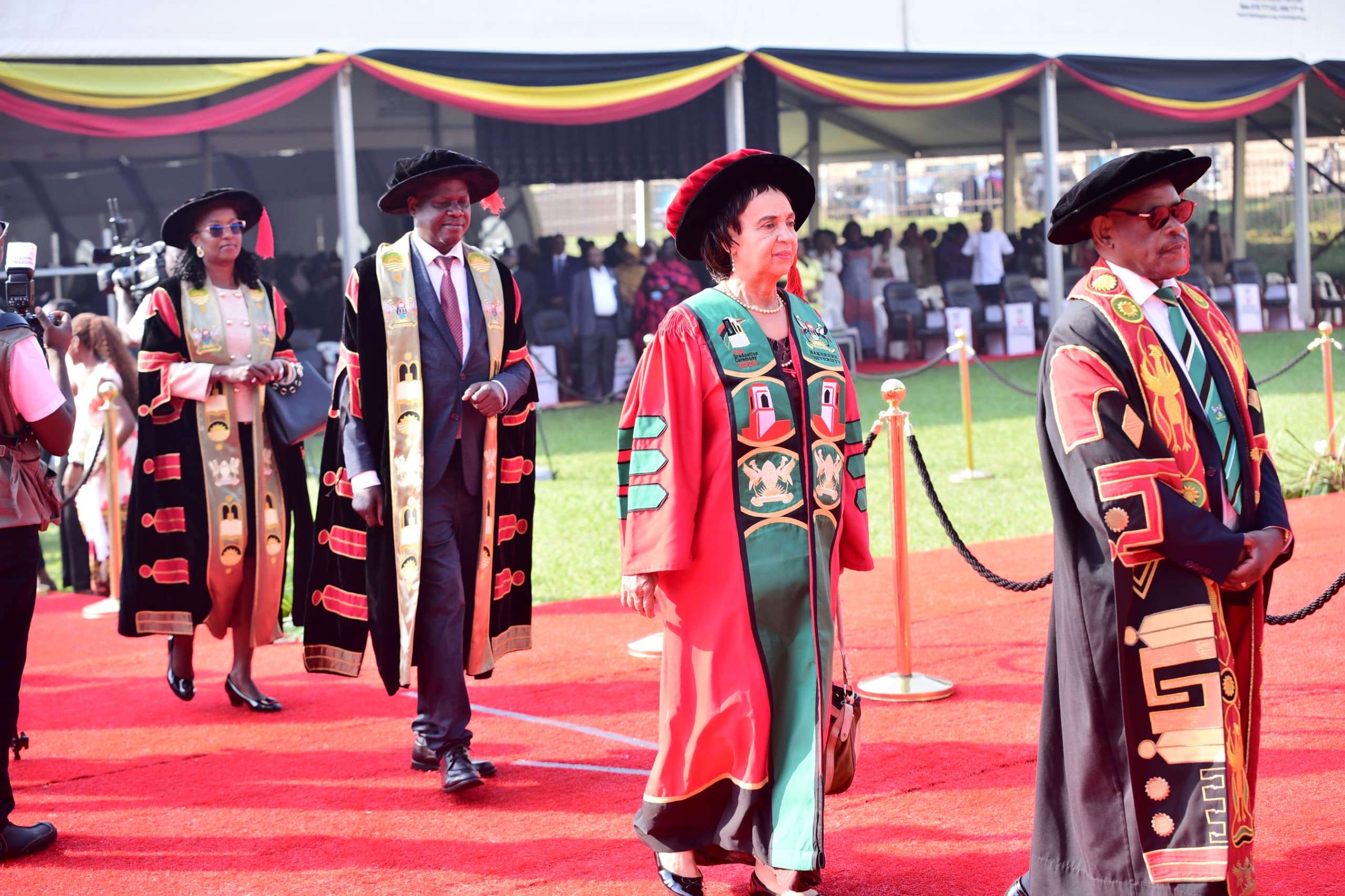
“You do not need to become accountants but you must be able to read the essentials: understand simple financial statements, budgets and key metrics so you can judge whether a clinic, lab, or program is sustainable. You are encouraged to start your business. There are numerous investment opportunities in your areas of training. You can provide services to our people and create jobs,” Dr Kigozi, said.
She shared candidly how, when she first stepped into leadership, she realised she did not understand balance sheets or budgets well enough. So, she returned to Makerere for short courses to strengthen herself.
“A well-run Hospital, clinic or lab delivers better outcomes, attracts staff, and secures funding. Business savvy is not only about profit, it’s about sustainability and the freedom to serve ethically and effectively. Carry clinical skill with business sense so your work endures and grows,” Dr. Kigozi, noted.
Quoting renowned writer and producer Shonda Rhimes, creator of Grey’s Anatomy, who once reflected that succeeding in one area of life can sometimes mean falling short in another, Dr. Kigozi encouraged women graduates to intentionally balance professional ambition with family responsibilities.
“When one area thrives, another is often under strain. When Navio was graduating from school I had to manage the Presidential Investor Round Table on the same day as Executive Director Uganda Investment Authority. I chose my job and delegated his siblings to attend Navios graduation. I learnt from this. I choose family always after that thing you achieve once and keep forever,” Dr Kigozi, said.
In his speech, the Prof Barnabas Nawangwe, the Vice Chancellor, informed the congregation that Makerere’s ranking on all university ranking platforms has remained stable, placing Makerere among the top 10 African universities and within the top 4.5% globally.
“In the Times Higher Education global ranking, Makerere University made a formidable jump from the 1200-1500 bracket to the 800-1000 bracket. This was no mean achievement and I congratulate all members of the Makerere Community on this stellar performance,” Prof Nawangwe, said.
-
 Humanities & Social Sciences5 days ago
Meet Najjuka Whitney, The Girl Who Missed Law and Found Her Voice
-
 Health1 week ago
Uganda has until 2030 to end Open Defecation as Ntaro’s PhD Examines Kabale’s Progress
-

 Agriculture & Environment1 week ago
Uganda Martyrs Namugongo Students Turn Organic Waste into Soap in an Innovative School Project on Sustainable Waste Management
-

 General4 days ago
76th Graduation Highlights
-

 General1 week ago
Mastercard Foundation Scholars embrace and honour their rich cultural diversity