
General
Mak Produces Affordable Multipurpose Tractor


The Head of Operation Wealth Creation, General Salim Saleh on 31st December 2015 officially launched MV Mulimi, the multipurpose tractor developed by the College of Agricultural and Environmental Sciences (CAES), Makerere University, with a challenge that the institution should endeavour to produce even more.
During the launch held at Makerere University Agricultural Research Institute at Kabanyolo (MUARIK), Gen. Saleh said Makerere had proved that it could resolve the farmers’ problems with practical solutions.
“I am pleased that Makerere is moving to solve these problems, which tie up the farmers in poverty. We hope that the MV Mulimi will resolve their problems, and therefore demand that several more similar vehicles are produced,” he said.
He pledged to hold talks with Makerere University on the feasibility of ordering 20 units of MV Mulimi for field demonstration purposes. Gen. Saleh also indicated that there were other opportunities to be derived from this innovation.
 “His Excellency, President Yoweri Kaguta Museveni has pledged to increase the budget for agriculture to over 1 trillion, but there is a concern about the absorption capacity of that money at the grassroots. I hope that research centres like Makerere University and others will be able to join in and help us absorb this new capacity,” he said.
The MV Mulimi was developed by a team from CAES, consisting of Prof. Noble Banadda (the Principal Investigator), Prof. John Lumkes (Purdue University), Dr. Ahamada Zziwa, Dr. Nicholas Kiggundu of Makerere as well as Mr. Tyler Anselm (Purdue University), Mr. Ernest Tibaku-Zira, Mr. Samuel Mutesasira and Mr. Denis Nsubuga. Other than Prof. Lumkes and Mr. Anselm, the rest of the team members are from Makerere University.
The idea to develop a low cost multipurpose vehicle suitable for African conditions arose out of a 2013 trip by Prof. Noble Banadda to three Universities in the US, sponsored by the School of Food Technology, Nutrition and Bio-Engineering. Prof. Banadda’s trip was aimed at exploring opportunities of collaboration between CAES and Purdue University, University of Georgia and Iowa State University.
 In June 2015, the College of Agricultural and Environmental Sciences challenged Prof. Banadda and a team of researchers to develop such a vehicle. The design and development of MV Mulimi took place at MUARIK under the sponsorship of the Presidential Initiative on Science and Technology, from September 1, 2015 for a period of six weeks.
Commenting on the vehicle’s abilities, Prof Banadda explained that the vehicle was able to thresh maize, pump water from a depth of 7 metres to a height of 33m, plough gardens, transport 20 adults and their goods over a reasonable distance, as well as charge a mobile phone.
According to Dr. Nicholas Kiggundu, the vehicle’s design is the ultimate value addition, as it attempts to solve farmers’ problems at the source. This follows a demonstrated need for low cost technologies in farm field and postharvest handling operations.
“The MV Mulimi cost UGX 30million to develop and its optimal cost; including all the elements required to carry out the tasks, would be about UGX 19million on the open market, once it is in production,” he said.
The Dean, School of Food Technology, Nutrition and Bio Engineering, Prof John Muyonga, commended the team on a job well done. “The project was designed to add value to agricultural produce. Our research has shown that farm operations like threshing, pumping water and aspects of tilling, which remain a major challenge for farmers, can be resolved at a low cost” he said, further adding “I am pleased that they were able to accomplish this task in a short time.”
Prof. Muyonga equally thanked Prof. William Kyamuhangire, the Manager of the Makerere University Food Technology and Business Incubation Centre for championing the cause of adding value to agricultural products.
The Deputy Principal of CAES, Dr. Goretti Nabanoga expressed her pleasure at the latest development. “I am happy that Makerere is participating as the lead researcher in addressing the challenges faced by farmers at the grassroots. This project will link us directly to the farmers,” she said.

“The MV Mulimi is made from locally available materials, which indicates that the product can be easily maintained in Uganda, since its spares are easily accessible.”
She challenged the researchers to continually improve the product by designing a shelter on top of the vehicle to shield occupants from weather elements such as rain or sunshine, and was optimistic that the vehicle’s design would evolve even further in 2016.
“As Gen Salim Saleh once said, the biggest problem facing farmers is not the lack of funding but the availability of logistics. I am positive that in 2016 we will improve this tool further.”
Speaking on behalf of the Private Sector, the Director of Peacock Paints, Kaddu Kiberu, commended Makerere University for developing the MV Mulimi, soon after the Kiira EV, was developed by the College of Engineering, Design, Art and Technology (CEDAT).

“I am happy to see what is happening at Makerere. Let us hope that this innovation will not be allowed to fail. Please be prepared for the criticism so that you can improve the product even further,” he said.
He shared that the private sector was willing to come in and help develop MV Mulimi. “I don’t expect all the parts of the MV Mulimi to come from Makerere. Instead you should partner with others to supply the parts and your job should be to design the final product,” he added.
The Vice Chancellor, Prof John Ddumba-Ssentamu said the MV Mulimi had arrived at the right time.
“It is my informed opinion that mechanized farming is a step in the right direction for this country and we as Makerere University are proud to contribute towards this… As Makerere University, we have demonstrated that with seed financing, we can come up with practical innovations that solve real world challenges. I look forward to seeing more units rolled out to our farmers.”
The Chinese Ambassador to Uganda, H.E. Zhao Yali also commended the team for producing the multipurpose vehicle for use in agriculture. He urged Makerere to consider working with China to improve the product further.

“I encourage Makerere to cooperate with some of the Chinese firms, which are already here in Uganda and are involved in developing and marketing agricultural implements and vehicles. The Vice Chancellor together with his team has a big role to play here,” he said.
He revealed that the Chinese Government would be providing US$60bn to Africa under the Sino-Africa cooperation from 2016 to 2018, for among other uses, developing agriculture in Africa.
“I strongly urge Uganda to take advantage of this. I feel that agricultural development should be at the forefront of this cooperation with China,” he concluded.
In the true spirit of friendship and brotherhood from China, the Ambassador presented a New Year (2016) gift comprising two (2) tractors to Makerere University to support farming and practical sessions at MUARIK.
The Director MUARIK, Associate Professor Phinehas Tukamuhabwa said the MV Mulimi is a great achievement for MUARIK and CAES, as it practically addresses issues of agriculture and the environment. He congratulated Prof. Noble Banadda and the team of researchers for the innovation that will contribute to the transformation of agriculture in Uganda.
Article by: Ritah Namisango, Mak Public Relations Office
Photos by: Landmark Media Consultancy Ltd


By Moses Lutaaya
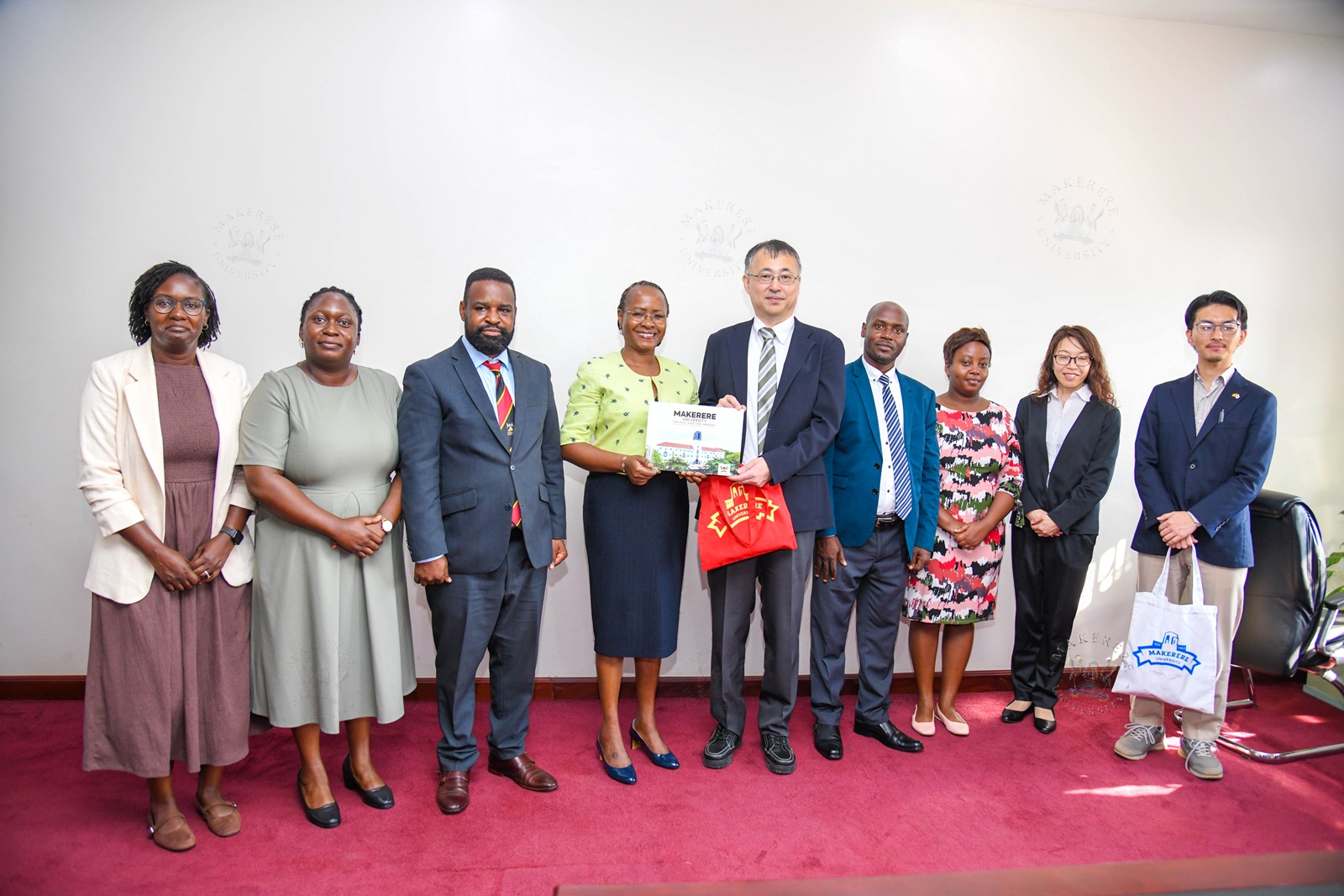
Kampala, September 4, 2026 — Makerere University and the Japan International Cooperation Agency (JICA) have explored new opportunities for strengthening academic, research and innovation collaboration between Uganda, Japan and other African countries, with a particular focus on artificial intelligence (AI), aerospace engineering, materials and remote sensing, food value chains, energy, water and climate change.
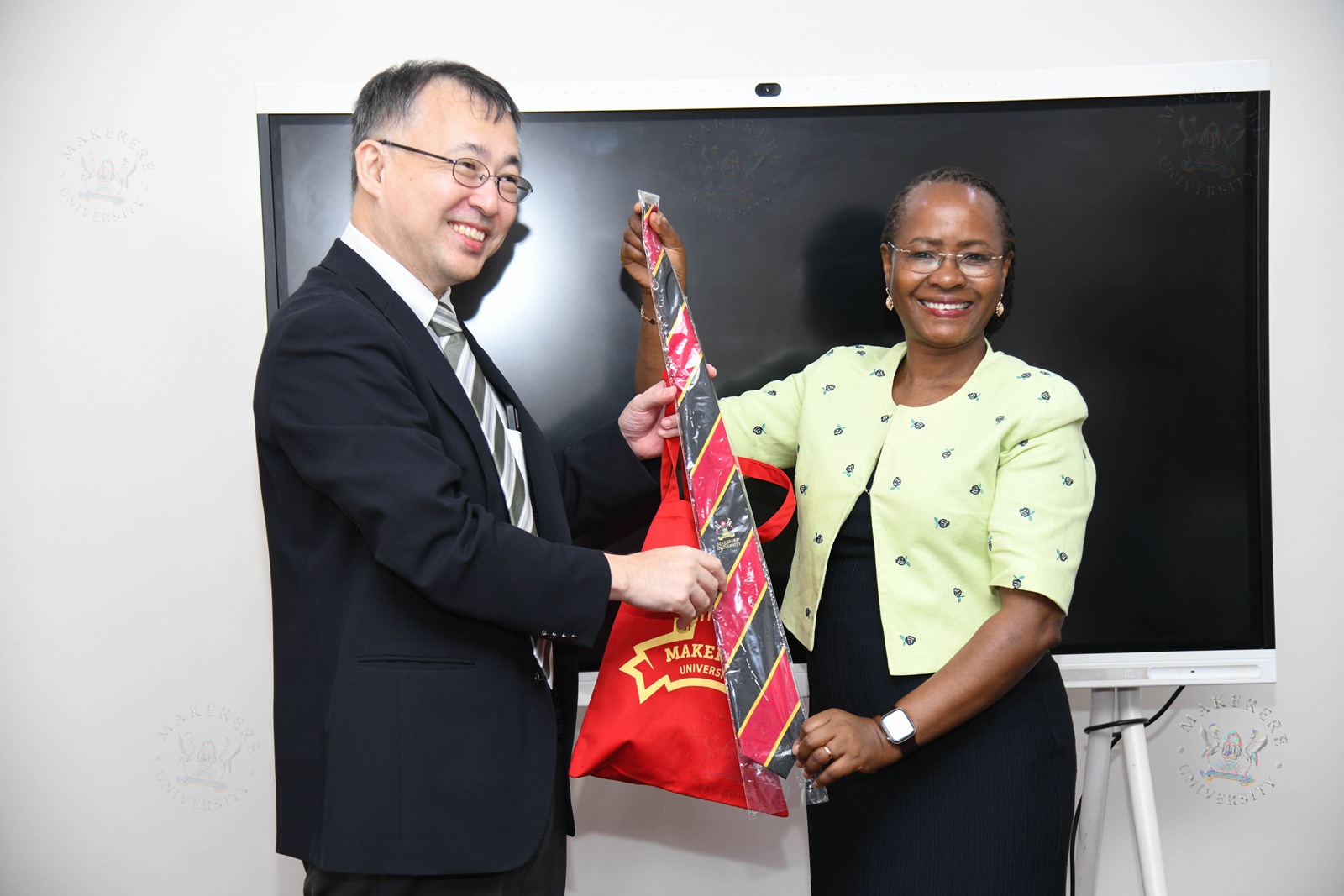
The discussions took place on Friday, September 4, 2026, at the Makerere University Main Building in the Vice Chancellor’s Board Room, during a visit by a JICA delegation led by Dr. Okano Takasei, Senior Advisor, Human Development Department of JICA.
Makerere keen to deepen collaboration with JICA
Welcoming the delegation, the Deputy Vice Chancellor (Academic Affairs), Prof. Sarah Ssali, highlighted Makerere University’s long-standing tradition of research, international collaboration and contribution to knowledge generation in Uganda and beyond.
Prof. Ssali noted that Makerere has built a strong global research footprint through partnerships with institutions around the world, observing that the University is well positioned to deepen international collaboration as emerging technologies, particularly artificial intelligence, continue to transform research and higher education.
“Uganda has a very long history of doing research, and particularly it has informed research findings in the areas global health research,” Prof. Ssali said, pointing to Uganda’s historical contribution to global scientific knowledge.
She cited the country’s contribution to medical and biological research, including early research on sleeping sickness, noting that Uganda’s unique research environment continues to offer opportunities for scientific discovery.
Prof. Ssali said Makerere’s history of collaboration with Japan is particularly significant, noting that Japanese cooperation has contributed not only to academic and research activities but also to infrastructure development and other sectors in Uganda.
She cited the establishment of the JICA building at Makerere, describing it as one of the visible symbols of Japan’s long-standing partnership with Makerere University.
According to Prof. Ssali, the building, which houses College of Natural Sciences (CoNAS) disciplines of geology, petroleum studies and administrative offices, was constructed during her undergraduate years and completed within a remarkably short period.
Prof. Ssali said the long-standing relationship between Uganda, Makerere University and Japan provides a strong foundation upon which new areas of collaboration can be built. She encouraged the visiting JICA delegation to explore the University and identify areas where existing partnerships could be strengthened or new areas of cooperation developed.
“Please take time and explore and see where either you already have a footprint, where you’ve ever had a footprint, or where you could explore new areas,” she said.
Prof. Ssali added that Makerere was privileged to host the JICA delegation and expressed optimism that the visit would lead to meaningful and sustainable partnerships.
Strengthening Joint Collaboration through AJ-ASPIRE
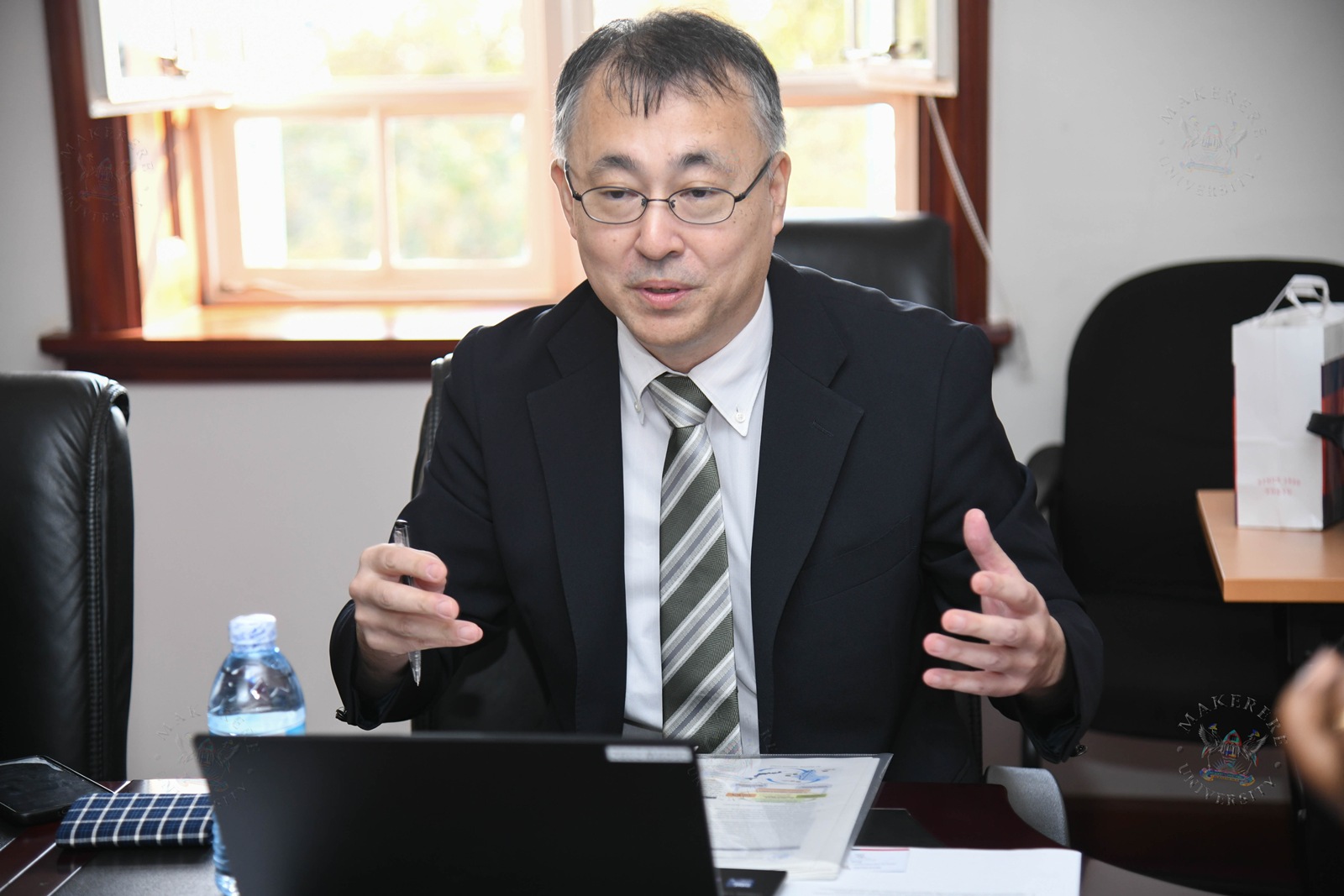
Dr. Okano, in his remarks as leader of the delegation said the visit formed part of a broader JICA initiative aimed at promoting academic and research collaboration between Japanese and African universities.
He explained that the initiative was launched on the occasion of the ninth Tokyo International Conference on African Development (TICAD 9), held in Yokohama in September 2025, with the objective of strengthening academic and research partnerships between Japan and Africa.
According to Dr. Okano, the initiative is intended to benefit both African and Japanese universities by providing platforms for internationalisation, collaborative research and the exchange of knowledge, researchers and students. “We would like to play a role of facilitator between universities in Japan and Africa and Uganda as well,” he said.
He explained that JICA is currently promoting the initiative through three African hub universities where JICA already has ongoing projects and experts on the ground.
The three institutions are Egypt-Japan University of Science and Technology (E-JUST) in Egypt, Jomo Kenyatta University of Agriculture and Technology (JKUAT) in Kenya, and Stellenbosch University in South Africa.
Dr. Okano said the selection of the three institutions was informed by the presence of ongoing JICA-supported projects and experts who can facilitate collaboration between the hub universities and institutions across Africa and Japan.
The hub universities are currently coordinating research with Japanese universities in strategic areas, with E-JUST focusing on energy, JKUAT leading work on food value chains, and Stellenbosch University focusing on water and climate change.
Dr. Okano said JICA was particularly pleased to explore collaboration with Makerere University under the African-Japan Initiative for Research and Education Partnerships, known as AJ-ASPIRE.
He outlined three major avenues through which Makerere could participate in the initiative.
The first is participation in existing research programmes hosted by the three hub universities. He added that Makerere researchers could join ongoing research on energy, food value chains, water and climate change, thereby creating opportunities to work with Japanese and other African researchers.
“We would like to explore opportunity for researchers from Makerere University to participate in these ongoing research activities and expand collaboration with Japanese and African partner institutions,” Dr. Okano said.
The second area is the development of new research networks in artificial intelligence and aerospace engineering. Dr. Okano said JICA was planning to establish new research groups focusing on the two areas and would be interested in having Makerere researchers participate in the emerging networks. “We would like to also invite researchers from Makerere University to join these networks and implementation of future collaboration in these two research topics, aerospace engineering and AI,” he said.
The third proposed avenue is increased collaboration between Makerere University and E-JUST, which Dr. Okano said offers fully funded scholarship opportunities for African students through a programme jointly supported by the governments of Egypt and Japan.
He noted that a number of Makerere graduates have already benefited from the programme, including researchers who have pursued doctoral studies and research opportunities in Egypt and Japan.
Dr. Okano cited the example of Mr. Abdonoor Kalibala, a Makerere alumnus whom he recently met in Hiroshima, Japan, following completion of PhD in Mechatronics and Robotics engineering at E-JUST. Mr. Kalibala conducted research in Japan for up to six months under the supervision of a Japanese professor as part of his doctoral programme.
Dr. Okano said such programmes could help strengthen the movement of researchers between Uganda, Egypt and Japan and create lasting institutional partnerships.
He added that JICA is also providing small research grants to alumni of the programmes to help them maintain and expand research collaboration involving Japan, E-JUST and African institutions.
He said Makerere could leverage such opportunities to increase the participation of its students and researchers in international research networks.
AI, Materials and Remote Sensing and International Relations Set the Pace
Prof. Robert Wamala, Director of Research, Innovations and Partnerships at Makerere University, said the visit followed an online engagement held a few weeks earlier between Makerere University and JICA, during which several areas and units within the University were identified as potential points of collaboration.
Prof. Wamala said these included the Makerere University AI Lab, the University’s International Office and researchers working in space engineering, particularly in materials and remote sensing.
He welcomed the transition from online discussions to physical engagement, saying the visit would allow JICA representatives to interact directly with researchers, academic units and University authorities. “This interest is being followed up through an in-person visit, which provides us an opportunity for JICA to engage directly with the relevant units and researchers at Makerere University,” Prof. Wamala said.
For Makerere, he added, the initiative provides an opportunity to connect the University’s research strengths with Japanese universities, research institutions and development partners to address shared development challenges.
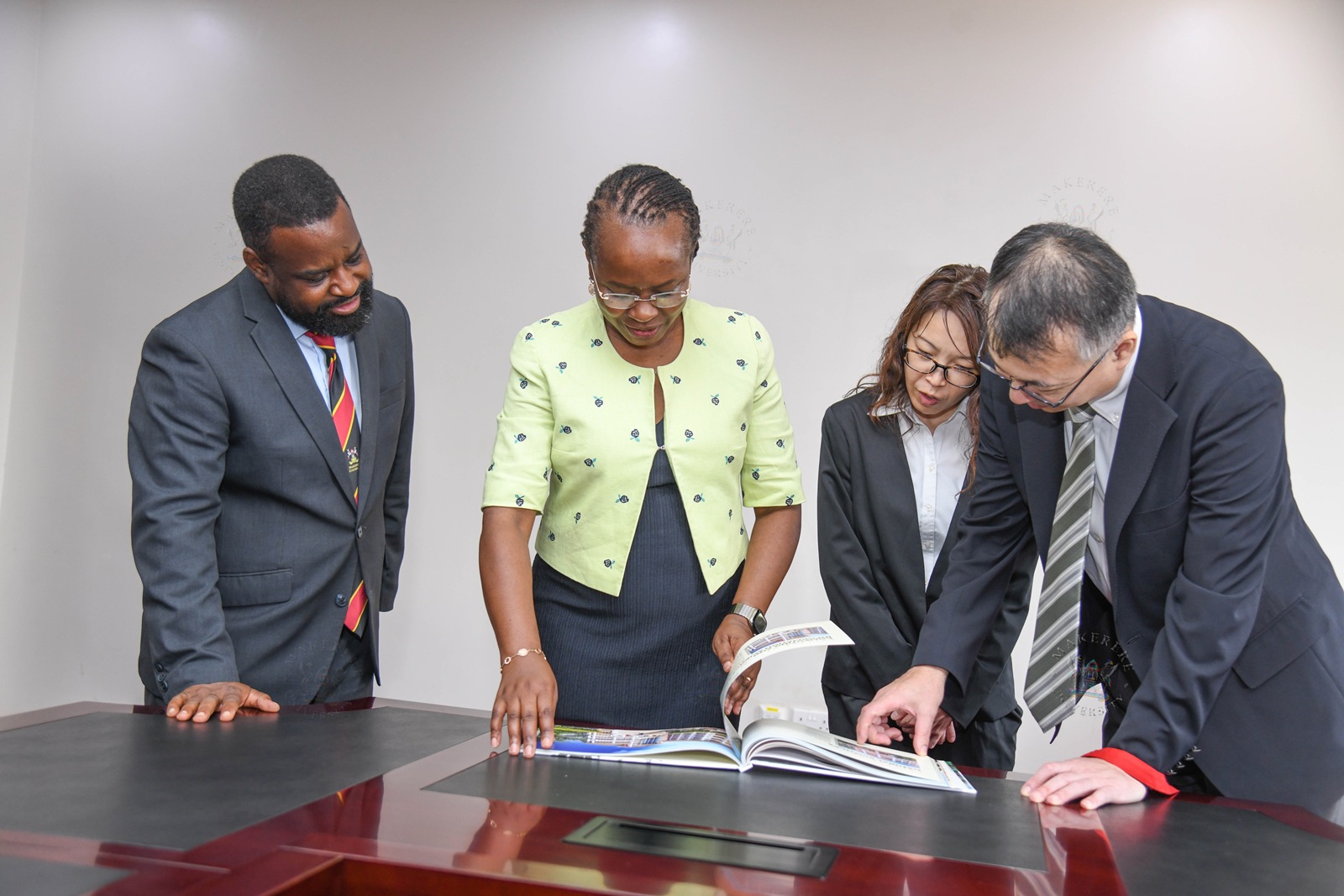
Prof. Wamala said the University was particularly interested in identifying practical areas of collaboration that could move beyond general discussions to concrete research partnerships, joint projects and opportunities for students and researchers.
He noted that the JICA delegation’s on-campus interactions scheduled to take place throughout the day would enable the two sides to identify specific areas of mutual interest. “We hope these engagements will help us identify specific areas of future interest and provide a basis for developing concrete areas of collaboration under the AJ-ASPIRE,” Prof. Wamala said.
He reiterated Makerere’s commitment to strengthening international research partnerships and thanked JICA for its continued interest in the University.
Dr. Okano, was accompanied by Mr. Ito Idomu, Research and Advisor at the Embassy of Japan, Mr. Osaki Mistuhiro from JICA headquarters, Ms. Eric Maeda from JICA Headquarters, and Ms. Ruth Mbabazi from JICA Uganda.
JICA follow-up meetings with Makerere research units
Following the high-level meeting in the Vice Chancellor’s Board Room, the JICA team, together with the Directorate of Research, Innovations and Partnerships, proceeded to engage with key research and administrative units at Makerere University identified as strategic to the proposed areas of collaboration.
The delegation held meetings with the Makerere University AI Lab, led by Dr. Joyce Nabende of the College of Computing and Information Sciences (COCIS), to explore opportunities for cooperation in artificial intelligence and related emerging technologies.
The team also met officials from the Makerere University International Office, led by Mr. Mathias Ssemanda, where discussions focused on opportunities for strengthening international academic linkages, mobility and institutional partnerships.
A further engagement was held with the Department of Geomatics and Land Management, focusing on materials and remote sensing, led by Prof. Lydia Kayondo from the College of Engineering, Design, Art and Technology (CEDAT).
The engagements provided an opportunity for the JICA team and Makerere researchers to move from broad discussions on collaboration to more specific conversations around research interests, expertise, existing projects and potential areas for joint work.
The visit marks an important step towards strengthening Makerere University’s engagement with Japanese and African research institutions under AJ-ASPIRE, while opening opportunities for researchers and students to participate in emerging international networks in artificial intelligence, aerospace engineering, remote sensing and other strategic areas of science, technology and innovation.
-
 General1 week ago
Makerere University Welcomes a New Cohort of 258 Mastercard Foundation Scholars
-
 Health1 week ago
Call for Applications: Short-term Positions under the STOP-AMDR Project
-
 General2 days ago
Undergraduate Admissions: Students allowed to Change Programs/Subjects 2026/27
-
 Health1 week ago
MakSPH Takes Mpox Response Lessons to Districts for Stronger Outbreak Preparedness
-
 General1 week ago
50 Master’s Students Awarded Scholarships Under the Africa Climate Collaborative at Makerere University