Connect with us

General

President Museveni reiterates Governments’ commitment to funding the Makerere University Perimeter Wall.

Published

on

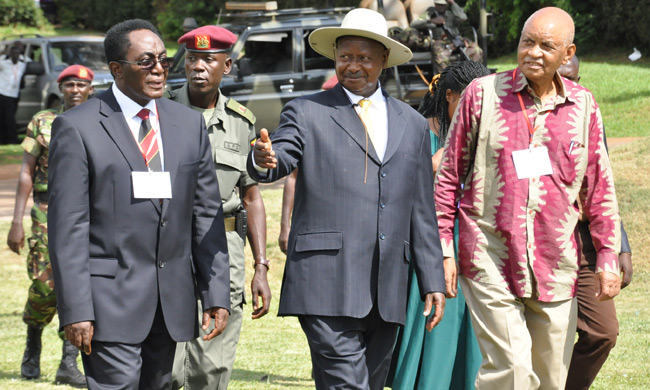
On Saturday 23rd May 2015, H. E President Yoweri K. Museveni paid a courtesy call on the Vice Chancellor, Prof. John Ddumba-Ssentamu.

Commenting on the historic courtesy call held in the Office of the Vice Chancellor, Prof. John Ddumba-Ssentamu informed the Mak Public Relations Office that the Vice Chancellor and the Head of State who is also the Visitor of Makerere University had a one-on-one interaction focusing on scaling Makerere University to greater heights.

The Vice Chancellor used the same opportunity to thank H.E President Museveni for increasing funding to Makerere University.  He equally thanked the President for the ongoing negotiations between the Government and the Church of Uganda aimed at securing the land occupied by Mak College of Veterinary Medicine, Animal Resources and Bio-Security (CoVAB).

After the courtesy call on the Vice Chancellor, President Museveni proceeded to the Freedom Square accompanied by the Minister of State for Lands, the Chancellor, Chairperson of Council, Vice Chancellor, Deputy Vice Chancellor (Finance and Administration), University Secretary, Academic Registrar, Chairperson of Makerere University Academic Staff Association (MUASA), Guild President, Vice Guild President and other dignitaries.

The Chancellor, Prof. George Mondo Kagonyera commended H.E President Museveni for ensuring that the Government of Uganda increases salaries for Makerere University staff, supporting research and innovations through the Presidential Initiative on Science and Technology among other strategic initiatives.

Addressing the congregation gathered in the Makerere University Freedom Square on Saturday 23rd May 2015, H.E President Yoweri Kaguta Museveni reiterated the commitment of Government to funding the Makerere University Perimeter Wall.

"The Vice Chancellor has told me that we need UGX.5billion to build the fence. This matter keeps coming up. I will follow up this issue of the perimeter wall with the Ministry of Education, Science Technology and Sports so that we solve the problem of the perimeter wall. We need a secure university," emphasized the Head of State and Visitor of Makerere University amidst applause from the audience.

H.E President Museveni, who is the Chairman of the National Resistance Movement (NRM), then addressed the congregation focusing on building a stronger political party base, budgeting and prioritization for sectors critical to national development as well as re-orienting the congregation on the NRM principles.

“I thank the NRM for organizing the Makerere University NRM Sub-county conference. This is a very important day for ideological fellowship. We should remember the need for unity in the NRM, patriotism-the love for Uganda, and Pan-Africanism-the love for Africa,” emphasized President Museveni, Chairman of the Party.

The Chairman of the NRM also condemned in the strongest terms sectarianism based on religion, tribe and any other form. “Sectarianism is wrong scientifically. It mixes up identity with interest. Sectarianism threatens unity critical for national development and economic integration,” said the Chairman of NRM.

Story by:  Ritah Namisango


Elias Tuhereze

Continue Reading

General

Undergraduate Admissions: Students allowed to Change Programs/Subjects 2026/27

Published

on

The Office of the Academic Registrar has released lists of students whose applications for change of Programme/Subjects have been approved for the Academic Year 2026/2027.

The lists can be accessed by following the inks below:

Mak Editor

Continue Reading

General

Uganda to Launch ACT-PREP, Africa’s New Epidemic Preparedness Research Network

Published

on

A KCCA Medical Office debriefs the MakSPH Field Epidemiologists and Surveillance Team during the CoVID-19 pandemic. Makerere University School of Public Health, Kampala, Uganda, East Africa.

By Henry Mugenyi

When the next infectious disease outbreak strikes, the question for African researchers should not be whether they have the capacity to conduct the research, but how quickly they can begin.

That is the gap a new five-year research initiative, Advancing Clinical Trials and Epidemic Preparedness Research Capacity in Africa (ACT-PREP), is seeking to address.

The project will be officially launched in Uganda on September 28th, 2026, bringing together researchers and partners from universities and research institutions across Africa and Europe. The launch will be held at the Makerere University School of Public Health (MakSPH) Auditorium in Kampala.

Led by Makerere University School of Public Health, ACT-PREP is designed to strengthen Africa’s ability to conduct clinical trials and other research before and during infectious disease outbreaks.

Africa has repeatedly faced epidemics of diseases such as Marburg, Ebola, COVID-19 and other emerging infections. Yet when outbreaks occur, the capacity to quickly generate the evidence needed to guide treatment, prevention and public health decisions remains underdeveloped.

ACT-PREP aims to make research part of outbreak preparedness not something that begins only after an epidemic has already spread.

According to Prof Rhoda Wanyenze, the Principal Investigator on the project, “the initiative will establish a framework for more equitable collaboration among 10 African and two European institutions, working alongside Universities and the Africa Centres for Disease Control and Prevention (Africa CDC)”.

The consortium includes institutions from Uganda, Rwanda, Tanzania, the Democratic Republic of Congo, Somalia, South Sudan and Senegal, as well as European partners in Sweden and Germany. Africa CDC is also among the participating institutions.

For Uganda, the launch at Makerere University is significant. The university is taking the scientific lead on a programme that places African research institutions at the centre of efforts to prepare for future epidemics.

One of ACT-PREP’s central ambitions is to address the shortage of researchers and systems capable of rapidly conducting high-quality clinical research during emergencies.

The project will strengthen clinical research, ethics and regulatory capacity, while also supporting laboratory and disease surveillance systems. It will integrate training into PhD and postdoctoral programmes, with the consortium aiming to train at least 700 fellows at the end of the project.

“The idea is straightforward: Africa needs not only laboratories and equipment, but also people with the skills to use them when an outbreak begins” – Says Dr Steven Kabwama, ACT-PREP Project Manager.

Researchers will also be supported to share expertise, data, resources and technology across institutions and national borders.

ACT-PREP will further explore One Health approaches and artificial intelligence-supported systems to improve disease prediction, detection and rapid response. The project also seeks to support more streamlined regulatory processes so that clinical trials can be deployed and monitored more quickly when they are needed.

The experience of recent epidemics has shown that time is one of the most valuable resources in an outbreak.

Delays in detecting a pathogen, setting up research sites, securing ethical and regulatory approvals or generating reliable evidence can affect how quickly health authorities are able to respond.

ACT-PREP is built around the idea that many of these systems should already be in place before the next emergency.

That means having trained researchers, functioning laboratories, established regulatory pathways, surveillance systems and relationships between institutions that can be activated when an outbreak occurs.

It also means changing how research partnerships are built.

Rather than relying on external institutions to arrive when a crisis begins, the project seeks to strengthen African institutions themselves and create longer-term collaborations in which expertise, technology, data and resources can be shared across borders.

Mak Editor

Continue Reading

General

SPH celebrates Claire’s 14 years of service

Published

on

The Dean and Staff of SPH with Claire Nakayizi during the celebration. Celebrating Claire Nakayizi's 14 years of service as Custodian, August 2026, Makerere University School of Public Health (MakSPH), Mulago Hospital Complex, Kampala Uganda, East Africa.

After 14 years of dedicated service, Claire Nakayiza, a familiar face and trusted custodian at the School of Public Health (SPH), has retired, leaving behind a legacy of hard work, commitment, kindness and service to the School community.

For many people at the School of Public Health, the sight of Claire arriving early in the morning, opening up the building and ensuring that everything was in order was simply part of the daily rhythm of life at the School.

For 14 years, Claire has been a constant presence at SPH. She has witnessed generations of staff, students, researchers and visitors walk through the School’s doors. She has seen colleagues join, grow and eventually move on, while she remained a dependable presence, quietly carrying out her responsibilities and ensuring that the School was ready to welcome everyone each day.

Her retirement was therefore more than a routine farewell. It was an opportunity for colleagues to celebrate a woman whose contribution, though often carried out behind the scenes, touched many lives and contributed significantly to the smooth running of the School.

Prof. Rhoda Wanyenze (R) and Claire Nakayiza (L). Celebrating Claire Nakayizi's 14 years of service as Custodian, August 2026, Makerere University School of Public Health (MakSPH), Mulago Hospital Complex, Kampala Uganda, East Africa.
Prof. Rhoda Wanyenze (R) and Claire Nakayiza (L).

At a farewell brunch organised by the Dean, School of Public Health, Prof. Rhoda Wanyenze, colleagues and friends described Claire in glowing terms. Words such as hardworking, kind, patient, resilient, dependable and caring repeatedly featured in the tributes.

For many, Claire was much more than a custodian. She was described as a mother figure, a counsellor and someone people could approach whenever they needed a listening ear, encouragement or simply a warm smile.

A commitment that went beyond the call of duty

One of the strongest themes to emerge during the farewell was Claire’s extraordinary commitment to her work.

Colleagues recalled how she would routinely open the School building as early as 6:00 a.m., ensuring that staff and students arriving for the day found the premises ready. Her working day could stretch well into the evening, with some days requiring her to remain at the School until 8:00 p.m. or even 10:00 p.m.

Despite the long hours and demanding nature of her responsibilities, colleagues said Claire rarely complained. Instead, she approached her work with patience and resilience, always focused on ensuring that the School was secure and that its operations could continue smoothly.

Her dedication was particularly evident in her contribution to improving the security of the School building. Over the years, Claire became a trusted custodian of the premises, helping to ensure that the building was opened and closed responsibly and that the environment remained secure for those who worked and studied there.

Speaking at the farewell, Prof. Wanyenze described Claire as someone who consistently worked beyond the call of duty.

Claire Nakayiza receives a plaque in appreciation of her service from the Dean and Leadership of SPH. Celebrating Claire Nakayizi's 14 years of service as Custodian, August 2026, Makerere University School of Public Health (MakSPH), Mulago Hospital Complex, Kampala Uganda, East Africa.
Claire Nakayiza receives a plaque in appreciation of her service from the Dean and Leadership of SPH.

The Dean acknowledged that saying goodbye to Claire was an emotional moment, given the many years she had spent serving the School and the relationships she had built along the way.

However, Prof. Wanyenze said she had spoken to Claire and was assured that she was ready to embrace the next phase of her life.

She joined colleagues in wishing Claire good health, happiness and prosperity as she begins her retirement journey.

More than a custodian

Claire’s impact at SPH was not limited to the physical responsibilities associated with her job. To those who interacted with her regularly, her greatest contribution was perhaps the warmth and humanity she brought to the workplace.

Amos Ddembe, the Internal Auditor, described Claire as a joy to watch as she went about her work.

He particularly remembered her interactions with people when she was stationed at the reception area. Claire, he noted, was almost always smiling and welcoming to staff and visitors.

Her ability to make people feel comfortable, regardless of their position or role at the School, earned her the affection and respect of many colleagues.

Claire’s colleagues also remembered her as someone who was willing to listen and offer guidance. Her patience and calm demeanour meant that people could approach her with their concerns, knowing they would receive a sympathetic ear.

Over the years, these seemingly small interactions accumulated into meaningful relationships, helping to make Claire one of the most recognisable and trusted members of the SPH community.

A legacy of service

Fourteen years is a significant period in the life of any institution. During that time, Claire witnessed changes in leadership, staff, students, programmes and the physical environment of the School.

She remained a constant through these transitions.

Her service represents the important contribution made by members of the support staff whose work often happens quietly but is essential to the functioning of an institution.

From opening the building before sunrise to securing it late in the evening, welcoming people at reception, supporting the day-to-day operations of the School and contributing to the security of the premises, Claire’s work helped create an environment in which others could perform their own responsibilities.

Claire Nakayiza makes her remarks. Celebrating Claire Nakayizi's 14 years of service as Custodian, August 2026, Makerere University School of Public Health (MakSPH), Mulago Hospital Complex, Kampala Uganda, East Africa.
Claire Nakayiza makes her remarks.

Her story is a reminder that the success of an institution is built not only through high-profile academic and research achievements, but also through the dedication of people who ensure that the institution functions every day.

A gesture of appreciation

As part of the farewell, the Department of Community Health and Behavioral Sciences also expressed its appreciation for Claire’s years of service.

Representing the Department, Dr. Christine Nalwadda presented Claire with a cash envelope on behalf of the staff as a token of appreciation for her commitment and contribution to the School.

A new chapter begins

As Claire leaves the School of Public Health, she takes with her the memories of 14 years of service and the goodwill of the many people she encountered along the way.

For the colleagues who gathered to celebrate her, the farewell was not simply about marking the end of employment. It was about celebrating a colleague who had become part of the fabric of the School.

As she begins this new chapter, the School of Public Health joins together in saying:

Thank you, Claire, for 14 years of dedicated service. Thank you for the early mornings, the long evenings, the smiles, the patience and the unwavering commitment.

May retirement bring you the good health, peace, happiness and prosperity you so richly deserve.”

Betty Kyakuwa
Betty Kyakuwa

Continue Reading

Trending