
General
Mak MoH CDC Launch Uganda Public Health Fellowship Pgm

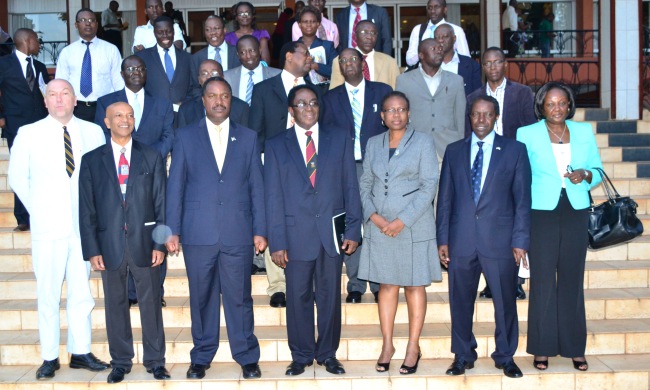
The Uganda Public Health Fellowship Programme (PHFP) was on Thursday 30th April 2015 launched by the Minister of Health, Honourable Dr. Elioda Tumwesigye. The launch ceremony, attended by over 150 guests was held at Serena Hotel, in Kampala.
The Uganda Public Health Fellowship Programme (PHFP) is a partnership by the Uganda Ministry of Health, School of Public Health, College of Health Sciences (CHS), Makerere University and the US Centres for Disease Control and Prevention (CDC). The overall purpose of the fellowship is to “reinforce implementation of priority public health programmes to reduce morbidity and mortality, and cultivate core capacities for International Health Regulations compliance”, said Associate Professor Rhoda Wanyenze, the Programme Director. She said each of the partners involved in the implementation comes with a set of skills critical for the success of the programme.
Recent Ebola outbreaks in West Africa and Marburg in Uganda provide significant lessons in the importance of strong health systems and sound public health structures.
“At this critical point as we plan to effectively control disease occurrences, the role of key players in different aspects, collective responsibility, role of communities in mobilization, awareness creation, behaviour change in regard to sanitation and personal hygiene, and tracing of contacts cannot be underestimated”, said the Minister of Health, Honourable Dr. Elioda Tumwesigye.
 Dr. Tumwesigye applauded the country on achievements registered in containment of outbreaks like Ebola in Bundibugyo, Marburg, Hepatitis and Typhoid, successful implementation of the Integrated Disease Surveillance and Response Guidelines, improvement of the data management system and the improved turn-around time for lab test results due to the National Sample and Results Transportation network.
A word of caution though: “despite these successes we still have a lot of challenges. We fell short of achieving the MDGs. The vital indicators of health service delivery are still poor. The burden of disease remains very high, with communicable diseases alone contributing more that 50% of Disability-Adjusted Life Years (DALYs) lost in the country. The health systems remain weak. For instance there is inadequate human resource for health both in terms of numbers and competencies. Access to health facilities is challenging because of poverty. Coordination is still inadequate in many aspects of financial and technical responses. The gap between evidence and policy as well as inadequacy in the implementation science i.e. translation of policy to action is still evident”, he said.
Dr. Tumwesigye said the different components of the programme are critical to public health, but the Ministry of Health needs to think critically about their career paths.
 The Uganda Public Health Fellowship Programme is therefore one of the strategies by the Ministry of Health, working in partnership with School of Public Health, College of Health Sciences (CHS), Makerere University and the US Centres for Disease Control and Prevention (CDC) and partners to address some of the challenges.
Professor George Mondo Kagonyera, the Chancellor applauded Makerere University for its central role in building capacity for the health sector in Uganda. He emphasized the University’s deliberate efforts to form partnerships for effective implementation of programmes and projects. “The College of Health Sciences in general and the School of Public Health in particular, are giant powerhouses in the area of capacity building in the health sector. The College of Health Sciences has got the expertise that is necessary to influence the health affairs of this country. I am therefore happy to note that School of Public Health and the Ministry of Health have teamed up to jointly improve the skills and competences of the public health workforce. As a University, it is always a pleasure for us to work with the respective sectors of the economy as we build for the future”, he said.
He lambasted those individuals who “carelessly criticize Makerere University for training only through theory, yet we train through learning by doing”, he said.
 The Vice Chancellor, Prof. John Ddumba Ssentamu was happy to note that the Uganda Public Health Fellowship Programme has put emphasis on evidence-based public health practice, staying in sync with the University’s role of knowledge generation and dissemination. He expressed the University’s readiness to partner and work with other organisations for the health of all Ugandans. He thanked the US Government for the support to capacity building programmes at the School of Public Health, with over USD 30M invested in these programmes.
World Health Organisation Country Representative, Dr. Wondimagegnehu Alemu expressed happiness about the partnership between the various organisations that have come together to implement the programme and committed the support of WHO to its successful implementation. He emphasized the critical need for workforce in efforts to revitalize surveillance system, a fact that brings out the importance of the fellowship programme clearly.
Associate Director, Communications, CDC Uganda Mr. Erik Friedly, representing the CDC Country Director and the US Ambassador, said that the US government through CDC is very proud to be associated with the programme and happy to continue to support it. “The need for countries and governments to be prepared and respond to public health emergencies is very real, as seen in West Africa in the recent past”, he pointed out.
 He said strong public health systems in Uganda do not only protect the people of Uganda but other countries as well, as far as the USA.
The Dean, Makerere University School of Public Health, Associate Professor William Bazeyo pointed out that Makerere University no longer teaches for the sake of it, but teaches to meet the human resource needs of the country. “Uganda has well-trained health workers, even the lowest level has training programmes designed for them and many have undergone this training”, he emphasized.
Prof. David Serwadda, the Principal Investigator of the Makerere University School of Public Health – CDC Fellowship Programme, said that there are gaps in health sector and numbers and competences available not well-matched to the existing gaps. He particularly singles out challenges of new epidemics, rise in non-communicable diseases and the high population growth in Uganda as health challenges that require certain skill sets to manage. He therefore emphasized the need for aligning training programmes with the health needs of the population, which can be done by working in partnership with the Ministry of Health and other players in the sector.
Steven Kabwama one of the current fellows – based in the Mental Health and Substance Abuse Unit of the Ministry of Health- made a presentation of experiences in investigation of the typhoid outbreak in Kampala, showcasing the epidemiologic value of the fellowship programme.
 The Director General of Health Services, Ministry of Health Dr. Jane Ruth Aceng noted that the existing capacity at both national and sub-national levels is sub-optimal with “lack of essential practical exposure and competencies in public health practice; human resource gaps in numbers and deficiency to use evidence to make decisions”. This further emphasizes the need for the fellowship programme. She committed the Ministry of Health to create an environment conducive to the fellows' productivity for in so doing, the Ministry stood to greatly benefit from their technical capability. She said the initial cohort of fellows were recruited under the Field Epidemiology Track (FET). It is expected that in 5-7 years a network of public health practitioners at national and sub-national levels will be formed to strengthen human resources for disease surveillance.
Article by Milly Nattimba, College of Health Sciences

General
Call for Research Support Applications from Master’s Students who have Completed their First Year of Taught Classes at Makerere University



-

 General4 days ago
Bachelor of Laws Pre-Entry Examination Results 2026/2027
-

 General1 week ago
Mature Age Admission List – Government Sponsorship 2026/27
-
 General1 week ago
Makerere University DVCFA Accomplishments will continue – Prof. Alinaitwe
-
 General2 weeks ago
From Information to Innovation: ‘This Is a Marathon, Not a Sprint’—Academic Registrar and Director of Graduate Training Urge PhD Cohort 11
-
 General2 days ago
Call for Research Support Applications from Master’s Students who have Completed their First Year of Taught Classes at Makerere University