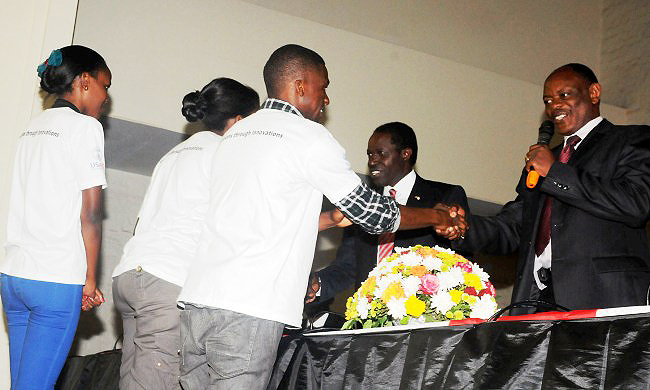
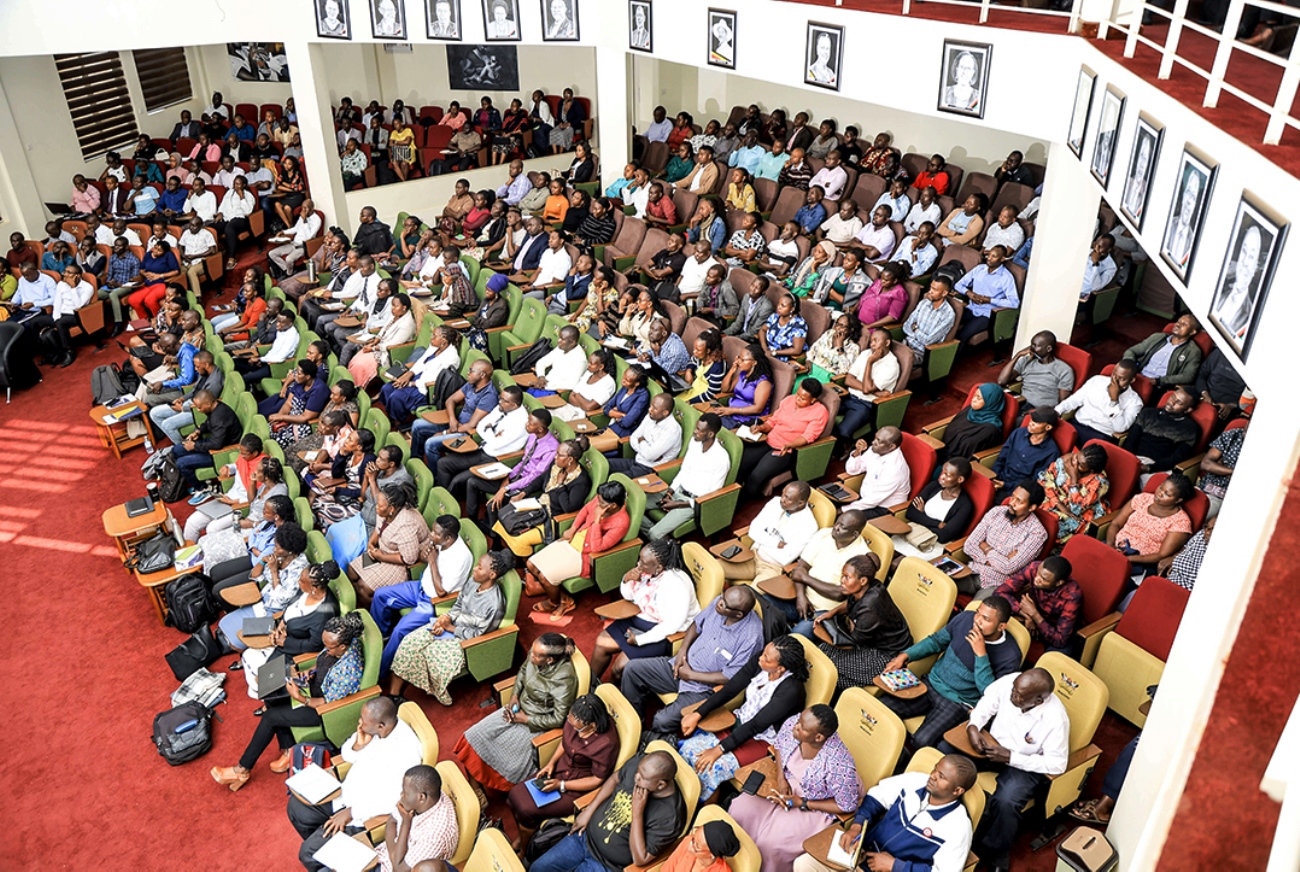
ResilientAfrica Network (RAN) held an Innovations Exhibition in the Makerere University Main Hall on Friday March 14th, 2014. This was an opportunity for the faculty, students, private sector, Government, NGOs and the community at large to showcase their prototypes or projects that would be considered for acceleration in the Eastern Africa’sResilience Innovation Lab (EA RILab).
This type of exhibition is one of the main ways that RAN is using to identify promising innovations from within partner universities and local innovation hubs. Such innovations will be entered into RAN’s Resilience Innovation Acceleration Program where teams will receive technical support by leveraging expertise within RAN and the HESN, mentorship, capacity building and financial support to help them, accelerate the development, piloting and scaling up of their innovations.
The Makerere University Deputy Vice Chancellor, Prof. Barnabas Nawangwe graced the occasion and officially launched the EA RILab’s Resilience Innovation Acceleration Program. “It is such programs like ResilientAfrica Network (RAN) that have enormously contributed to Makerere University’s great achievements including being the 4th best University in the whole of Africa. Faculty, students and the community benefit a lot from such initiatives.”He was flanked by Prof. Celetino Obua, the Deputy Principal at the Makerere University College of Health Sciences who noted in his remarks that “Mr. Deputy Vice Chancellor, RAN is yet another testimony that we, who you sent out to do the work, are actually doing it. We pledge to further take Makerere University greater heights”. He also noted and acknowledged the great work by the students, faculty and community innovators both present at the exhibition and elsewhere.
The event was a great success and it was exciting to see over thirty projects being exhibited by both students and faculty teams. In line with RAN’s strategy to foster multi-disciplinary collaboration, these teams were drawn from six out of eight colleges, representing atleast 15 different academic disciplines from Makerere University (Software Engineering, computer Science, Data Communications and Networking, Architecture, Survey, Electrical Engineering, Forestry, Environmental Geographical Sciences, Agricultural Sciences, Food Science, Nutrition and Bio-Engineering, School of Law, Animal Resources and Bio-Security, Humanities and Social Sciences, Peace and Conflict and School of Health Sciences).There was also a huge turnout from the university community and the general public who engaged the exhibitors on their innovations. In acknowledging the great turnout and vibrant atmosphere in the hall, Prof. William Bazeyo in his remarks noted,“ Look at the brains in this room, the potential this institution brings together and the ability of Africans to provide solutions to their own challenges-solutions through innovations. All is evidenced here”.
Selection of the promising innovations was done by a competent and experienced team of judges drawn from within and outside RAN. These included Prof. David Serwadda-RAN Technical Advisor, Dr. Wanjiku Nganga-RAN Director of Innovations, Dr. Roy William Mayega-RAN Deputy Chief of Party, Dr. Dorothy Okello-EA RILab Director, Dr. Julius Ssentongo-RAN EA RILab Program Coordinator and Mr. Michael Niyitegeka-Facilitator at Franklin Covey Uganda, and a well-respected innovation thought leader in the region. In making their selections, the judges were required to ascertain the potential for an innovation to strengthen resilience in line with the EA RILab thematic areas of climate change and chronic conflict, as well as establishing technical and financial feasibility and potential to scale in target communities. The judges took time to appreciate and understand all aspects of a given innovation, by interacting with the teams, asking questions, testing some of the innovations and awarding scores. It was also an opportunity to emphasize the linkage between the innovations and resilience arms of the RAN project.
Out of the thirty-two projects exhibited, six including;RootIO, KUDU, Unearthing the potential of Earth Worms as livestock feed, FINDIT, Improved Pull & Push Approach in Northern Uganda and Integrated Backyard Farming were selected after a very thoroughvetting by the judges. These six teams were further required to pitch their innovations to the judges and the public during an interactive question and answer session. Three projects,namely,RootIO, KUDU and Unearthing the potential of Earth Worms as livestock feedwere finally selected for consideration to join the EA RILab’s Resilience Innovation Acceleration Program. These innovations address key resilience aspects that were identified from the EA RILab’s community consultations including community mobilization and knowledge sharing, economic empowerment/poverty eradication, diversification of livelihoods and environmentally friendly production methods. The exhibition participants had been asked to vote for their preferred innovation with a view of enriching their experience and participation, and the team ‘Community-based legal mobile clinic’ led by female students from Makerere University’s School of Law, which provides legal assistance pro-bono to vulnerable communities received a unanimous vote for the “Peoples Choice” Award.
RAN is proudly led by Makerere University (School of Public Health) as one of the seven development labs within the USAID-funded Higher Education Solutions Network (HESN). It is a partnership of 20 African Universities in 16 countries focused on strengthening the capacities of vulnerable communities to withstand natural and man-made shocks and stresses. One of the core objectives of RAN, is to strengthen resilience at the individual, household, and community levels to natural, man-made stresses and shocks through innovative technologies and approaches to development, which will be identified, incubated, tested, scaled and evaluated through the RAN in collaboration with its partners http://www.ranlab.org.
RAN carries out its operations within four Resilience Innovation labs. These are: The Eastern Africa RILab, Horn of Africa RILab, Southern African RILab and West Africa RILab. The Eastern Africa RILab is located in Makerere University School of Public Health with a mandate to source innovative ideas in line with RAN’s thematic focus from within the academic community and support their incubation, areas of development and piloting. This was the first event organized by the Eastern Africa RILab to source for innovations that provide solutions to community challenges.
The Office of Academic Registrar, Makerere University has released admission lists of candidates admitted under the Talented Sports Men & Women, Disability and District Quota Schemes with Government sponsorship 2026/27 Academic Year including appeals and remarked cases.
Other admission lists released include A-Level Applicants with Ugandan and those with Foreign Qualifications, Diploma in Performing Arts, Mature-Age Entry and Bachelor of Education (EXTERNAL Batch 2) for the Academic Year 2026/2027 under self sponsorship.
Makerere University has officially launched its Strategic Plan 2025-2030, marking a major milestone in its commitment to strengthening research, innovation, and human capital development in line with Uganda’s national development priorities.
The launch brought together senior government officials, university leadership, and development planners, including the Minister of Finance, Planning and Economic Development, Hon. Henry Musasizi, and a representative from the National Planning Authority (NPA), alongside the University Vice Chancellor.
Hon. Henry Musasizi unveils the Makerere University Strategic Plan (2025-2030).
A Vision Anchored in National Transformation
Speaking at the launch, the Vice Chancellor underscored the University’s ambition to significantly expand graduate training and strengthen its contribution to national development. He noted that the institution is targeting a return to pre-COVID enrolment levels and a substantial increase in postgraduate numbers by 2030, with a focus on producing highly skilled graduates, innovators, and researchers.
He emphasized that the Strategic Plan positions the University as a key driver of Uganda’s transformation through knowledge generation, innovation, and entrepreneurship, aligned with national priorities.
“The staffing distribution is shown here. Under the approved establishment, we intended to have 419 Professors, but we currently have only 75. We planned for 473 Associate Professors, but currently have only 144. This clearly demonstrates that we still have considerable room for growth in strengthening our academic staff profile,” the VC said.
Prof. Barnabas Nawangwe.
The VC appreciated researchers and research centres, that continue to attract substantial research funding. He highlighted the Infectious Diseases Institute (IDI) and the Makerere University Walter Reed Project which attracted approximately US$70 million in international research funding into Uganda.
“When you combine the grants won by all our researchers through competitive international funding, the total exceeds US$200 million,” he said.
In her remarks, the Chairperson of the University Council, Dr. Lorna Magara, described the Strategic Plan as more than an institutional roadmap, calling it “a public covenant with the people of Uganda.”
She noted that the Plan marks “the launch of Makerere University’s next chapter,” adding that decisions taken over the next five years will shape not only the future of the institution, but also Uganda’s development trajectory through graduates, research, innovations, and leadership.
Dr. Lorna Magara.
Dr. Magara emphasized Makerere’s unique national role as Uganda’s premier public university, entrusted with public resources and public confidence.
“Every investment made in Makerere must produce measurable value for the people of Uganda,” she said, underscoring the need for accountability, integrity, and impact.
Ambitious Targets for Transformation
The Council Chairperson and the Vice chancellor outlined bold performance targets under the Strategic Plan, including doubling postgraduate enrolment, increasing STEM enrolment from 30% to 55%, improving PhD completion rates from 10% to 35%, and more than doubling peer-reviewed research output, alongside a significant rise in patents and innovations.
Dr. Magara stressed that these targets are not aspirations alone but binding commitments against which institutional performance will be measured.
Hon. Henry Musasizi (3rd R) and Prof. Barnabas Nawangwe (2rd L) display an autographed dummy of the signed Strategic Plan as L-R: Hon. Kadondi Gracious, Prof. Henry Alinaitwe, Rt. Hon. Daniel Kidega, Dr. Lorna Magara, H.E. Mubiru John Bosco and Prof. Sarah Ssali witness.
“Ambition is precisely what this moment demands. A strategic plan is not measured by the elegance of its language, but by the lives it transforms,” she said.
Call for Stronger Governance and Legal Reform
Dr. Magara also highlighted the need for reform of the Universities and Other Tertiary Institutions Act, Cap. 262, noting that the current legal framework has not kept pace with the evolving realities of university governance and innovation.
She called on Government and Parliament to support a timely review of the Act to enable universities to better optimise knowledge systems, productive assets, and innovation capacity in support of national development.
Government Endorsement and Strategic Alignment
Hon. Henry Musasizi commended the University for developing a forward-looking Strategic Plan aligned with Uganda’s Vision 2040 and the Fourth National Development Plan (NDP IV), which serves as the foundation for the country’s Tenfold Growth Strategy.
He explained that Uganda’s ambition to grow its economy from about USD 50 billion to USD 500 billion requires accelerated growth driven by productivity gains, innovation, and strong human capital development.
Hon. Henry Musasizi.
“Universities are central actors in national transformation. They are engines of knowledge creation, innovation, and human capital development,” he said.
The Minister stressed that government priorities include strengthening research, promoting industrialization, and ensuring that knowledge generated in universities is translated into practical solutions that support economic growth. He further highlighted the importance of accountability, efficiency, and value for money in public investments in higher education.
Universities as Drivers of the Tenfold Growth Strategy
In his presentation, the Senior Planner at the National Planning Authority, Samuel Kasule, emphasized that the Strategic Plan is firmly anchored in Uganda’s comprehensive development framework under Vision 2040 and NDP IV.
He noted that the Tenfold Growth Strategy seeks to accelerate Uganda’s economic growth into double-digit territory, enabling the country to achieve structural transformation and reach upper middle-income status.
Mr. Samuel Kasule.
Kasule underscored that universities play a critical role in this transformation through labour productivity, research, and innovation. He pointed out that priority sectors such as agriculture, tourism, minerals, oil and gas, and ICT depend heavily on skilled graduates and strong research ecosystems.
He also highlighted the importance of competency-based education, alignment of academic programmes with national human resource needs, and strengthening postgraduate training and research outputs.
A Shared Commitment to Transformation
Across all speeches, a strong message emerged: universities are central to Uganda’s development agenda and must evolve into research-intensive institutions that directly contribute to economic transformation.
The Strategic Plan 2025-2030 was widely commended for its focus on innovation, industry collaboration, digital transformation, and the commercialization of research outputs.
Government leaders reaffirmed continued support for higher education institutions through research funding, innovation ecosystems, and strengthened university–industry partnerships.
Conclusion
The launch of the Strategic Plan 2030 signals a renewed commitment to positioning the University as a key partner in Uganda’s development journey. With strong alignment to national priorities, the Plan is expected to accelerate research, innovation, and skills development necessary for achieving Uganda’s long-term economic ambitions. The Strategic Plan may be accessed at: https://mak.ac.ug/about/strategic-plan
Visionary Blueprint to Drive Excellence, Innovation, and National Development.
Kampala, Uganda – July 2, 2026. — Makerere University today officially launched its Strategic Plan 2026–2030, outlining a bold roadmap for academic excellence, research innovation, and transformative impact on Uganda and the region. The high-profile launch event, held at Makerere University Main Campus, brought together government leaders, university stakeholders, development partners, and academia.
The Chief Guest, Hon. Henry Musasizi, Minister of Finance, Planning and Economic Development, presided over the official launch. In his presentation, Vice Chancellor Prof. Nawangwe Barnabas highlighted the University’s past achievements and the new Plan’s strategic vision. “This Strategic Plan builds on our rich legacy while positioning Makerere University as a leader in addressing contemporary challenges through cutting-edge research, quality education, and innovation,” he stated.
The Plan was developed through an inclusive process led by the Deputy Vice Chancellor for Finance and Administration, Prof. Henry Alinaitwe, with input from across the University community. It aligns closely with national development priorities, as affirmed by Dr. Joseph Muvawala, Executive Director of the National Planning Authority.
University Council Chairperson Dr Lorna Magara emphasised the Council’s oversight role and commitment: “The University Council is fully committed to providing the strategic leadership and oversight necessary for the successful implementation of this Plan. It will strengthen Makerere’s role as a driver of Uganda’s socio-economic transformation and ensure we remain a beacon of excellence in higher education across Africa.”
Development partners, Vice Chancellors from other public universities, college principals, deans, professors, and student representatives attended the event, underscoring broad stakeholder support.
Key Pillars of the Strategic Plan 2026–2030 include enhancing excellence in teaching and learning, advancing research and innovation, strengthening infrastructure and sustainability, promoting inclusivity, and deepening engagement with industry and government. Following the formal proceedings, guests participated in a networking breakfast and media engagement session.
Additional Quotes:
“Makerere University remains Uganda’s flagship institution. This Strategic Plan will further harness our intellectual capital to contribute meaningfully to the National Development Plan and Vision 2040.” — Hon. Henry Musasizi, Minister of Finance, Planning and Economic Development.
“We are excited to embark on this new strategic journey. With the support of our dedicated staff, students, alumni, and partners, we will achieve even greater heights in the next five years.” — Prof. Nawangwe Barnabas, Vice Chancellor, Makerere University
Makerere University is Uganda’s oldest and largest public university, established in 1922. It is a world-class institution recognised for academic excellence, groundbreaking research, and cross-disciplinary innovation. With over 35,000 students and a strong alumni network, Makerere continues to shape leaders and solutions for Africa and beyond.
For more information, contact:
Ms. Eunice Rukundo, Deputy Chief, Public Relations