Connect with us

Research

Makerere University Charts Course for Responsible AI Adoption in Research Management

Published

on

By Moses Lutaaya

KAMPALA, Uganda, June 10, 2026Makerere University has reaffirmed its commitment to embracing Artificial Intelligence (AI) as a catalyst for research excellence, innovation and institutional efficiency, while calling for robust safeguards to protect research integrity and academic quality.

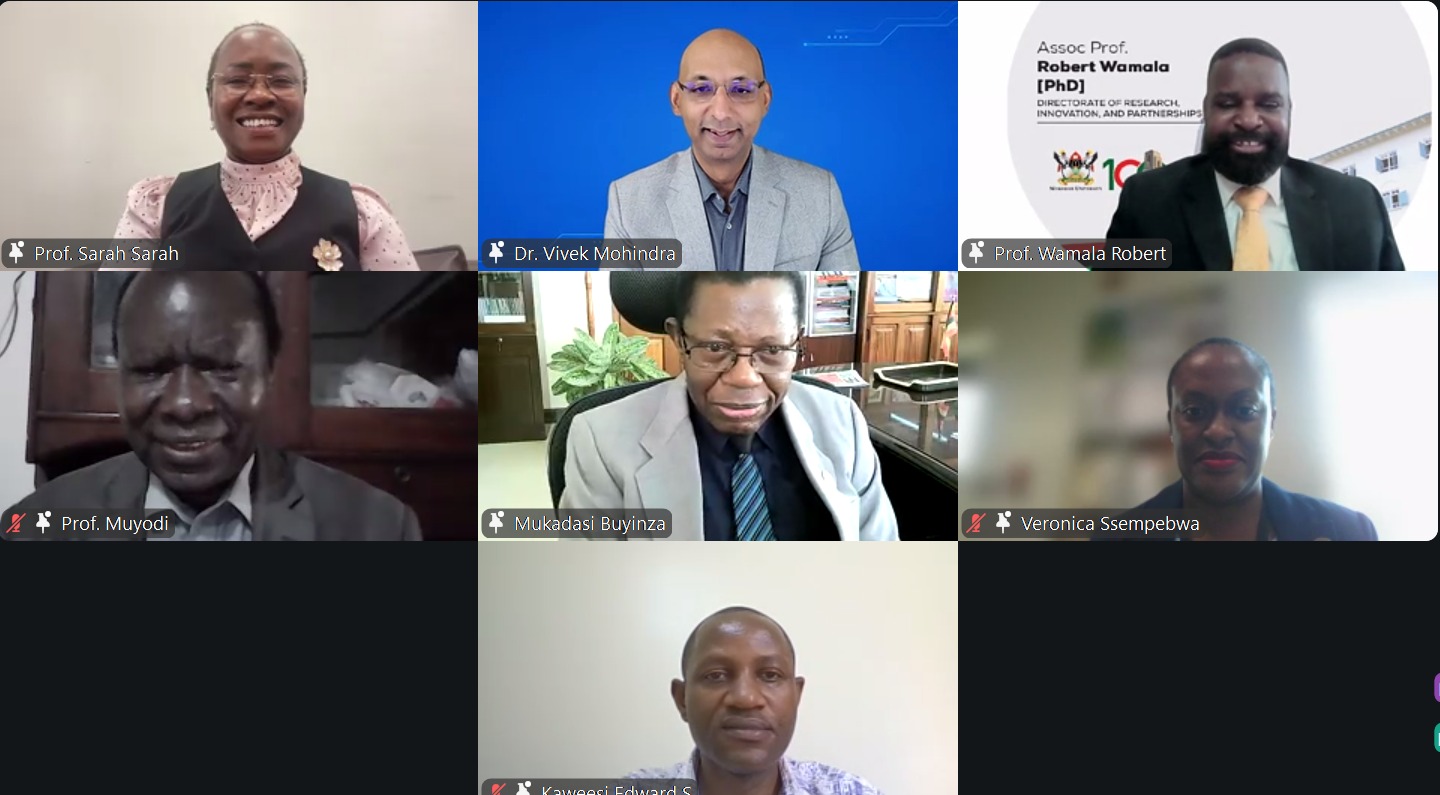
The call was made during an online webinar on “Adoption of Artificial Intelligence (AI) in Research Management at Makerere University, held on Thursday, June 4, 2026, from 3:30 p.m. to 5:30 p.m. (EAT) via the Zoom platform. The webinar attracted members of University Management, academic staff, researchers, graduate coordinators, members of Research Ethics Committees, students and development partners interested in understanding the growing role of AI in research and higher education.

The webinar was organized by the Directorate of Research, Innovation and Partnerships (DRIP) in collaboration with the Alliance for African Partnership (AAP), the U.S. Embassy in Uganda, the Great Lakes Centre for United States Studies at Makerere University, the Directorate of Graduate Training, the Makerere University Writing Centre and the Makerere University Research and Innovation Fund.

Opening the engagement, the Director of Research, Innovation and Partnerships, Prof. Robert Wamala, described AI as a transformative force that is reshaping the global research landscape and changing the way universities conduct research administration and scholarly work.

“Artificial Intelligence is increasingly transforming the global research ecosystem and redefining how universities undertake research administration, knowledge production, scholarly communication and innovation management,” Prof. Wamala said.

He noted that AI is creating new possibilities for universities, from literature mapping and proposal development to research integrity checks and administrative automation.

“From literature mapping and proposal development to research integrity checks and administrative automation, AI presents significant opportunities for enhancing efficiency, productivity and evidence-based decision-making within higher education institutions,” he explained.

Prof. Wamala said Makerere University recognizes the growing importance of digital transformation and the need to prepare researchers, administrators and graduate training systems to effectively harness emerging technologies responsibly and ethically.

“This webinar therefore provides an important platform for dialogue, learning and reflection on how AI can support research management while safeguarding research integrity and academic excellence,” he added.

The highlight of the webinar was a presentation by international AI consultant Dr. Vivek Mohindra on the adoption of Artificial Intelligence in research management. During his presentation, Dr. Mohindra shared global perspectives on how AI is transforming research administration, scholarly communication, grant management and institutional operations across universities worldwide.

He explained that AI is increasingly being used to support literature reviews, proposal development, data management, academic writing and administrative efficiency, enabling researchers and institutions to make better-informed decisions and improve productivity.

Dr. Mohindra encouraged universities to embrace AI as a tool that enhances human capabilities while maintaining academic oversight and professional judgment. He also emphasized the importance of responsible AI adoption, cautioning institutions against practices that could compromise research integrity, confidentiality and intellectual property rights.

His presentation sparked an engaging discussion among participants, who raised questions on the ethical use of AI in academic writing, disclosure of AI-assisted editing, data privacy concerns and the use of secure AI platforms for research purposes. Participants also sought guidance on how universities can develop policies and systems that support innovation while safeguarding scholarly standards.

In his remarks, the Director of Graduate Training, Prof. Julius Kikooma, emphasized the need to prepare graduate students and supervisors for a rapidly evolving digital research environment. He noted that AI is already influencing how research is conducted and communicated and called for continuous training to equip researchers with the skills needed to use emerging technologies responsibly.

Prof. Kikooma stressed the importance of maintaining originality, critical thinking and ethical scholarship even as researchers increasingly adopt AI-powered tools. He also highlighted the need to strengthen mentorship, research ethics training and scholarly writing support to ensure that technological advances contribute positively to research quality and graduate education.

Closing the webinar, the Deputy Vice Chancellor (Academic Affairs), Prof. Sarah Ssali, thanked participants for their active engagement and commended the organizers and partners for convening what she described as a timely and important discussion.

She paid tribute to the Directorate of Research, Innovation and Partnerships, the Alliance for African Partnership, the U.S. Embassy in Uganda, the Great Lakes Centre for United States Studies, the Directorate of Graduate Training and the Makerere University Writing Centre for supporting initiatives aimed at strengthening research excellence and innovation at the University.

Prof. Ssali also applauded Dr. Mohindra for sharing practical insights on how AI is transforming research administration, scholarly writing, grants management, research integrity and institutional efficiency around the world.

“The discussions today have clearly demonstrated that AI is no longer a distant concept but an emerging reality that universities must thoughtfully engage with,” Prof. Ssali said.

She noted that as Makerere University continues to position itself as a research-led institution, it must embrace technologies that improve productivity, collaboration and knowledge generation while ensuring their responsible and accountable use.

“As Makerere University continues to position itself as a research-led institution, we must embrace technologies that enhance productivity, efficiency, collaboration and knowledge generation while ensuring responsible, ethical and accountable use of AI tools,” she said.

Prof. Ssali observed that the webinar had also highlighted the need for stronger institutional policies, enhanced digital capacity, effective research integrity systems and continuous training to guide AI adoption.

“Today’s engagement reminds us of the need to strengthen institutional policies, digital capacity, research integrity systems and continuous training to ensure that AI adoption supports rather than undermines academic quality and scholarly rigor,” she added.

She encouraged academic units, researchers, graduate students and administrators to continue exploring innovative ways through which AI can support teaching, learning, research management and community impact. The webinar concluded with a shared commitment among participants to continue engaging on AI governance, responsible adoption and digital transformation as Makerere University advances its vision of becoming a leading research-led university that leverages emerging technologies to address societal challenges and generate impactful knowledge.

Mak Editor

Research

DGT Newsletter Jan-Jun 2026

Published

on

Cover page of the DGT Newsletter Jan-Jun 2026. Directorate of Graduate Training (DGT), Makerere University, Kampala Uganda, East Africa.

It is a pleasure to present the January – June 2026 edition of the MakGrad Newsletter by Makerere University Directorate of Graduate Training. At the Directorate of Graduate Training we are committed to building an enabling environment where our students can flourish and their academic journey is well-supported. Formerly one of the two main divisions that constituted the Directorate of Research and Graduate Training, the stand alone Directorate of Graduate Training is mandated to coordinate and administer all matters related to postgraduate studies.

At time when Makerere University is steadily transforming into a research led institution, we are on hand to review and initiate policies meant to provide a conducive environment for graduate training and innovative research. From redesigned PhD crosscutting courses, enhanced supervision structures, improved infrastructure, to stronger partnerships with global institutions — we are laying the foundation for increased success.

In this edition of our newsletter, we share with you highlights of some of the activities during the period January – June 2026. The 76th graduation ceremony in February 2026 recorded key important in roads in Makerere University’s efforts to respond to the country’s need for increased capacity in doctoral training. The 213 PhDs was a significant increase from the previous number of 144. It reflects an intentional progress towards increased completion rates. Beyond focusing on technical expertise, the Directorate coordinates efforts to cultivate critical thinking, problem-solving, communication, and interdisciplinary fluency of all our graduate students. Today’s challenges rarely fit neatly into one discipline; they demand collaboration across disciplinary fields. In this edition of the Newsletter, we share some of the training of trainers and learners’ trainings we have conducted to achieve this objective.

I thank all the staff of the Directorate and the university at large, the graduate students and all the stakeholder for the support and collaboration. You are part of a growing, supportive community committed to excellence and transformation that our country prides in.

Assoc. Prof. Julius Kikooma
Acting Director

Mak Editor

Continue Reading

Research

CARTA Newsletter: Jan – June 2026

Published

on

Cover page of the CARTA Newsletter: Jan – June 2026. Consortium for Advanced Research Training in Africa (CARTA)

The latest Consortium for Advanced Research Training in Africa (CARTA) Newsletter (Issue 22, January–June 2026), themed Research to Impact showcases how CARTA fellows, graduates, and partner institutions are moving evidence beyond publications into policy, practice, innovation, and everyday lives.

An article titled “Why Research Uptake Requires More Than Good Science” featuring Dr. Godwin Anywar, a Lecturer in the Department of Plant Sciences, Microbiology and Biotechnology, Makerere University’s work precisely captures this transition. His research began by systematically documenting indigenous medicinal plants used by traditional healers in Uganda to support people living with HIV/AIDS. This work has grown into internationally recognized science that has informed understanding of traditional medicine, sparked global collaborations, and even reached communities through a traveling mobile museum.

Dr. Anywar’s personal reflection captures this succinctly: producing good research was only the beginning. Visibility, deliberate communication, sustained engagement, and opportunities to share the work were equally essential in transforming locally generated evidence into global influence.

Beyond his work, this edition of the Newsletter captures; research shaping better care for TB survivors in Malawi, smarter solutions for mosquito control emerging, efforts to transform graduate supervision institution by institution, and reflections on embedding stakeholder engagement as a core university function.

Read the Full Newsletter

Mark Wamai

Continue Reading

Research

Mak-RIF Bi-Annual Bulletin Issue 6: Jan-Jun 2026

Published

on

Prof. Barnabas Nawangwe (L) presents Prof. Daniel Branch (C) with the Makerere necktie and Makerere@100 Coffee Table Book as Prof. Fred Masagazi Masaazi (R) witnesses during his visit on 13th February 2026. Makerere University, Kampala Uganda, East Africa.

It is my pleasure to present the sixth issue of the Makerere University Research and Innovations Fund (Mak-RIF) Bi-Annual Bulletin, highlighting the remarkable progress made between January and June 2026 in advancing research, innovation, knowledge translation, and capacity building at Makerere University.

This edition demonstrates the transformative impact of research supported by the Government of Uganda through Mak-RIF. Across diverse disciplines, researchers continue to generate practical, evidence-based solutions to Uganda’s most pressing development challenges, including food security, public health, clean energy, climate resilience, education reform, digital transformation, and public sector productivity. These achievements reaffirm the critical role of research and innovation in driving national development and improving the lives of Ugandans.

The stories featured in this bulletin are a testimony that Makerere University is strengthening its position as a research-intensive institution committed to producing knowledge that addresses societal needs. Through technologies that convert invasive water hyacinth into renewable fuel, innovations in food safety through machine learning, improved agricultural technologies, digital public sector solutions, groundbreaking advances in teacher education, and more, researchers continue to demonstrate that locally generated knowledge can deliver globally relevant solutions.

Equally encouraging is the University’s continued commitment to building strategic international partnerships. Makerere’s engagement with the University of Warwick reflects our shared vision of strengthening collaborative research, graduate training, innovation, and institutional capacity. Such partnerships expand opportunities for our researchers and students while contributing to the global exchange of knowledge required to address increasingly complex development challenges.This issue also highlights Mak-RIF’s growing emphasis on research knowledge translation. Through dedicated capacity-building initiatives, researchers are being equipped to communicate their findings more effectively to policymakers, practitioners, industry, and the public. By strengthening the interface between research, policy, and practice, we are ensuring that scientific evidence informs decision-making and delivers measurable impact beyond academia.

The continued growth in high-quality research publications showcased in this bulletin further demonstrates the increasing visibility and influence of Makerere University’s research community. These scholarly contributions not only advance scientific knowledge but also strengthen Uganda’s participation in global research while fostering innovation, collaboration, and evidence-informed policymaking.

These accomplishments would not have been possible without the unwavering support of the Government of Uganda, whose investment in Mak-RIF continues to strengthen the University’ research and innovation ecosystem. I commend our researchers, project teams, University leadership, industry collaborators, government MDAs, and communities for their commitment and collaboration. I invite you to explore the inspiring stories presented in this bulletin and celebrate the collective achievements of our researchers and Makerere University.

Prof. Fred Masagazi-Masaazi
Chairperson, Grants Management Committee (GMC)

Mak Editor

Continue Reading

Trending