Connect with us

Health

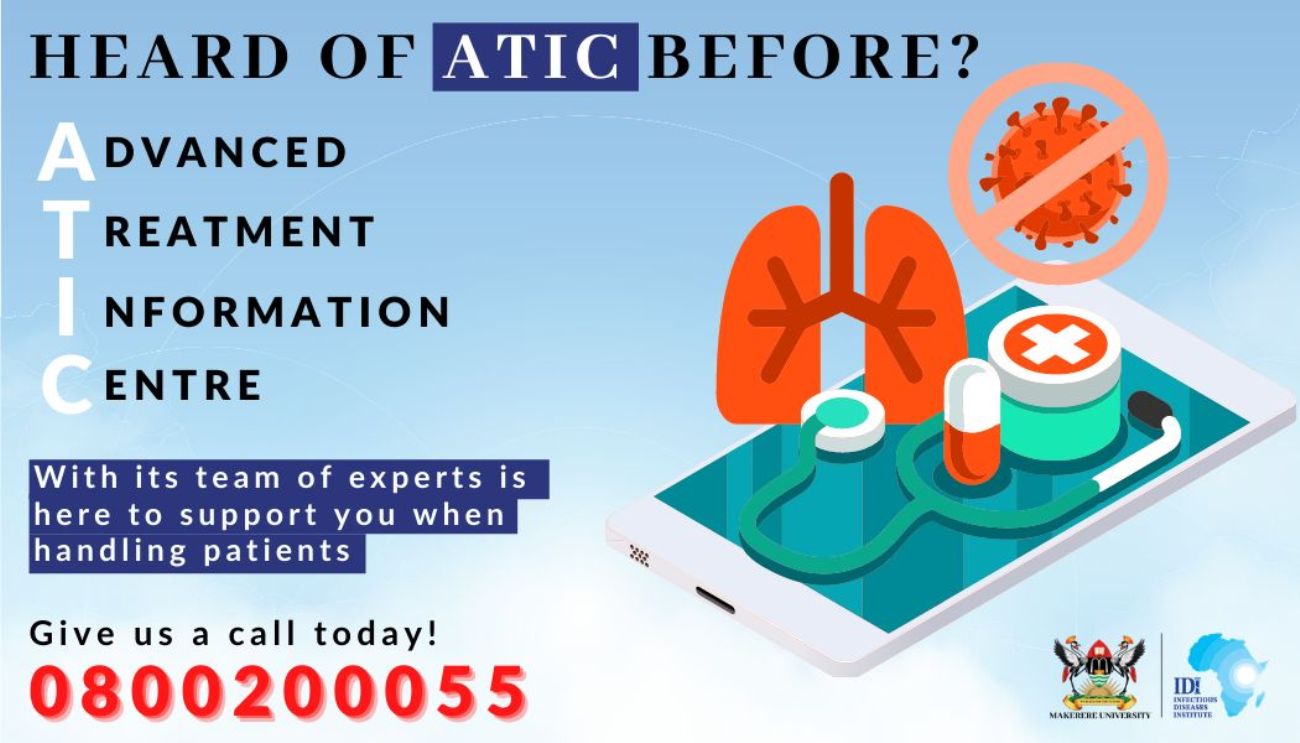
IDI Offering Free 24/7 Patient Support Through ATIC/LIC

Published

on

The Advanced Treatment and Information Centre (ATIC)/Learning Innovations Centre (LIC), which falls under the Makerere University Infectious Diseases Institute (IDI)’s Training Programme provides a free call-in resource for health workers with questions about clinical case management, drug dosing, drug reactions, and other information.

The ATIC/LIC also provides drug monographs, treatment guidelines, and reference charts for providers. In addition to hosting the ATIC/LIC, the Training Programme remains in contact with alumni once they return to their health facilities, and offers mentoring and support as needed, including (in some cases) on-site mentorship and support supervision.

Need support dealing with your patient? Call the ATIC/LIC 24/7 Toll-free number 0800200055.

Click here for more information about ATIC/LIC

Mark Wamai

Health

MakCHS Lecturer selected for Global Atlantic Fellowship to Advance Brain Health Equity

Published

on

Dr. Joy Louise Gumikiriza-Onoria.

Dr. Joy Louise Gumikiriza-Onoria, a Clinical Psychologist and Assistant Lecturer in the Department of Psychiatry at Makerere University College of Health Sciences, has been selected for the prestigious 2026–27 Atlantic Fellows for Equity in Brain Health program.

Based at the Global Brain Health Institute (GBHI) at the University of California, San Francisco (UCSF), the global fellowship brings together leaders across multiple disciplines to develop innovative, equitable solutions for brain health and dementia care worldwide. Dr. Gumikiriza-Onoria, who holds a PhD in Brain Health, is an accomplished academician and researcher whose expertise spans neuropsychology, mental health, cognitive functioning, behavioural science, and implementation research.

Uganda currently faces a rising prevalence of dementia, compounded by limited public awareness and a shortage of specialized care facilities. Dr. Gumikiriza-Onoria’s work directly addresses these challenges by focusing on dementia, HIV and aging, neuropsychology, and community-based interventions. Through her strategy of generating rigorous evidence and developing scalable interventions, she aims to enhance cognitive and mental health outcomes for older adults—particularly those aging with HIV—in sub-Saharan Africa.

As part of the 2026–27 cohort, Dr. Gumikiriza-Onoria joins 15 other incoming fellows at UCSF representing diverse fields including medicine, public health, advocacy, policy, and the arts. Together, they become part of a lifelong global network of more than 330 Atlantic Fellows spanning over 70 countries. Over the coming year, the fellows will collaborate across disciplines, hone their leadership skills, and design scalable approaches to reduce brain health inequities.

Through the fellowship, Dr. Gumikiriza-Onoria plans to establish key international partnerships to translate her research into practical, culturally relevant solutions. Her goal is to strengthen local brain health systems, support dementia caregivers, and improve healthy aging outcomes for vulnerable populations across Uganda and the broader African continent.

View on CHS

Zaam Ssali
Zaam Ssali

Continue Reading

Health

Ministry of Health Launches National University Health Screening Initiative at Makerere 92nd Guild Medical Camp

Published

on

L-R: Prof. Josaphat Byamugisha, Prof. Richard Idro, and H.E. Kadondi Gracious present a plaque to Hon. Anifa Kawooya appreciating the Ministry of Health Support to the Medical Camp on 17th September 2026. Launch of the two-day 92nd Makerere University Guild Annual Medical Camp and intensified testing and active case finding for Malaria, HIV/AIDS and Sickle Cell Disease in universities and tertiary institutions, 17th September 2026, Freedom Square, Makerere University, Kampala Uganda, East Africa.

Despite a morning downpour, the two-day 92nd Makerere University Guild Annual Medical Camp successfully commenced on September 17, 2026 with a launch at the Freedom Square.

The Launch marks a strategic partnership between the Ministry of Health and higher education institutions to advance physical well-being and awareness of students from public and private universities.

Presiding over the event, the Minister of State for Health (General Duties), Hon. Anifa Kawooya Bangirana, launched the intensified testing and active case finding for Malaria, HIV/AIDS and Sickle Cell Disease.

Ministry officials emphasized that laboratory screening and diagnostic testing are critical entry points for early detection, linkage to care, appropriate clinical management, surveillance and prevention, and the Ministry of Health pledges full support to strengthen these services across universities nationwide.

A section of students that attended the Annual Medical Camp 2026. Launch of the two-day 92nd Makerere University Guild Annual Medical Camp and intensified testing and active case finding for Malaria, HIV/AIDS and Sickle Cell Disease in universities and tertiary institutions, 17th September 2026, Freedom Square, Makerere University, Kampala Uganda, East Africa.
A section of students that attended the Annual Medical Camp 2026.

Held under stewardship of the Makerere University Dean of Students office, the camp offered a comprehensive suite of health services to the student body and the wider community. Attendees had access to the following services:

  1. General and Specialist Consultations
  2. Sickle Cell, Malaria RDT and HIV Screening
  3. Eye Care and Laboratory Diagnostics
  4. Free Essential Medicines
  5. Reproductive Health Counseling
  6. Mental Health Counseling

While addressing the attendees, Hon. Kawooya emphasised that health is synonymous with national economic productivity.

She guided the youth to prioritise well-being, and avoid living in denial for it is the first step to refusing help. This will help build a firm foundation for any future contributions to national development.

Hon. Anifa Kawooya accompanied by Guild Health Ministers from various institutions tours the exhibition. Launch of the two-day 92nd Makerere University Guild Annual Medical Camp and intensified testing and active case finding for Malaria, HIV/AIDS and Sickle Cell Disease in universities and tertiary institutions, 17th September 2026, Freedom Square, Makerere University, Kampala Uganda, East Africa.
Hon. Anifa Kawooya accompanied by Guild Health Ministers from various institutions tours the exhibition.

The Minister further warned students against risky behaviours, including substance abuse and sexual immorality, which she described as poisonous.

She advocated for responsible reproductive health practices, urging students to utilise resources available to protect themselves for the future.

Why you should Know Your Status

Prof. Charles Olaro, who is the Director General of Health Services at the Ministry of Health, Uganda reflected on his time at the university during the peak of the HIV epidemic, recalling a visit from the late Bongole Lutaya.

He noted that today’s youth have not witnessed the severity of the AIDS due to the availability of care and ARVs, which can create a false sense of security.

“People are in care and you have not seen the real slim disease. You have not seen it”

Prof. Charles Olaro. Launch of the two-day 92nd Makerere University Guild Annual Medical Camp and intensified testing and active case finding for Malaria, HIV/AIDS and Sickle Cell Disease in universities and tertiary institutions, 17th September 2026, Freedom Square, Makerere University, Kampala Uganda, East Africa.
Prof. Charles Olaro.

He added that some attending are products of mothers that undertook prevention of mother-to-child transmission of HIV, and they gave birth to negative children. But now when we are grown up, they are reckless with their sexual life.

Prof Olaro summarized his remarks by noting that health is an irreplaceable asset and that decisions made today have significant future ramifications. They urge the audience to take the opportunity to know their status, whether for HIV or sickle cell disease, as this is the essential entry point for care and life planning.

Benefits of knowing your status:

  1. It serves as the entry point for receiving necessary care.
  2. It allows for better life planning.
  3. It enables individuals to manage other aspects of their lives effectively.
  4. It prevents future health complications.

Genetic Awareness and Blood Donation

Associate Professor Richard Idro the Deputy Principal of the Makerere University College of Health Sciences (MakCHS) emphasised the importance of seeking appropriate information with a focus on genetic awareness. He advised the students to know their status before marriage to prevent passing on genetic conditions.

“One day when you fall in love, you know that preferably you should not marry somebody who is also carrying a certain gene.”

Prof. Richard Idro. Launch of the two-day 92nd Makerere University Guild Annual Medical Camp and intensified testing and active case finding for Malaria, HIV/AIDS and Sickle Cell Disease in universities and tertiary institutions, 17th September 2026, Freedom Square, Makerere University, Kampala Uganda, East Africa.
Prof. Richard Idro.

He then delved into the importance of treating HIV and clearing malaria parasites, which he addressed exhaustively.

From this, Dr Idro’s focus turned to blood donation where he acknowledged a number of people that had already participated in the exercise at the Uganda Red Cross Society tent.

“I see the Red Cross at one corner. As we passed there, 36 people had donated blood. Although, gentlemen, I saw very few of you donate blood.”

He concluded by challenging the young men present and reminding them that they can donate blood up to four times a year and still remain healthy.

Empowering Ambassadors of Global Health Awareness

The Ministry of Health called upon the students attending the camp to serve as ambassadors for global health awareness in their respective institutions.

The Executive Director/Commissioner National Health Laboratory and Diagnostic Services (NHLDS), Dr. Susan Nabadda Ndidde advised the students to make sure that they mobilise and intensify testing for all these diseases.

Dr. Susan Nabadda Ndidde. Launch of the two-day 92nd Makerere University Guild Annual Medical Camp and intensified testing and active case finding for Malaria, HIV/AIDS and Sickle Cell Disease in universities and tertiary institutions, 17th September 2026, Freedom Square, Makerere University, Kampala Uganda, East Africa.
Dr. Susan Nabadda Ndidde.

“We will work with you as a Ministry to provide the tests to make sure that we know your status and prevent these diseases in time.”

She wrapped up her message by thanking Makerere for allowing the Ministry of Health to partner on this cause and urged the students to embrace this opportunity and make sure they leave after establishing their status.

By bringing these critical services directly to campuses, the government fosters a healthier, and more informed generation capable of driving Uganda’s future development.

Students Appreciate the Medical Camp

According to Denise Kainomugisha, the Chairperson of the Makerere University School of Public Health (MakSPH) and Vice Minister of Health in the 92nd Guild, the Camp served as a vital platform for capacity building.

92nd Guild Health Minister Hon. Wamezaya Ebenezer (R) and his Vice Hon. Denis Kainomugisha (L). Launch of the two-day 92nd Makerere University Guild Annual Medical Camp and intensified testing and active case finding for Malaria, HIV/AIDS and Sickle Cell Disease in universities and tertiary institutions, 17th September 2026, Freedom Square, Makerere University, Kampala Uganda, East Africa.
92nd Guild Health Minister Hon. Wamezaya Ebenezer (R) and his Vice Hon. Denis Kainomugisha (L).

“The screening, the testing, the sports science, was all handled by the student volunteers under supervision” she confessed.

She also explained that the camp extended to broader public health goals and additionally fostered leadership and collaboration among students, who were encouraged to work together to address community health needs.

Concluding her remarks, Kainomugisha expressed gratitude to the respective partners for providing both financial support and the opportunity for students to take on active roles throughout the Medical Camp.

Elvis Lubanga, Makerere University, Kampala Uganda, East Africa.
Elvis Lubanga

Continue Reading

Agriculture & Environment

Makerere Hosts Inaugural Falling Walls Lab Competition as Innovators Pitch Solutions to National Challenges

Published

on

Students and researchers from Makerere University and other institutions pitched 12 innovations addressing challenges in healthcare, clean energy, agriculture, waste management and community resilience during the inaugural Falling Walls Lab Kampala, held at the School of Public Health Auditorium, Makerere University.

The competition brought together emerging innovators to present solutions to practical challenges through a three minute pitch, followed by questions from a panel of judges.

Modelled on the Falling Walls format that originated in Berlin, the event required each participant to identify a “wall” a problem or barrier, and demonstrate how their innovation seeks to break it down.

Mudhasi wins with newborn jaundice screening device

Andrew Mudhasi of Makerere University emerged as the overall winner with a score of 90 per cent for a low cost medical device designed to improve newborn jaundice screening across different skin tones.

Overall competition winner Andrew Mudhasi (left) receives his first Place award certificate for his innovation

Mudhasi explained that the device uses optical sensor technology and a skin tone targeting algorithm to provide a rapid reading, with the aim of helping nurses and clinicians identify jaundice more efficiently.

During questions from the jury, Mudhasi said the device had not yet been tested on actual babies but had undergone laboratory testing using simulated skin tones.

He reported an accuracy rate of 94 per cent when the device was compared with laboratory spectrophotometers.

The innovation is intended initially for use in clinics and hospitals, with Mudhasi saying the team is also considering a version that could eventually allow mothers to screen babies at home.

Mudhasi’s innovation has previously received recognition at the African Business Concept Challenge and the iF Design Student Award, according to his presentation.

Rhonda’s innovation tackles diaper waste

Rhoda John of the University of Nairobi emerged in second place with 89.6 per cent for an innovation addressing the problem of used diaper waste.

Rhondah John pitches her innovation repurposing diaper waste into soil moisture retention

Under the theme “Breaking the wall of diaper waste and drug soils,” Rhonda explained that her team extracts sodium polyacrylate, the absorbent polymer found in diapers, and replaces the sodium with potassium.

The resulting potassium based superabsorbent material is designed to act as a “water battery” in soil by absorbing and retaining water for plants during dry periods.

John said testing showed a 99 per cent increase in germination and a 23 per cent increase in drought resistance.

The innovation also seeks to reduce the amount of used diapers ending up in landfills and the environmental effects associated with their decomposition.

During the question and answer session, John explained that her team was working with government environmental officials in Nairobi on a pilot collection system to address the challenge of gathering used diapers at scale.

Mahera takes third place with herbal peptic ulcer treatment

Stuart Mahera of Makerere University finished third with 86.2 per cent for a herbal formulation targeting peptic ulcers.

Stuart Mayira (left) receives his 3rd Place award certicate at the school of Public Health Auditorium.

Presenting under the theme “Breaking the wall of Nature and Modern Medicine,” Mahera argued that conventional treatment for peptic ulcers can involve multiple medicines and may be associated with side effects and antimicrobial resistance.

His proposed formulation, MARAC capsules, is intended as a monotherapy, combining properties required for peptic-ulcer treatment in a single capsule.

Mahera said his team had carried out quality control work, including characterisation and dose quantification, and had conducted preclinical trials on laboratory mice.

He also told the jury that an application had been submitted to the National Drug Authority as the team awaits the next stage of the regulatory process.

According to Mahera, the proposed seven day treatment would cost about Shs21,000, compared with the existing 14 day treatment approach.

Innovators present solutions to practical challenges

The remaining presentations covered a wide range of challenges.

Esther Nakungu of Utamu University presented Agri-Track, a digital record keeping solution intended to improve visibility, accountability and management of farm operations and financial information.

Dr. Jimmy Chachiga, a Makerere University participant, presented a solar photovoltaic cooker with a heat storage system designed to provide a cleaner and more reliable cooking option during both sunny and non sunny periods.

His presentation focused on reducing dependence on biomass fuels and addressing the challenges associated with intermittent solar energy.

Abdul Noor Luttamaguzi, a PhD student and senior government fisheries officer, presented a mobile application aimed at helping fish farmers and extension officers report, track and manage disease outbreaks.

Henry Duke Tamale presented a herbal cream targeting antibiotic resistant biofilm infections associated with diabetic foot ulcers.

Marvin Seruwu proposed adapting existing near infrared brain monitoring technology to help detect extra-axial brain bleeds in health facilities where access to CT and MRI equipment is limited.

His proposal seeks to repurpose existing technology towards a diagnostic need that could be particularly important in settings where advanced imaging facilities are not readily available.

Kennedy Kisame presented a poultry alert and diagnosis system combining satellite weather information with computer vision disease detection. The proposed system could be accessed through a smartphone application, SMS or USSD, making it potentially usable by farmers with limited internet access.

Frank Atwiine proposed a solar powered mobile diagnostic van designed to bring ultrasound and other diagnostic services closer to rural communities.

Johnson Makmot, a software and blockchain developer, presented a platform that combines GPS tracking and blockchain-based tokens to incentivise and verify plastic-waste collection in Kampala.

Dr. Nelson Ndugu, from a partner university, presented an artificial intelligence tool designed to translate agricultural research publications into local Ugandan languages and generate voice notes for radio-based extension delivery.

The final presentation came from Dr. Juliet Akola, a Ugandan post doctoral researcher at Mangosuthu University of Technology in South Africa.

Akola presented a community digital resilience initiative focused on mapping risks in Kampala’s informal settlements, including flooding, fire, poor sanitation, waste management and inadequate infrastructure.

Her proposal seeks to combine local community knowledge with geographical information systems and link identified risks to action plans involving municipalities and other stakeholders.

Nawangwe calls for more investment in innovation

Closing the event, Prof. Nawangwe congratulated all the participants and described their presentations as an important beginning for Makerere University, Uganda and the wider region.

Vice Chancellor, Prof. Banabas Nawangwe giving his remarks

Drawing on his experience attending the Falling Walls conference in Berlin, the Vice Chancellor said initiatives of this nature are important because innovation will play a major role in determining the future of countries.

He encouraged participants to make their pitches more precise by clearly identifying the problem they are addressing, explaining their proposed solution and demonstrating what they have already achieved.

Prof. Nawangwe also welcomed the participation of innovators from other universities and countries, noting that the Kampala event had attracted participants beyond Makerere.

He thanked the Africa Office of the Falling Walls Foundation for its role in bringing the initiative to Makerere and encouraged continued support for innovation.

The Vice Chancellor further linked innovation to Uganda’s growing youth population and the need to develop home-grown solutions to address challenges such as youth unemployment.

The inaugural Falling Walls Lab Kampala ultimately provided a platform for innovators to move ideas beyond the classroom and laboratory and demonstrate how research, technology and creativity can be applied to challenges affecting communities.

PositionWinnerInstitutionScore
1stAndrew MudhasiMakerere University90%
2ndRhoda JohnUniversity of Nairobi89.6%
3rdStuart MaheraMakerere University86.2%

Allan Ainematsiko

My name is Ainematsiko Allan. I am a student of Makerere University and currently in my final year. I am pursuing a Bachelors in Journalism and Communication.

Continue Reading

Trending