Connect with us

Research

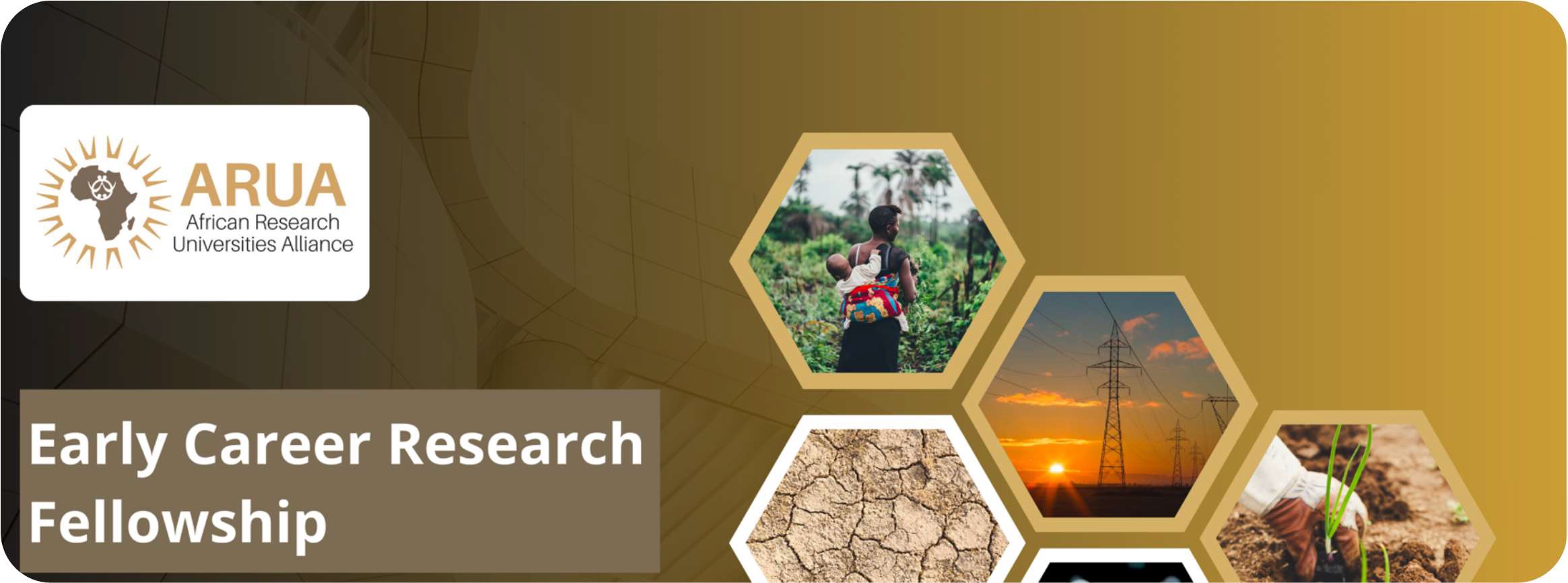
Call For Applications: ARUA-Carnegie Early Career Research Fellowship

Published

on

This Early-Career Research Fellowship is being initiated by the African Research Universities Alliance (ARUA), with support from the Carnegie Corporation of New York, to support a total of thirteen (13) Early-Career Research (ECRs) Fellows to undertake globally competitive research at the ARUA Centres of Excellence (CoEs). The goal is to strengthen the capacity of ECRs at African universities by giving them time away from teaching responsibilities at their home institutions while working with very senior and accomplished researchers. Each CoE is expected to host one research fellow from a country other than where the CoE is located.

Background to ECR Fellowships

The ARUA CoEs operate on a ‘Hub’ and ‘Spoke’ institution basis. The ‘Spoke’ institutions are organized around the ‘Hub’. The CoEs reflect the current priority areas of the network, and they are expected to significantly enhance research and graduate training. Currently, the CoEs are organized as follows:

(i) Energy,
(ii) Unemployment and Skills Development,
(iii) Non-Communicable Diseases,
(iv) Inequality Research,
(v) Notions of Identity in Africa,
(vi) Migration and Mobility,
(vii) Sustainable Food Systems,
(viii) Urbanization and Habitable Cities,
(ix) Climate and Development,
(x) Good Governance,
(xi) Post-Conflict Societies,
(xii) Water and
(xiii) Materials, Energy & Nanotechnology (MEN).

To support the activities of these Centres, ARUA is announcing a residential Early Career Research Fellowship opportunity with a duration of 12 months. During this period, prospective research fellows are expected to stay at the ‘Hub’ university of the relevant CoE and conduct research related to their existing projects. It is possible for the prospective fellow to be stationed at a ‘Spoke’ university of the CoE based on a recommendation from the Centre Director and so far as this ‘Spoke’ university is not the same as the home university of the applicant. Applicants are encouraged to suggest preferred locations and possible mentors/supervisors.

Successful applicants may explore new lines of research with the approval of the Centre Director. Prospective applicants are encouraged to visit the ARUA website (www.arua.org.za) as well as those of the 13 CoEs to familiarize themselves with their ongoing research projects.

For prospective fellows interested in the ARUA CoE in Climate and Development, applications in the following research areas are strongly encouraged: (i) Ecosystem-based adaptation, (ii) Coastal climate change impacts and/or adaptation, (iii) National climate policy development and implementation, just energy transitions, (iv) Climate governance and (v) Climate change attribution and/or loss and damage.

ARUA views this ECR Fellowship as critical to consolidating the progress being made by the CoEs, which aligns with the main vision of the network. ARUA, therefore, seeks to use this opportunity to enhance the relevance of postgraduate training for early career researchers at its member universities.

Application Process

To apply for this research fellowship, please submit the following documents:

  • An introductory letter to express interest in Fellowship
  • Curriculum Vitae
  • A brief introduction to the proposed research (not more than 1,000 words)
  • Names and addresses of two academic referees.
  • Letter of support from applicant’s home institution

The selection of the successful candidates shall be done by the Director of the Centre to which the application is directed, in consultation with the host institution’s Deputy Vice-Chancellor. Applications should be submitted via the submission portal https://arua.org.za/early-career-research-fellowships-2023/ no later than 20th July 2023.

Successful candidates shall be contacted by 31st August 2023 and will be expected to begin the fellowship on 1st October 2023.

See below for detailed call.

Mak Editor

Research

DGT Newsletter Jan-Jun 2026

Published

on

Cover page of the DGT Newsletter Jan-Jun 2026. Directorate of Graduate Training (DGT), Makerere University, Kampala Uganda, East Africa.

It is a pleasure to present the January – June 2026 edition of the MakGrad Newsletter by Makerere University Directorate of Graduate Training. At the Directorate of Graduate Training we are committed to building an enabling environment where our students can flourish and their academic journey is well-supported. Formerly one of the two main divisions that constituted the Directorate of Research and Graduate Training, the stand alone Directorate of Graduate Training is mandated to coordinate and administer all matters related to postgraduate studies.

At time when Makerere University is steadily transforming into a research led institution, we are on hand to review and initiate policies meant to provide a conducive environment for graduate training and innovative research. From redesigned PhD crosscutting courses, enhanced supervision structures, improved infrastructure, to stronger partnerships with global institutions — we are laying the foundation for increased success.

In this edition of our newsletter, we share with you highlights of some of the activities during the period January – June 2026. The 76th graduation ceremony in February 2026 recorded key important in roads in Makerere University’s efforts to respond to the country’s need for increased capacity in doctoral training. The 213 PhDs was a significant increase from the previous number of 144. It reflects an intentional progress towards increased completion rates. Beyond focusing on technical expertise, the Directorate coordinates efforts to cultivate critical thinking, problem-solving, communication, and interdisciplinary fluency of all our graduate students. Today’s challenges rarely fit neatly into one discipline; they demand collaboration across disciplinary fields. In this edition of the Newsletter, we share some of the training of trainers and learners’ trainings we have conducted to achieve this objective.

I thank all the staff of the Directorate and the university at large, the graduate students and all the stakeholder for the support and collaboration. You are part of a growing, supportive community committed to excellence and transformation that our country prides in.

Assoc. Prof. Julius Kikooma
Acting Director

Mak Editor

Continue Reading

Research

CARTA Newsletter: Jan – June 2026

Published

on

Cover page of the CARTA Newsletter: Jan – June 2026. Consortium for Advanced Research Training in Africa (CARTA)

The latest Consortium for Advanced Research Training in Africa (CARTA) Newsletter (Issue 22, January–June 2026), themed Research to Impact showcases how CARTA fellows, graduates, and partner institutions are moving evidence beyond publications into policy, practice, innovation, and everyday lives.

An article titled “Why Research Uptake Requires More Than Good Science” featuring Dr. Godwin Anywar, a Lecturer in the Department of Plant Sciences, Microbiology and Biotechnology, Makerere University’s work precisely captures this transition. His research began by systematically documenting indigenous medicinal plants used by traditional healers in Uganda to support people living with HIV/AIDS. This work has grown into internationally recognized science that has informed understanding of traditional medicine, sparked global collaborations, and even reached communities through a traveling mobile museum.

Dr. Anywar’s personal reflection captures this succinctly: producing good research was only the beginning. Visibility, deliberate communication, sustained engagement, and opportunities to share the work were equally essential in transforming locally generated evidence into global influence.

Beyond his work, this edition of the Newsletter captures; research shaping better care for TB survivors in Malawi, smarter solutions for mosquito control emerging, efforts to transform graduate supervision institution by institution, and reflections on embedding stakeholder engagement as a core university function.

Read the Full Newsletter

Mark Wamai

Continue Reading

Research

Mak-RIF Bi-Annual Bulletin Issue 6: Jan-Jun 2026

Published

on

Prof. Barnabas Nawangwe (L) presents Prof. Daniel Branch (C) with the Makerere necktie and Makerere@100 Coffee Table Book as Prof. Fred Masagazi Masaazi (R) witnesses during his visit on 13th February 2026. Makerere University, Kampala Uganda, East Africa.

It is my pleasure to present the sixth issue of the Makerere University Research and Innovations Fund (Mak-RIF) Bi-Annual Bulletin, highlighting the remarkable progress made between January and June 2026 in advancing research, innovation, knowledge translation, and capacity building at Makerere University.

This edition demonstrates the transformative impact of research supported by the Government of Uganda through Mak-RIF. Across diverse disciplines, researchers continue to generate practical, evidence-based solutions to Uganda’s most pressing development challenges, including food security, public health, clean energy, climate resilience, education reform, digital transformation, and public sector productivity. These achievements reaffirm the critical role of research and innovation in driving national development and improving the lives of Ugandans.

The stories featured in this bulletin are a testimony that Makerere University is strengthening its position as a research-intensive institution committed to producing knowledge that addresses societal needs. Through technologies that convert invasive water hyacinth into renewable fuel, innovations in food safety through machine learning, improved agricultural technologies, digital public sector solutions, groundbreaking advances in teacher education, and more, researchers continue to demonstrate that locally generated knowledge can deliver globally relevant solutions.

Equally encouraging is the University’s continued commitment to building strategic international partnerships. Makerere’s engagement with the University of Warwick reflects our shared vision of strengthening collaborative research, graduate training, innovation, and institutional capacity. Such partnerships expand opportunities for our researchers and students while contributing to the global exchange of knowledge required to address increasingly complex development challenges.This issue also highlights Mak-RIF’s growing emphasis on research knowledge translation. Through dedicated capacity-building initiatives, researchers are being equipped to communicate their findings more effectively to policymakers, practitioners, industry, and the public. By strengthening the interface between research, policy, and practice, we are ensuring that scientific evidence informs decision-making and delivers measurable impact beyond academia.

The continued growth in high-quality research publications showcased in this bulletin further demonstrates the increasing visibility and influence of Makerere University’s research community. These scholarly contributions not only advance scientific knowledge but also strengthen Uganda’s participation in global research while fostering innovation, collaboration, and evidence-informed policymaking.

These accomplishments would not have been possible without the unwavering support of the Government of Uganda, whose investment in Mak-RIF continues to strengthen the University’ research and innovation ecosystem. I commend our researchers, project teams, University leadership, industry collaborators, government MDAs, and communities for their commitment and collaboration. I invite you to explore the inspiring stories presented in this bulletin and celebrate the collective achievements of our researchers and Makerere University.

Prof. Fred Masagazi-Masaazi
Chairperson, Grants Management Committee (GMC)

Mak Editor

Continue Reading

Trending